A campaign that needs a ticket is a campaign that ships after the date. Eqlo is for the page, the variants, and the conversion table you take to a stakeholder the same week. The landing page guide is the reading order. Five projects stay free, with no card.
30 minCampaign page
20 minThree variants
1 hConversion table
$19Plus, per month
01
Write the brief as a trade-off, not a mood
Name the audience, the offer, the date it dies, the one action, and what is out. Existing customers, spring kit, 48 dollars, ends 20 June, email to reserve, no second product is a brief. Make it feel premium is a stall. Put the budget on the same note. A stakeholder who has not agreed the cut will reopen it after you ship.
02
Ship the first page the day you have the offer
Paste the brief. The first draft lands in two to five minutes. Correct the line. Put in the date and the price. Publish. A first page live on Tuesday beats a perfect page still in the engineering queue on the 19th. You are allowed to be thin. You are not allowed to be late.
03
Run two or three variants with the same form
Once the first page is live, ask for a variant that leads with the price, or with the date, or with the named result. Keep the same form. If you change the offer and the line, you will not know which one converted. Three URLs, traffic you already control, a week of honesty.
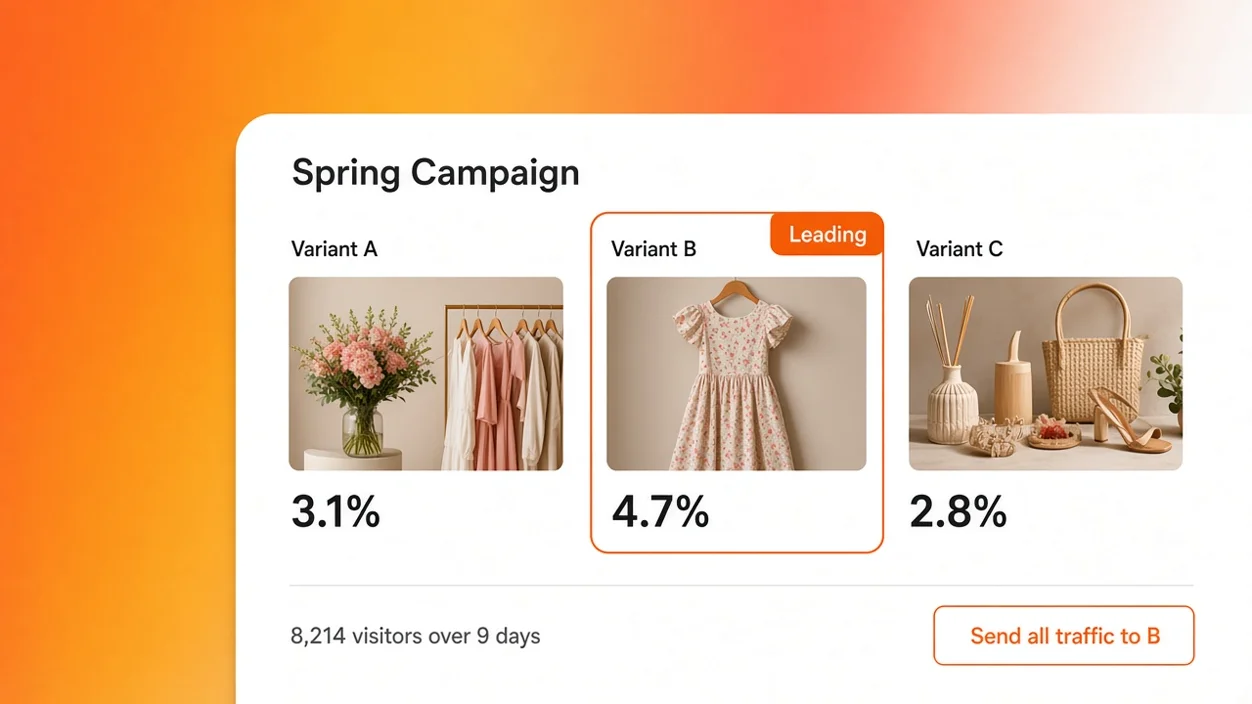
Spring kit · 3 variants
A 3.1% · promise first
B 4.7% · price first
C 2.8% · date first
Three variants, one form. The leading page is the one a stakeholder can fund.
04
Read the conversion table the same week
Visits, form starts, finishes. A page with 2,400 visits and 11 finishes is a sentence problem. A page with 180 visits and 16 finishes is a traffic problem. Change one thing: the promise, the catch, or the date. Take the three numbers to the stakeholder before you ask for more budget. Sign-off is a person who saw the counts. Release is you pointing the campaign at one page and turning the others off.
What slows you down today
Three frictions, all of them a queue you did not choose.
The engineering ticket that eats the date
A campaign page is a form and a sentence. When it sits behind a two-sprint queue, the date dies and the budget goes to a channel with no place to land. Independence is the point of this page. The first draft is two to five minutes. The rest is your judgement.
One page, no variants, a story after the fact
You shipped the line the brand team liked. You never learned if the price first would have won. A quarterly retro cannot recover a week of traffic. Variants are a cycle habit, not a research program. Twenty minutes is enough to ask for two more URLs.
Conversion that lives in someone else's tool
If the only person who can read finishes is on leave, you are guessing. Count visits, starts, and finishes on the project. Keep the analytics you already pay for. Google Analytics is a sentence you can ask for. The table you take to the stakeholder still belongs on the project.
What you can build yourself
Times assume the offer is already a sentence. The landing page guide is the reading order.
A campaign page, about 30 minutes
Paste the brief. Eqlo writes the page, the navigation, the copy, and the form. You cut the second product. You put in the date and the price. You publish. A first page live the same afternoon beats a ticket that misses Friday.
Three variants, about 20 minutes
Ask for a version that leads with the price, the date, or the named result. Keep the same form. Each exchange creates a version you can restore. You compare two on screen. Ten variants is a stall. Three is a week of honesty.
A conversion table, about 1 hour
Visits, starts, finishes, on the three URLs. You can ask for Google Analytics in a sentence. The table you send the stakeholder is still three numbers and a kill date. Sign-off is a reply. Release is one URL and two pages turned off.
A worked example
This is a worked example, not a named company. A growth lead at a thirty-person kit brand has a spring drop that has always taken three weeks: a brief, a ticket, a review, a missed Friday. On a Tuesday they write existing buyers, spring kit, 48 dollars, ends 20 June, email to reserve, no new product. The first page is live that afternoon. Two more URLs follow the next morning: price first, date first. Nine days, a few thousand visits. The price-first page finishes ahead. The three numbers go to the stakeholder on the 13th. Sign-off takes one reply. All traffic points at the winner. The untouched engineering ticket closes. Next cycle they reuse the winner and change only the kit name.
Three weeks to an afternoon
The first page left the same afternoon as the brief. The old path had been a ticket and a Friday that always slipped.
One winner, two pages killed
Nine days, three URLs, the same form. Price first earned the release. The other two came down when the date died.
Paid traffic spent on a live page
The budget went to a URL that existed. In the previous drop, a third of the spend had landed on a holding page because the ticket was late.
What you keep from your current tools
Keep the mail tool, the ad accounts, the analytics, the brand library, the list. Eqlo is the page and the variants, not your customer file. Hand the colors and type to the page. Keep the designer for the two assets only they can make, and legal for the catch. Google Sheets can stay the place you dump an export. Slack can stay the place you drop the three URLs.
The calendar stays the calendar
Write the kill date on the same note as the offer. When the date dies, unpublish or switch the form to a waitlist. Do not leave a dead price up. That is how you train people to ignore the next cycle.
The brand stays the brand
Type, color, the one photograph you actually have. A generated second look is how a company starts to look like a template. Correct the first version. Do not ask for a new personality every cycle.
Where the autonomy stops and engineering takes over
Stop when the next constraint is a join you do not run: a live inventory feed, a coupon engine, a checkout that has to hit the ERP. You can ship the page, the form, and the three variants. You cannot promise a stock number you do not have. Hand the repository over. From Plus, GitHub sync is automatic. Release of a campaign is a URL and a date. Release of a connected offer is engineering. A very specific trade will need a developer. Generation can be wrong. Read the catch before legal sees it on Friday.
Related pages
The landing page guide is the reading order. This page is the cycle around it.
Yes, if the question is the reading order, the promise, the catch, the form. This page is the cycle around that craft: variants, conversion, the queue, sign-off, the kill date. Use both. Do not rewrite the offer craft here.
How many variants are enough?
Two or three, same form, one week. Ten variants is a stall. One variant is a guess you will defend. Change the line, the price emphasis, or the date. Do not change the offer underneath or you will learn nothing.
What if legal has to approve every page?
Send them the first URL the same day, with the catch written plainly. A cycle that hides legal until Friday is a cycle that ships late. Sign-off includes them. Build that into the brief, not into a surprise.
Can I reuse last cycle's winner?
Yes. Change the kit name, the date, the photograph. Keep the line that already converted. A new personality every drop is how you spend the budget on taste. A reused winner is a habit.
When does this become an engineering project?
When the page must talk to a system you do not control, or when the team wants the repository in their pipeline. Until then, you can ship, compare, and kill. Plus is $19 a month. The real cost is traffic you send to a page that does not exist yet.
Write the offer and the date it dies. Ship the page this cycle.
Five free projects, one seat, no card. Variants and a kill date stay yours.