Bakery and patisserie
Celebration cakes ordered in advance, the weekly specials and pickup at the counter only.


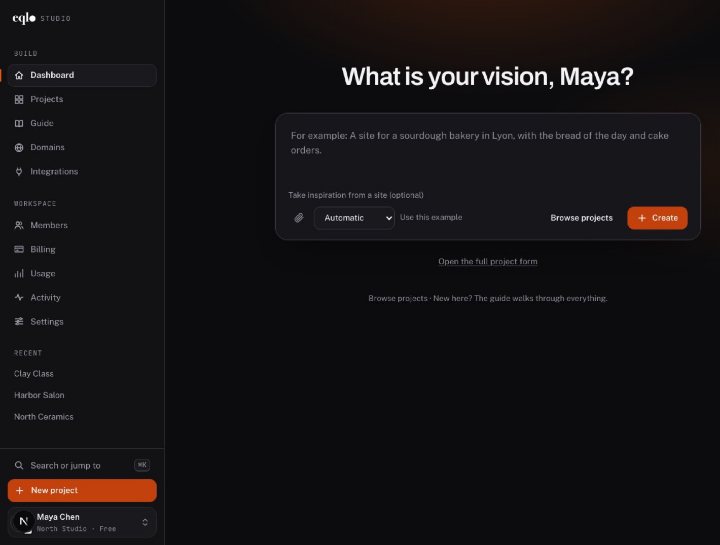
Create, edit and publish, then run your website and your app from their own dashboard. Every feature shown in real screenshots.
See the features
A Next.js project in React and TypeScript, sent to your GitHub repository. A spec change made in the repository comes back to Eqlo.
See the developer page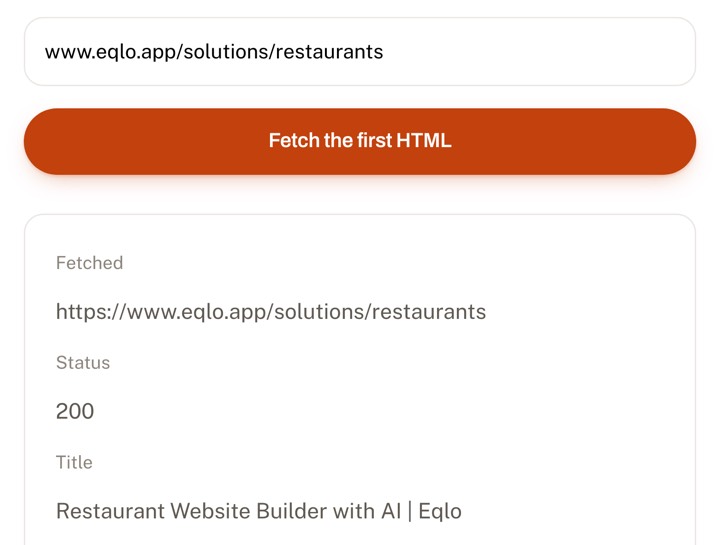
Paste a URL. In thirty seconds you see exactly what Google receives before any JavaScript runs.
Check a URLBefore crossing town, a shopper checks three things on their phone: are you open, do you have the item, and can they pick it up today. Eqlo is a retail website builder that puts those three answers on the first screen, from a description of your shop and the product list you already keep.

Each trade puts a different detail first. A florist sells something fresh and nearby, a bookshop a long list of titles, a wine merchant as much advice as bottles. Describe your shop in a sentence, and the categories, the product fields and the pickup options follow from it.
Celebration cakes ordered in advance, the weekly specials and pickup at the counter only.
Bouquets of the day, a delivery rate for nearby postcodes and a form for wedding orders.
Titles by category, the stock of each one and an order to collect from the shelf.
The selection of the month with tasting notes, and collection in the shop.
Seasonal boxes, producers named on each product and a short delivery area.
Size and color as variants, each with its own stock, so a shopper knows their size is there.
One-off pieces, an appointment booked online for advice, and a request form for repairs.
Sizes by variant, workshop slots for a bike service and shoes to try on in store.
Food by species and weight, and heavy bags set aside for pickup.
A product code on every item, stock per reference and a quote request for cutting to size.
One rule applies to all of them: the stock on the site must match the shelf. A shopper who travels for an item shown as available and leaves with nothing rarely tries again.
Hours are the first thing people look up, and a wrong time is worse than none. Eqlo places your hours, your address and your phone number on the home page, and a holiday closure is a sentence in the chat followed by a publish.
Each product carries a stock count, and each size or color can carry its own. When an order comes in, the count drops, and the cart warns the shopper when an item has run out. You get an alert when stock falls below a threshold, which is 3 unless you change it.
In-store pickup is one of the delivery options at checkout, next to your shipping rates. The shopper pays online by card, Apple Pay or Google Pay, or chooses to pay on collection if you switch that option on.
For a neighborhood shop, the website’s main job is to get people through the door. A parcel earns the margin minus postage, while a visit earns the full margin and often a second item picked up near the till.
That decides the order of the page. Hours, address and phone come before the buy button, stock comes before shipping, and pickup comes before delivery. Everything has to read well on a phone held in one hand on the sidewalk.
On the search side, every published site ships with complete HTML pages that Google can read, local business data on the home page, and product and price data on each product page. Your Google Business Profile stays separate: fill it with exactly the same name, address and phone number as the site.
This scenario describes no real shop. A kitchenware shop sells about 1,400 items and keeps its stock in a spreadsheet exported from the till. The owner describes the shop in two sentences, then imports that file as a CSV, with columns for name, price, product code and stock.
Every evening, the owner exports the till’s stock and imports it again, which updates the products already on the site instead of creating duplicates. Orders placed online come off the count straight away. Pay on collection is switched on for the heavy cast iron pieces, which customers prefer to see before buying.

The shop’s name, what it specializes in, the address, today’s hours and the phone number, all visible without scrolling.
One page per category with its own image, plus sorting, so a shopper finds the right shelf in two taps.
Up to 12 photos, the description, the price with an optional crossed-out former price, and the stock for each variant. Related products appear underneath.
Up to 20 rates, each with its countries, its price, a delivery time and free shipping above an amount, or the in-store pickup option.
How to get there, where to park, access for wheelchairs and strollers, and the holiday closures. Keep this page current, because people check it right before they leave home.
Each order shows the customer, the items, the amount, the payment method and its status. Refunds go back through Stripe, returns are logged with a reason, and canceling a pay-on-collection order puts the items back in stock.
You create a Stripe account from Eqlo or paste the keys of an existing one. The money from each sale goes straight to that account, and Eqlo takes no commission.
On Plus, connect a domain you already own or buy one inside Eqlo, registered in your name, with a transfer code if you ever move. HTTPS is set up automatically.
A reviews block shows the quotes you choose from your customers. Eqlo does not pull your Google reviews, so you copy the ones you want to feature.
Pick the page that matches how much you sell online and what you want to add.
Yes. Create a single delivery rate set to in-store pickup and leave shipping out. You can add postal rates later in the same project if demand grows.
Online orders lower the stock on their own. For counter sales, export the stock from your till as a CSV and import it again: existing products are updated, and the site republishes about 30 seconds later.
No. Your till stays in charge of the counter, and the CSV file is the bridge between the two. Eqlo has no direct connection to till systems.
Stripe charges its own fees under your agreement with them. Eqlo takes nothing on top, and each payment lands in your account.
The site gives Google what it needs: readable pages, your address and the local business data on the home page. Ranking still depends on your Google Business Profile, your reviews and time, so expect several weeks.
Write the change in the chat, for example “closed August 10 to 24”, check the preview and publish. The home page and the visit page show the new hours at once.
Yes, once you switch on pay on collection. The item is held so nobody else can buy it, the shopper confirms through a link sent by email, and you mark the order as paid at the counter.
Yes. The Free plan includes the shop, Stripe payments and hosting on an eqlo.dev address, with one seat and no card. Plus at $19 a month adds your own domain.
Start on the Free plan with no card. When the hours, the stock and the pickup option look right, connect your own domain on Plus.