Pages, navigation and copy ready to read
Eqlo creates the pages, the navigation, the copy and the forms, with free stock photos or your own. Every page is published as complete HTML that Google reads without JavaScript, and a sitemap is generated.


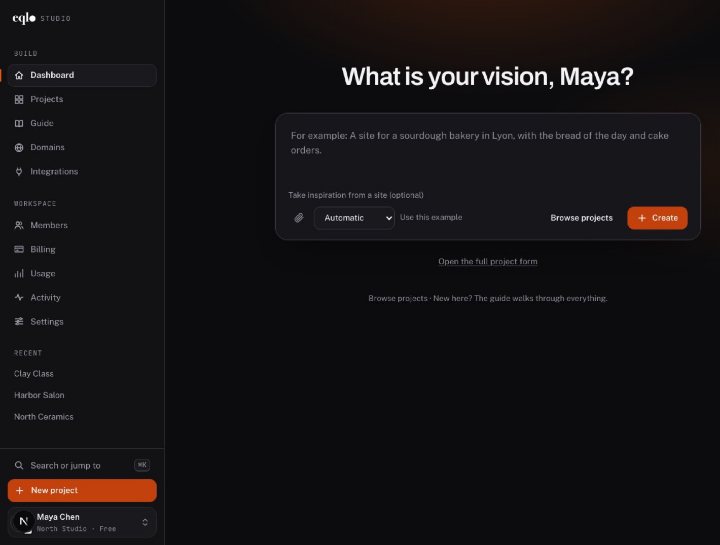
Create, edit and publish, then run your website and your app from their own dashboard. Every feature shown in real screenshots.
See the features
A Next.js project in React and TypeScript, sent to your GitHub repository. A spec change made in the repository comes back to Eqlo.
See the developer page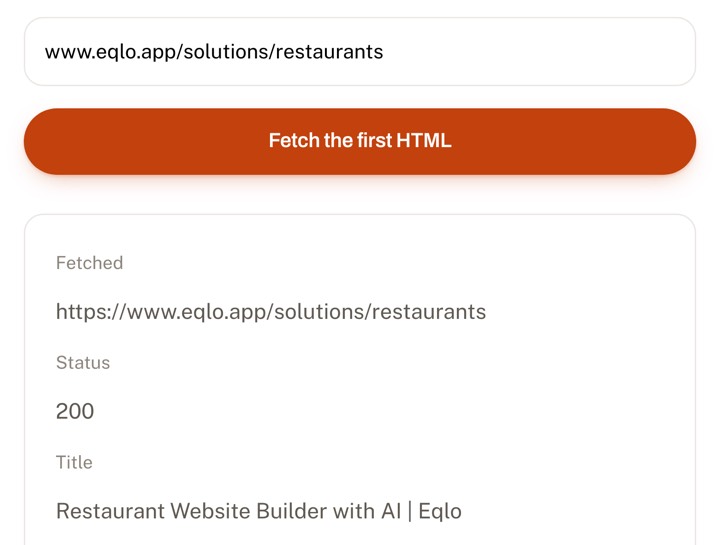
Paste a URL. In thirty seconds you see exactly what Google receives before any JavaScript runs.
Check a URLA plumber, a cheese shop, a bistro and a hiking club do not need the same things from a website. These website solutions by industry start from one sentence about your work, and Eqlo creates the pages your customers look for: what you do, where you work, and how to call, order or book. You read, you correct, then you publish, free to start and with no card.
A site a stranger can use at 9pm: the trade, the area you cover, a starting price, and a phone number or a quote form. Built for the van rather than for a brand presentation.
When the diary is the product, the site shows open slots and takes a deposit on the longer jobs. Appointments already in Google Calendar or Outlook block the matching slots.
The same catalogue on the counter and on the phone. In-store pickup, stock that stays accurate, and payments into your own Stripe account.
Ten products that exist, not two hundred you might order. Shipping rates set in a few sentences, and card fees that go to Stripe with no commission for Eqlo.
The menu, the opening hours and table booking, with a deposit on Saturday nights if you want one. A dish that changes on Tuesday is fixed in a sentence, with no menu to reprint.
Fixed-length slots, a booking window, a reminder email the day before. No-show figures for the last three months show whether the deposit or the reminder fills more tables.
A public page for people who have not joined yet, and member tracking for the committee. Dues, the next outing, and a reminder fourteen days before renewal.
When the activity happens on a trail or in a hall, the phone becomes the main tool. Let people try it with a 24-hour test link before you pay for a developer account.
The grid above is the starting point: a plumber needs a service area, a shop a cart, a dining room a table, and a club a member list. One sentence gets you the first version, then allow one to two hours of reading and corrections for a brochure site ready to publish.
Every project starts from a sentence about real work. You describe what you do, then adjust the pages until they look like your business.
Eqlo creates the pages, the navigation, the copy and the forms, with free stock photos or your own. Every page is published as complete HTML that Google reads without JavaScript, and a sitemap is generated.
The site starts on an eqlo.dev address. On Plus, you connect your own domain with two DNS records, and the HTTPS certificate installs itself. Photos are compressed and each one gets a description.
A call, a slot, a cart, a join form. Payments go through your own Stripe account. If the site offers a customer area, people get in with their password or a code emailed to them.
Open the page that matches your work, then adjust the first pages. If you already know which pages you want, the website builder page describes the tool itself.
Stock, variants, returns and the cart are covered in the store guide. The retail page is for the person who still stands at a till.
The nonprofit app page and the iPhone and Android guides show the way: try it on phones first, then move to Plus at $19 for signed builds.
The website builder, pricing and the industry pages take over from here.
No. It is the same editor and the same free plan. These pages talk about your trade, while the builder page talks about the tool. Pick whichever sounds like what you were searching for.
Yes. One project gives you the site and the app, which shows that site inside a native shell. A club can keep "how to join" on the web and offer the app to its members.
No. Eqlo places free stock photos to start with, but three photos of real jobs or of your shop beat ten generic images. Add them when you have them, and Eqlo writes their description.
The free plan covers five projects and one seat, hosted on an eqlo.dev subdomain, and asks for no card. Your own domain comes with Plus, at $19 a month for three seats.
Free to start, no card. Plus, at $19 a month, puts your own name on the door.