
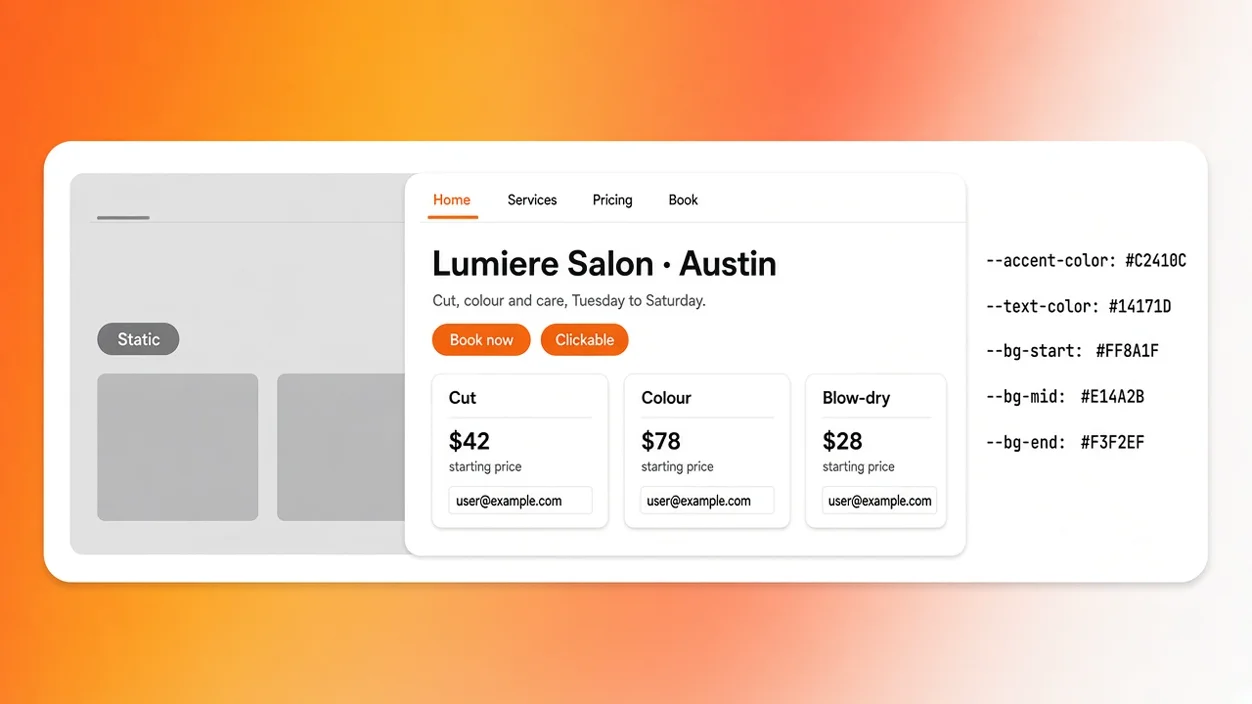
For designers who already have a system

For designers, your designs made usable

A flat frame is a preference about hierarchy. A clickable flow is a fact about the empty state and the back button. Eqlo wears the colors, type, and radius you already named. You are not waiting on a release to learn if the path works. Five projects stay free, with no card.

  • 1 hClickable mockup
  • 15 minSystem applied
  • NowNamed components
  • 5Free projects

This morning: flat

Flat design mockup of a settings flow with grey rectangles and no real copy
The static frame: grey blocks, no hover, no empty state.

This afternoon: clickable

Clickable settings flow wearing named tokens with a real empty state
The same hierarchy, clickable: real labels, a hover, an empty state, a back button.

What slows you down today

Twelve frames, no empty state

You have a file and a prototype of hotspots. A stakeholder clicks the pretty path and never sees the empty state. Engineering asks which frame is source. The trade-off, cut the advanced tab and keep the empty, lives in a comment nobody will find next cycle.

The same hierarchy, with states

Hover, empty, error, and back sit on the path. Comments pin to the spot. Acceptance is whether a stranger can finish without you. You still own the file for exploration. You stop pretending a hotspot is evidence.

The release queue that teaches you too late

The useful bug appears after build

The back control vanishes on the third step only after a release. You file a ticket. A week later the team has moved on. You learn the flow in production, which is a cruel critique method and a wasted cycle.

Five people fail it this afternoon

You make the path clickable today. Five people from the team, or five people who do the job, fail it before anyone estimates the tab you already wanted to cut. You correct the back control on the object.

A handoff that is a folder and a prayer

Four versions of the same button

Engineering rebuilds the button three times because the file has four versions of it. Tokens live in a slide. Named components do not come back. Sign-off is a thumbs-up on a frame that will not survive a keyboard.

Names you can search, files they can open

You point at the system you already have. Eqlo applies type, radius, and the six colors you already debate, across every screen. Components come back with names you would have picked. The repository is ordinary React and Tailwind. You still throw the theatrical layout.

What you can build yourself

About 1 hour

A mockup made clickable

Import the frames you already argued about, or drop a screenshot. Say which paths must work. Eqlo fills the states the mockup only implied. The first draft lands in two to five minutes. You delete the decorative screen that was never in the trade-off. The rest of the hour is the empty state and the back button.

About 15 minutes

The system applied to every screen

Headings, body, radius, the six colors. The preview updates on the same screen. A review that starts with why this pill is shaped that way is a review you already lost. Put the system on first. In-place text edits do not wait on a new generate.

Immediate

Named components, exported

Button, EmptyState, the row they will open every day. Names you can search. Usage sitting next to each one. From Plus, GitHub sync is automatic. You are not mailing a slide that says build this. The prototyping page covers the handoff panel. Here the job is: you stay the author of the names.

A worked example

This is a worked example, not a named company. A design team owns the system for a forty-person product group. An API-key settings flow has sat as twelve static frames since spring. One morning they import the file, point at the token set already in the repository, and ask only for create, list, empty, revoke, and back. The first generate adds a usage analytics tab nobody drew. They delete it. That afternoon four engineers and one support lead click the empty state. Two try to revoke a key that does not exist and hit a dead end. The empty and the error get written the same day. Sign-off lands two days later: ship the five screens, park analytics. Named components come back. Engineering starts the next week with a flow they have already failed, not a folder.

  • 5screens that survived the cut
  • 15 minto apply the system
  • 2 daysflat file to sign-off

What you keep from your current tools

Keep Figma, or whatever file still earns exploration. Keep the token repository. Keep the critique ritual if it is honest. Eqlo is a bad place to invent a brand, and a good place to stop arguing about a radius in the abstract. Keep the prototyping page open when you need the import loop written out. Keep engineering in the five-person pass. Budget for a system still sits with the team that owns the tokens. A generated theme you cannot name is not a system. Slack can stay the place you drop the share link.

Where the autonomy stops and engineering takes over

Stop when the next constraint is a component the system does not have, a motion the platform already owns, or an accessibility review that wants the repository in their pipeline. You can correct copy, spacing, and the obvious empty states. You cannot certify a design system from a sentence. You cannot fake a data table that loads 40,000 rows. Hand over. Stay for the next flow. Release is engineering connecting the real API to screens testers already understood. If they throw a screen, that is still cheaper than learning the path in production. A very specific trade will need a developer. Generation can be wrong.

Frequently asked questions

Will Eqlo overwrite my design system?

No. You point at the colors, type, and radius you already agreed. If you have none, it starts from a small set you can replace. A prototype is a bad week to invent a brand. The system remains the source. The generated theme is a guest.

Do I have to give up my design file?

No. Explore there. When the question is whether a stranger can finish the path, move the flow into something they can type in. Keep both. A file and a clickable project answer different critiques.

What comes back for engineering?

Ordinary components and tokens, with names and usage. React, TypeScript, and Tailwind. From Plus, GitHub sync is automatic. They will delete anything theatrical. They will keep the structure testers already learned. That is a better handoff than a folder and a prayer, and some screens will still be rewritten.

How do I get sign-off without a review theatre?

Send the link with three questions: can you create, can you leave, what did you not find. Collect five answers. Write the cut on the ticket. A workshop that starts from those notes is a workshop. A workshop that starts from a frame is a tour.

Where does the budget go if I can do this in a day?

Into the system, the research, and the two screens that were always hard. Not into waiting for a release to teach you the empty state. Free is $0 for five projects and one seat. Plus is $19 a month and three seats. The cycle is the cost. Spend it on judgement.

Point at the tokens. Make the path clickable today.

Five free projects, one seat, no card. Named components come back with the flow.