Title and description
You see the document title and meta description exactly as they appear in the first file. An og:description fills the gap only when the plain description field is missing from that same response.


Create, edit and publish, then run your website and your app from their own dashboard. Every feature shown in real screenshots.
See the features
A Next.js project in React and TypeScript, sent to your GitHub repository. A spec change made in the repository comes back to Eqlo.
See the developer page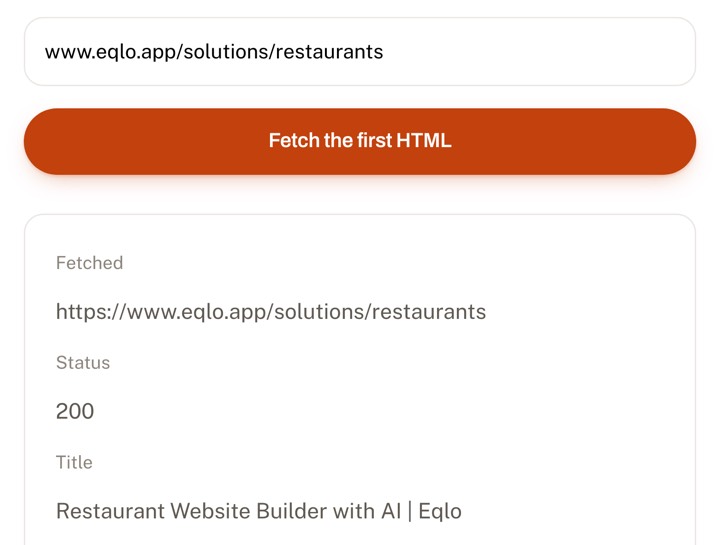
Paste a URL. In thirty seconds you see exactly what Google receives before any JavaScript runs.
Check a URLTo check if a site is indexable, enter a public http or https address and Eqlo downloads it from our servers, follows a short chain of safe redirects, then inspects the first HTML body. The report lists HTTP status, document title, meta description, H1 count with the first heading text, JSON-LD presence, visible word count and any robots meta tag. Search Console is a different product: this tool neither submits URLs nor reaches localhost or private networks.
Accepted schemes are http and https only, without login cookies or credentials, and without private hosts. Roughly eight seconds and about one megabyte are the hard stops for each run.
Crawlers begin with a single request, and if that first payload lacks a title, a real H1 and the sentences visitors later read, the URL has not entered the ranking contest. This checker surfaces those first-HTML signals for one address you choose, without scoring prose quality or predicting a position.
For the longer argument about AI shells that stay invisible, open the SEO page and decide what to change. Use this form when you want a quick look at one URL without disabling JavaScript by hand in your browser.
You see the document title and meta description exactly as they appear in the first file. An og:description fills the gap only when the plain description field is missing from that same response.
The report counts every H1 in the first HTML and prints the text of the earliest one. Multiple H1 tags are a warning sign, while none at all is a clear defect, and a decorative banner that is not markup as H1 never shows here.
You learn whether an application/ld+json script exists and what any robots or googlebot meta contains. Finding a script does not prove quality, whereas a noindex value is the concrete fact that usually matters most.
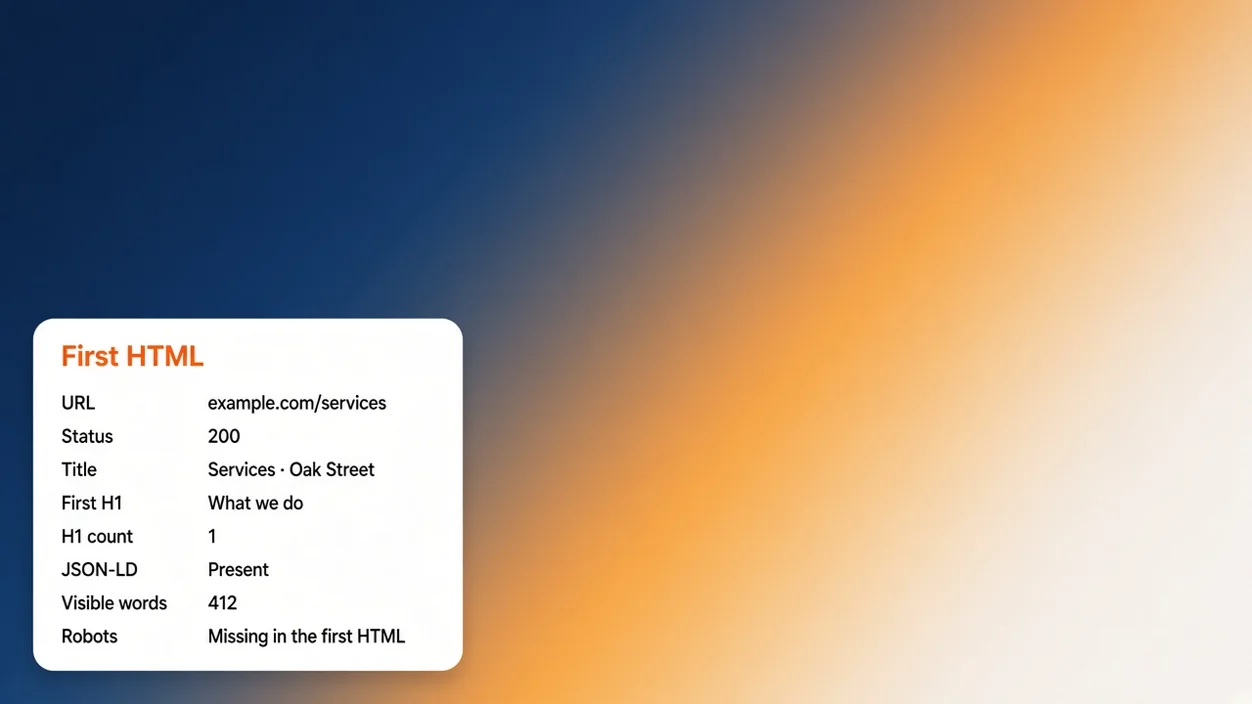
Read status first, then title, then H1 count, then visible words in that order. A 200 response with a blank title and no H1 means the first HTML is thin even when your browser paints a rich page after scripts run, and JSON-LD presence only tells you structured data arrived in that first file.
A robots or googlebot meta set to noindex explains why a solid page can still stay out of the index. Compare the visible word count with what a visitor should read on arrival; a near-zero count means fix rendering before you rewrite marketing copy.
Checking a public brochure is useful work, yet it is never permission to probe a private network, so blocked hosts are refused on purpose.
Put one clear title and a single H1 into the first HTML, then make sure the main sentences appear without waiting for a client script. Add JSON-LD when the page type needs it, and remove accidental noindex before you chase rankings. You may reuse title, H1 count, visible words and JSON-LD presence from this page with attribution and a link back here, including the fetch date when you cite a run.
This checker is separate from Google Search Console: it never requests indexing, never lists sitemap errors, and never explains why a URL is crawled yet unindexed. Those answers still live inside your Search Console property.
It is also not a lab score and not a vendor comparison: it does not invent competitor metrics. Thin first HTML means fix rendering; solid first HTML with an unseen URL means return to the SEO page and your sitemap next.
Empty documents belong on the SEO page first. Live rebuilds can start from a URL import or the redesign guide. If you want Eqlo to place words in the first response itself, open the website builder.
Your browser executed JavaScript while this fetch did not. Missing title and H1 here means a crawler that only stores the first file may keep nothing useful, which is the usual failure mode for client-only AI builders.
Local, private and link-local hosts are blocked by design. Publish a public preview instead, or inspect view-source on the machine that already reaches that host.
A high count only proves words exist in the first HTML. Ranking is a separate job, and thin, duplicated or noindexed pages can still report a large number.
No. The address is only used to build the report on screen, and the tool does not save it. Even so, avoid pasting secret links or links that carry an access token.
Sites published with Eqlo ship complete HTML pages that read without JavaScript, and a page with no main heading cannot be published. The Free plan covers five projects with no card required.