A conversation that feels good
Between your request and the result on screen, the exchange is quick and smooth. That is the heart of the product, and it works.

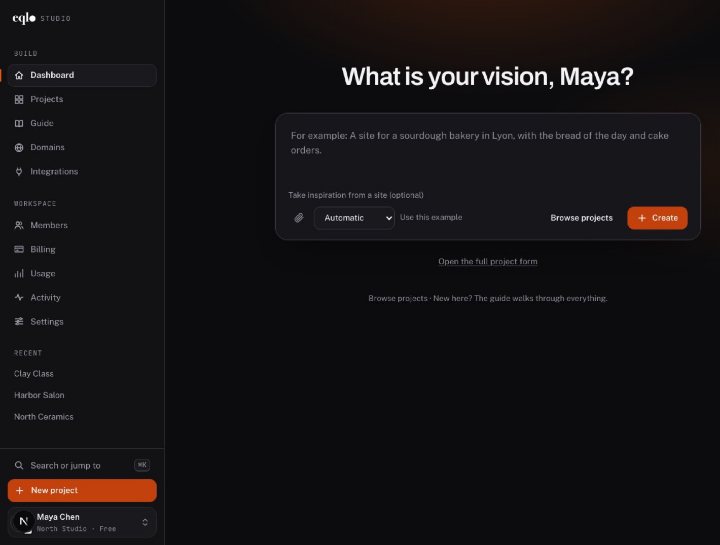
Create, edit and publish, then run your website and your app from their own dashboard. Every feature shown in real screenshots.
See the features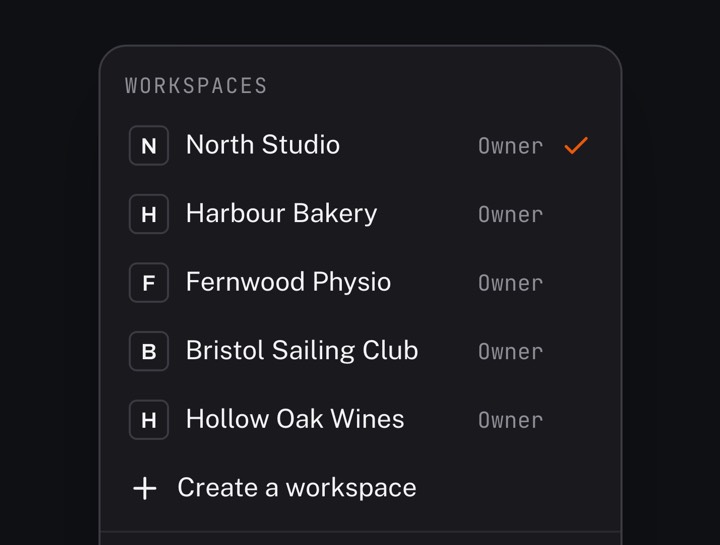
A Next.js project in React and TypeScript, sent to your GitHub repository. A spec change made in the repository comes back to Eqlo.
See the developer page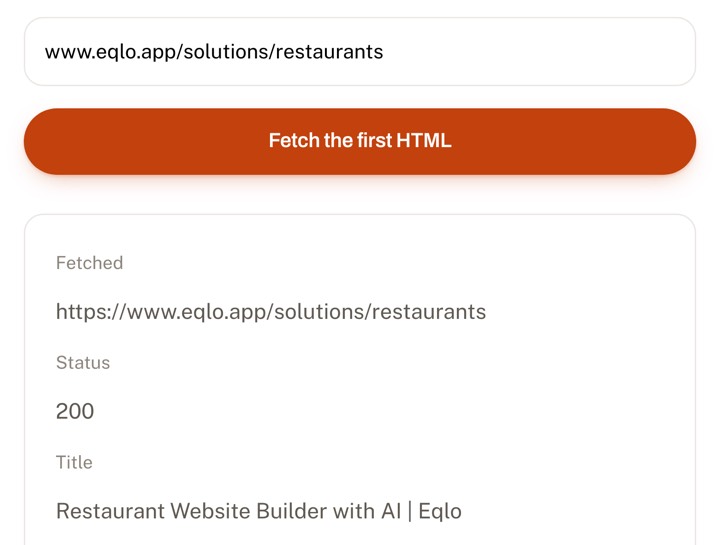
Paste a URL. In thirty seconds you see exactly what Google receives before any JavaScript runs.
Check a URLLovable and Eqlo start the same way: you describe your project in one sentence, and the AI builds it. If you are looking for a Lovable alternative, three gaps can be checked. Eqlo pages are readable by Google the moment they are published, the same project also produces the iOS and Android app, and the tools a business needs are already in place. Beyond that, the two tools are very much alike.
Comparison pages often skip this part, so let us start with it. Lovable made building apps through conversation mainstream, and it does it well.
Between your request and the result on screen, the exchange is quick and smooth. That is the heart of the product, and it works.
There are plenty of public projects to explore, tutorials and people ready to help. For someone new to the subject, that is a real advantage, and a younger tool does not catch up in a few months.
To show an idea that works, with no concern for search rankings or app stores, Lovable gets straight to the point. You will have a result in very little time.
These gaps are not flaws. They come from technical choices that suit some uses better than others. They start to matter as soon as a site needs to be found on Google, installed on a phone or run a small business.
An app built in the browser hands Google's crawler an almost empty page. It returns to render the page at some later point, which can take weeks for a new domain. For a prototype, that does not matter. For a site meant to bring in customers, it decides everything. Every Eqlo page goes live as complete HTML, and a page that depends on JavaScript cannot be published.
With Eqlo, the website project also produces the iOS and Android app. On the Plus and Team plans, signed builds go to TestFlight and Google Play internal testing. One important detail: the app shows your published site inside a native shell; it is not rebuilt screen by screen.
Every Eqlo site gets its own admin, and the usual features are ready: bookings with deposits, an online store paid into your own Stripe account with no commission, forms, and cookie-free analytics. With a general-purpose tool, those pieces get built over the course of the conversation.
Twelve criteria. The Lovable column reflects the September 19, 2026 survey, the Eqlo column the state of things on October 10, 2026. Plans change quickly in this space, so check before you choose.
| Criterion | Lovable | Eqlo |
|---|---|---|
| Starting point | one sentence | one sentence |
| Pages readable by Google on publish | not by default | yes, publishing blocked otherwise |
| iOS and Android app | separate project | same project, in a native shell |
| Builds sent to TestFlight and Google Play | no | yes, Plus and Team plans |
| Data included | yes | yes, tables with CSV or Excel import |
| User accounts | yes | yes, members area |
| Payments | through a connector | your Stripe account, no commission |
| GitHub sync | yes, both ways | yes, both ways |
| Site admin | to be built | created with the site |
| Custom domain | yes, paid plan | yes, from the Plus plan |
| Interface in French | yes | yes |
| Entry price | free plan, then paid | free, then $19 a month |
Easy to misread: Lovable offers pages in several languages, French included. Claiming otherwise would be wrong. The gaps described here concern how Google reads the pages, mobile, and built-in features, not language.
In these three situations, we would recommend Lovable without hesitation. Eqlo brings nothing decisive there.
If the goal is to show an idea, win over a team or learn, neither Google nor the app stores concern you. Pick the tool whose conversation suits you best.
Switching tools has a cost: habits, ongoing projects, muscle memory. Paying it for an advantage you do not need would be a bad deal.
No public site to get found, no mobile app, no business to run: the three gaps above then bring you nothing.
Once the decision is made, migrating takes less effort than people expect. Here are the three steps to plan for.
Export your current project's repository. You get readable React and TypeScript files, handy for describing to Eqlo exactly what you want to rebuild.
Export your tables as CSV, then import them into the new project, up to 20,000 rows per file. One column per field, one row per record: it is the easiest step.
If your site already gets visits, list the pages concerned and redirect each old address to the new one. Eqlo handles 301 and 302 redirects. It is the only step where a mistake is costly.
To dig into indexing, the site builder or pricing.
Yes, Lovable publishes pages in several languages, French included. Language is not what separates the two tools. The gaps concern how Google reads the pages, mobile, and built-in features.
Yes, through GitHub. You get standard React and TypeScript files. That is what makes switching tools reasonable, since both produce ordinary code.
Yes, provided the rendering issue is handled. An app built in the browser needs extra work to deliver its content on the crawler's first visit. Run the page source test on your own site before drawing conclusions.
Each column carries its own date, shown at the top of the page. Plans change often in this space. If you spot a difference, email us and we will fix it and date the change.
Both have a free plan and paid plans. Compare what each price includes rather than the amount alone: hosting, number of seats, custom domain, app store submission. At Eqlo, the Plus plan runs $19 a month for three seats, and the Team plan $49 for ten.
Yes, some people prototype in one and publish from the other. Since the code is standard on both sides, moving between them needs no conversion, only a review.
With Eqlo, the same project produces the website and the iOS and Android app, with the same data. The app wraps the published site in a native shell, which suits most small businesses but does not replace a custom-built native app.
Because many people ask the question, and it is better to answer it ourselves, with sources and a date. We state that we publish one of the tools and give an address for reporting mistakes.
At Eqlo, the Free plan includes five projects, no card required. Nothing beats trying it on your real case.