
For people teams who cannot put a hire in a sheet

For people teams, HR tools your staff will actually open

A forwarded workbook is not a people system. Addresses and a document number in a tab are the objection, and it is the right one. Eqlo starts with the region, the seats, and a log. Payroll still wins when a vendor already fits. Five projects stay free, with no card.

  • 2 hWeek-one onboarding
  • 2 hTime-off requests
  • 1 hTeam directory
  • 3Regions to pick

What you can build yourself

Week-one onboardingAbout 2 hours · A hire sees the same list as IT and the manager

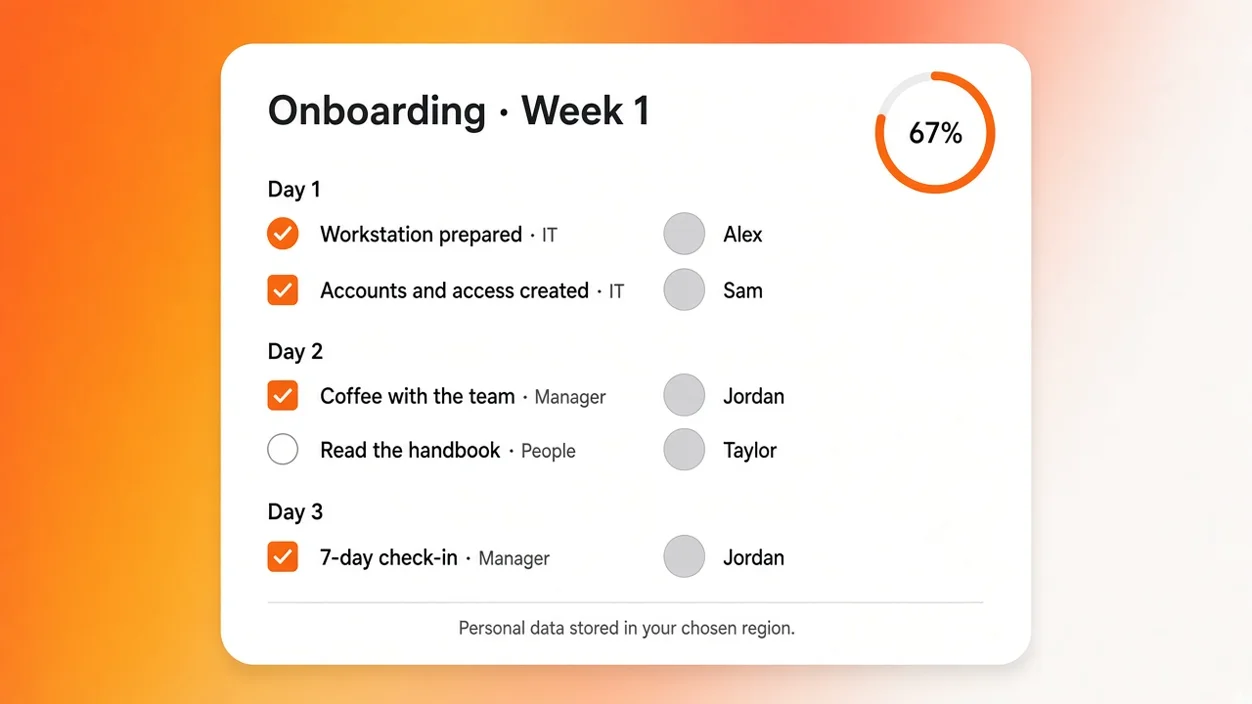
Workstation, accounts, a coffee, the handbook, a seven-day check-in. Each row has an owner. Personal fields sit behind the people seat, not on a sheet the whole team can sort. Write the region before you invite the first manager. A stakeholder in legal will ask. Have the answer. The first draft lands in two to five minutes. The rest of the two hours is the owners and the fields you refuse to import.

Week-one onboarding checklist with owners, a progress ring and a region note
Week one: named owners, a progress ring, personal data in the region you chose.
Time-off requestsAbout 2 hours · A balance and a named approver, not a color in a cell

Request, manager, people partner if the balance is odd. The team calendar can stay the one you already pay for. Google Calendar is a sentence you can ask for. Sick notes are not a channel topic. Trade-off: you will not get a full absence policy engine on day one. You will get a queue a covering colleague can trust. Roles so a neighbour cannot open the reason.

Time-off request with a balance, a manager step and a people-partner step
A team directoryAbout 1 hour · A name, a team, a public desk, nothing else

Who works here, which team, a desk or a city, a covering person. A birthday, a home street, a salary band is not a directory. Paste the columns. Cut the ones that were never public. CSV import if a list already exists. The budget for a full HRIS still sits with the vendor if you already have one. A directory staff will open is a thin one.

Staff directory with team, city and a covering person, no private fields

What slows you down today

Three frictions, all of them a sheet that should never have held a personal row.

A hire who lives in a forwarded workbook

Addresses, an emergency name, a document number in a tab. Legal has already written a note, or they will. The first new hire of the month is how you discover who still has the file. A tool starts with the region and the seats, then the checklist.

Time off that is a color in a cell

The covering colleague cannot see the balance. The manager approves in a chat. People ops reconstructs the month from three files. Acceptance is a named yes on a request, not a highlight. Release is the team trusting the queue.

A directory that is also the salary file

A birthday, a home street, a band sitting next to a public desk. Staff stop opening it because they do not know what is public. Cut the columns. A directory people will open is a thin one. The rest stays in the vendor you already pay.

A worked example

This is a worked example, not a named company. Take an 80-person company whose onboarding still lives in a workbook with addresses, emergency names, and a tab of travel documents. Legal has already written a note. A people partner sets the project in the EU, connects the company login, and builds week one from the checklist they already use. They do not import the travel-document tab. They write that those files stay in the vendor they already pay. In the first month, six hires finish week one. Time off opens two weeks later. The directory goes up the same week, with team, city, and a covering person, nothing else. The managing director sign-off is a condition: no personal row in a sheet by the end of the month. They meet it for the loops they built. Payroll stays with the HRIS.

  • EUregion, set before the first seat
  • 6hires through week one
  • 0travel documents moved into the tool

What you keep from your current tools

Keep the HRIS if it already runs payroll and contracts. Keep the calendar, the identity provider, the travel-document vendor, the DPO process. Eqlo is for the loops that never got a seat on that stack: week one, leave, a thin directory. Do not migrate a working payroll because a checklist appeared in an afternoon. The budget conversation is which gap, not which replacement. Google Sheets can stay an export. Slack can stay the place a hire is announced, once the row already exists in the tool.

Where the autonomy stops and engineering takes over

Stop when the next constraint is a feed you do not own: payroll, tax, a works council export, a background-check vendor, a medical file. You can correct copy, statuses, and who sees a field. You cannot become the system of record for pay, and you cannot store health data because a sentence allowed a column. Release is opening a tool to the company after legal has read the region, the seats, and the log. That sign-off is the work. The screens are the easy part. A regulated health file will need a developer. Generation can be wrong. Read the fields before the first hire lands.

Related pages

Residency and security take over when the question is the region and the log. This page is the people week.

Frequently asked questions

Where does personal data sit?

In the region you pick for the project, before the first seat. EU, United States, or United Kingdom. Read residency with legal. If you cannot name the region, do not start. Encryption at rest and in transit, an access log, daily backups with 30-day retention.

Is this a replacement for our HRIS?

No. If payroll and contracts already live in a vendor, keep them. This page is the gap: onboarding, leave, a directory. Replacing a working HRIS is a year. Filling a sheet is a cycle.

Who can see a review or an address?

The seats you name. People ops, the two people in a review, the manager on a leave request. Not the neighbour. Reader, editor, and admin. Finer rules are an engineering conversation, and a reason to stay on the HRIS. Free is one seat. Plus is three. Team is ten.

What about a DPO review?

Show them the region, the seats, the log, and what you refused to import. A travel-document tab that stayed out is a fact they can respect. Budget time for that conversation. It is not a Friday surprise.

Can employees take their data with them?

You can export a person's rows. A full data-subject process is still your program. Eqlo will not write the letter. It will give you a file that is not a scavenger hunt through mail. A full project export is available at any time.

Set the region. Then build the loop the sheet still runs.

Five free projects, one seat, no card. Personal data stays in the region you chose.