

Hostinger AI website builder review: I tested both build modes, then the renewal price
I tested both Hostinger AI Builder modes, then the renewal. Premium is $119.52 for four years and $527.52 for the next four, before tax. Manual mode fits a brochure site. Agentic mode bills every message.

By David RieuFounder of Eqlo

You've seen $2.49 a month on Hostinger's AI Builder page, and before you pay, you want to know which of its two build modes to use and what the site will cost once that price ends. This Hostinger AI website builder review answers both. Manual mode, the drag-and-drop editor, is a cheap and quick way to put a small business site online, and it's the mode I'd pick for a plumber or a hair salon. Agentic mode builds real web apps from a chat, but every message spends AI credits, and a new plan includes a single batch of 250.
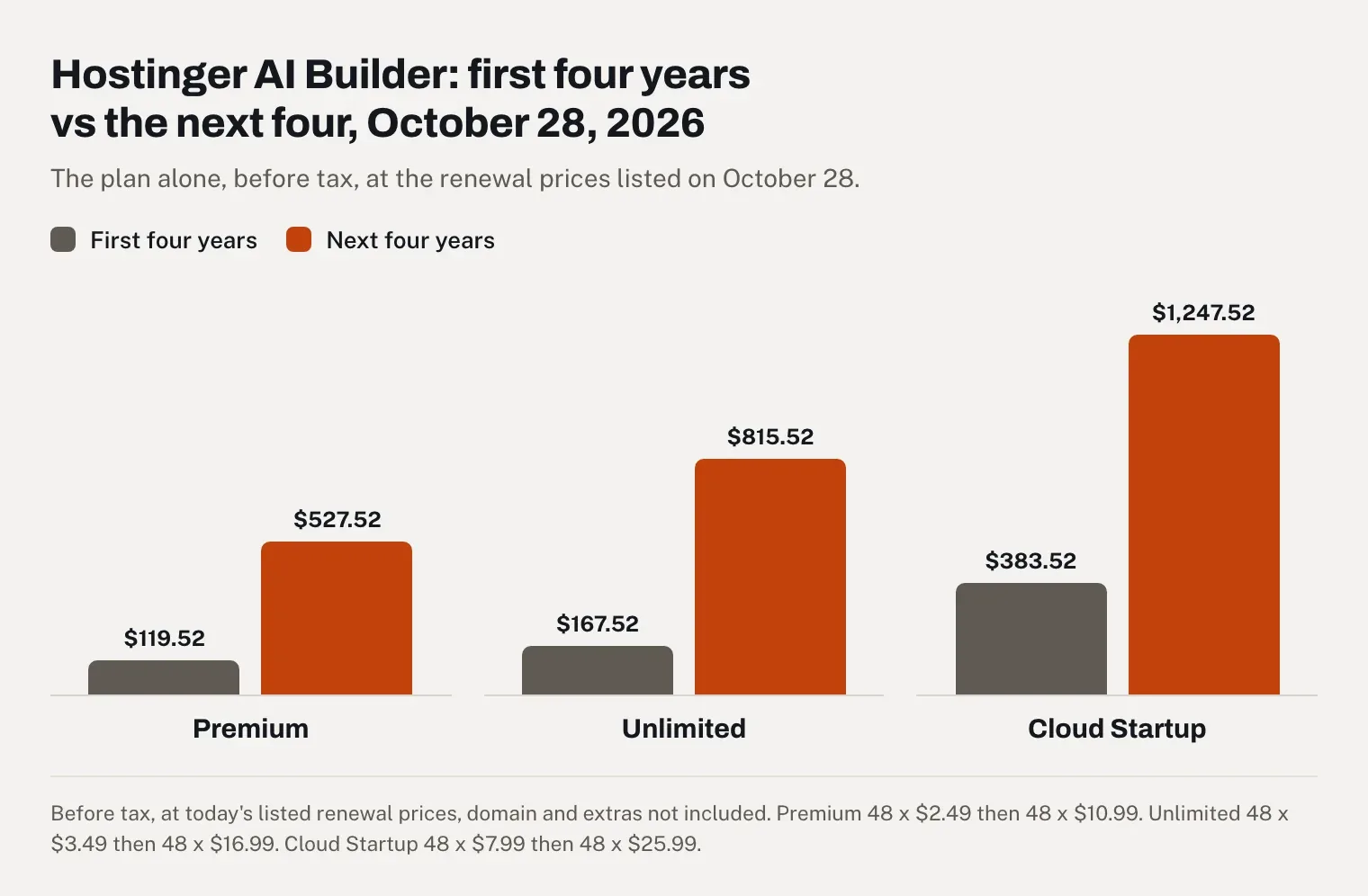
The $2.49 is the 48-month price, paid upfront: $119.52 at checkout for the Premium plan, before tax. Premium then renews at $10.99 a month, so the next four years cost 48 × $10.99 = $527.52, about 4.4 times the first four.
I founded Eqlo, which competes with Hostinger's AI Builder, so weigh this review with that in mind. Eqlo gets one marked section near the end, and every claim about Hostinger links to Hostinger's own pages first. I built a test project in each mode before writing, and what I saw matched what other hands-on reviewers describe. So instead of adding one more build diary, I've put the work into the evidence: other testers' results with their dates, Hostinger's pages and checkout as they stood on October 28, 2026, what customers say on Reddit and Trustpilot, and our team's measurements of 31 sites built with Hostinger.

Hostinger AI website builder review: the quick verdict
Best for: a site of a few pages for a plumber, a cleaner, a hair salon or a photographer, built in Manual mode by someone who plans to stay with Hostinger for years.
Skip if: you might move the site after the first term, need a store on the cheapest plan, want to build an app on the credits included with the plan, or need your data to leave with your code.
Price on October 28, 2026: Premium $2.49, Unlimited $3.49 and Cloud Startup $7.99 a month before tax, on 48-month terms paid upfront, renewing at $10.99, $16.99 and $25.99 a month. These are Black Friday prices.
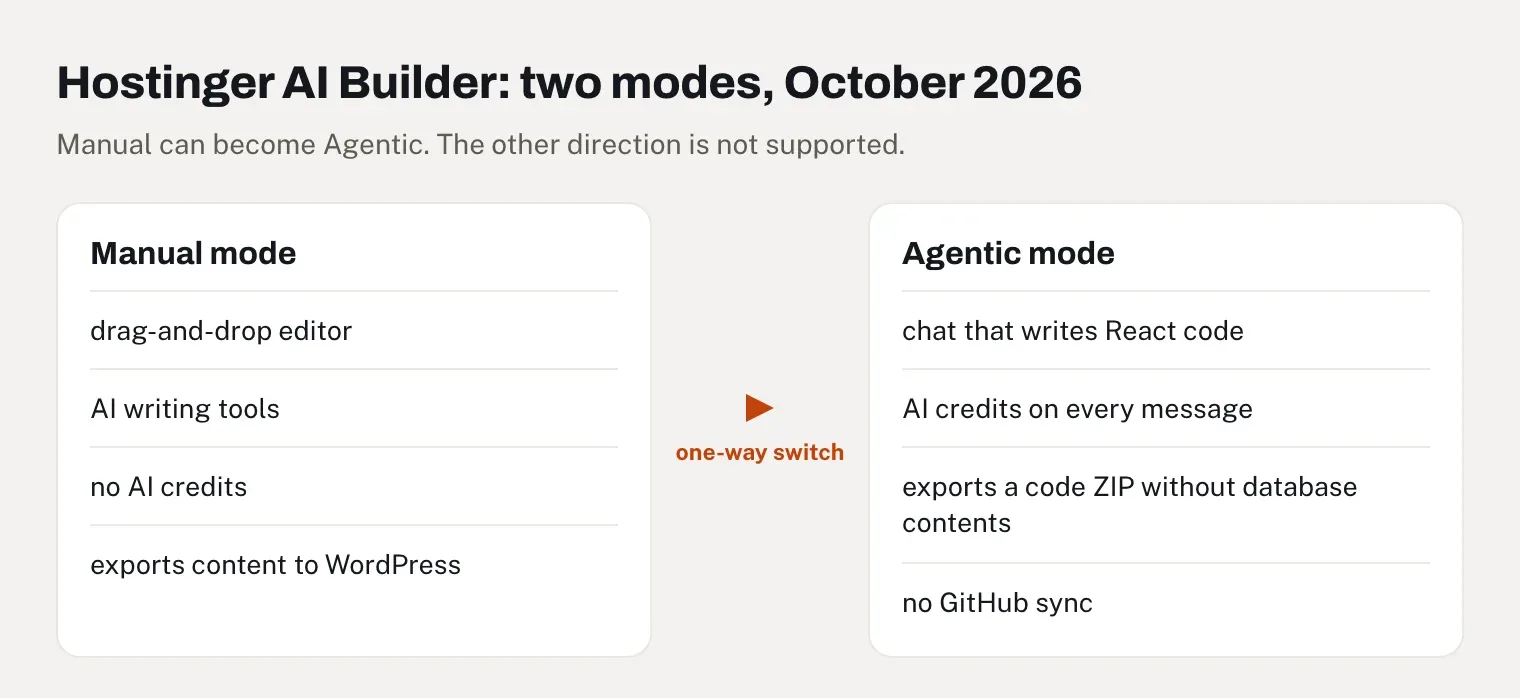
The two modes: Manual is a drag-and-drop editor with AI writing tools, and it uses no credits. Agentic is a chat that writes React code, and every message costs credits, questions included.
Credits: 250 with a new Premium plan (500 during Black Friday), given once. Hostinger's own FAQ says a simple business page usually takes 250 to 500.
Leaving: Agentic projects export as a code ZIP without the database contents. Manual sites send their pages, text, images and files to WordPress, and leave the layout, store, forms and SEO settings behind.
Trust: 4.6 out of 5 on Trustpilot from 73,531 reviews. Among the reviews that mention the builder or renewals, the ones Hostinger didn't invite are mostly 1-star.
What Hostinger AI Builder is now
Hostinger AI Builder is the site and web app builder included with most of Hostinger's web and cloud hosting plans. Since August 18, 2026, it has two modes: Manual, the former Website Builder, where you edit by dragging blocks, and Agentic, the former Horizons, where you describe what you want in a chat and the AI writes the code.
The merger explains much of the confusion in search results. Horizons launched in March 2025 as a separate app builder with its own credit plans, which is why WPShout's review still carries "formerly Horizons" in its title. Website Planet's review mentions a 14-day free trial, while Hostinger's documentation now says seven days. And the Reddit thread that ranks for this search dates from July 2025, a year before the two products merged (Hostinger's launch post).
At the launch, Hostinger framed the merger around what comes after the first draft. "The next battle in online presence is not about who can generate a homepage in 30 seconds," said Auksė Žirgulė, its vice president of product. "It is about what happens next." It's a fair test, and it's the one this review applies: what happens after the draft, and after the first invoice.
Both modes need a Hostinger hosting plan to publish, and the plan sets how many sites you can run: three on Premium, unlimited above it. VPS plans aren't compatible (hosting requirements).
Manual mode: the quick, cheap way to a brochure site
Manual mode is the old Hostinger Website Builder with AI at the start. You describe the business and the AI generates a first layout with a first version of the copy. Then you finish by clicking and dragging blocks. Hostinger lists an AI Writer, a blog generator, an SEO assistant, an image generator and a logo maker for this mode (Manual and Agentic compared), and none of them draws on a credit balance. "Manual mode doesn't use AI credits," says the AI Builder page.
My Manual session matched what most reviewers say about this mode. The draft came quickly and the editor took no learning, but the result looked like the template it came from, and the generated copy needed real prices and photos before it was worth publishing. Cybernews lists "no option to switch templates once you've started building" among its complaints (Cybernews, updated October 20, 2026). A developer on Reddit was blunter in 2025: "You can write 50 prompts in 50 different way, and there will barely be any differences between the generated options." Hostinger's special terms say much the same in legal language: "similar or identical outputs may be generated for multiple Customers."
For a trade business, Hostinger's gallery has plumbing designs in this mode, such as Corgan and Flowright, and we measured them below. Their text is in the HTML that search engines receive. Each one also loaded 381 kB of compressed JavaScript, about 1.3 MB once unpacked, two to three times what the Agentic templates load.
Selling is where the plans get murky. The plan cards show "Ecommerce available" on Unlimited and Cloud Startup, and not on Premium. Hostinger's help center adds that a Manual-mode store "connects to a separate Hostinger Ecommerce subscription by default, supporting up to 1,000 products," and that this subscription "is billed separately." The launch post says it for both modes: "To open a store, just add Hostinger Ecommerce, a separate subscription." If you need a shop, get the full price in writing before you prepay four years.
Leaving is the other limit. A Manual site can export its pages, text, images and files to a WordPress site. What stays behind, in Hostinger's words: "website styles and layout, online store, integrations, forms, collected submissions, or SEO settings" (export to WordPress). Hostinger's downloadable backups don't include AI Builder sites either (buying a new plan instead of renewing). In practice, a Manual site lives on Hostinger, and moving it means rebuilding the design somewhere else.
Agentic mode: an app builder that bills every message
Agentic mode is the former Horizons, and it's a different kind of tool. You describe the project in a chat, and the agent plans and writes the code. Every change after that is another message. Underneath is a real web app: React and Tailwind CSS for the pages, and behind them an Express server on Node.js with a PocketBase database for user accounts and stored data. New projects use React Router with server-side rendering, so each page arrives as complete HTML (code editor and export). It's the same family as Lovable or Bolt.new, with the hosting already attached.
What other testers built, and what broke
Agentic mode is also where my own test spent credits, and the published tests show the same pattern: the first build impresses, and the corrections cost. Their numbers, with their dates:
Cybernews (updated October 20, 2026) asked for a dark portfolio in "charcoal, black, and muted gold." The first draft took about 17 minutes and came back in a sand and terracotta palette; switching it to blue and white took about two more minutes. In a later test app, an AI feature displayed "raw Markdown symbols instead of properly formatted text."
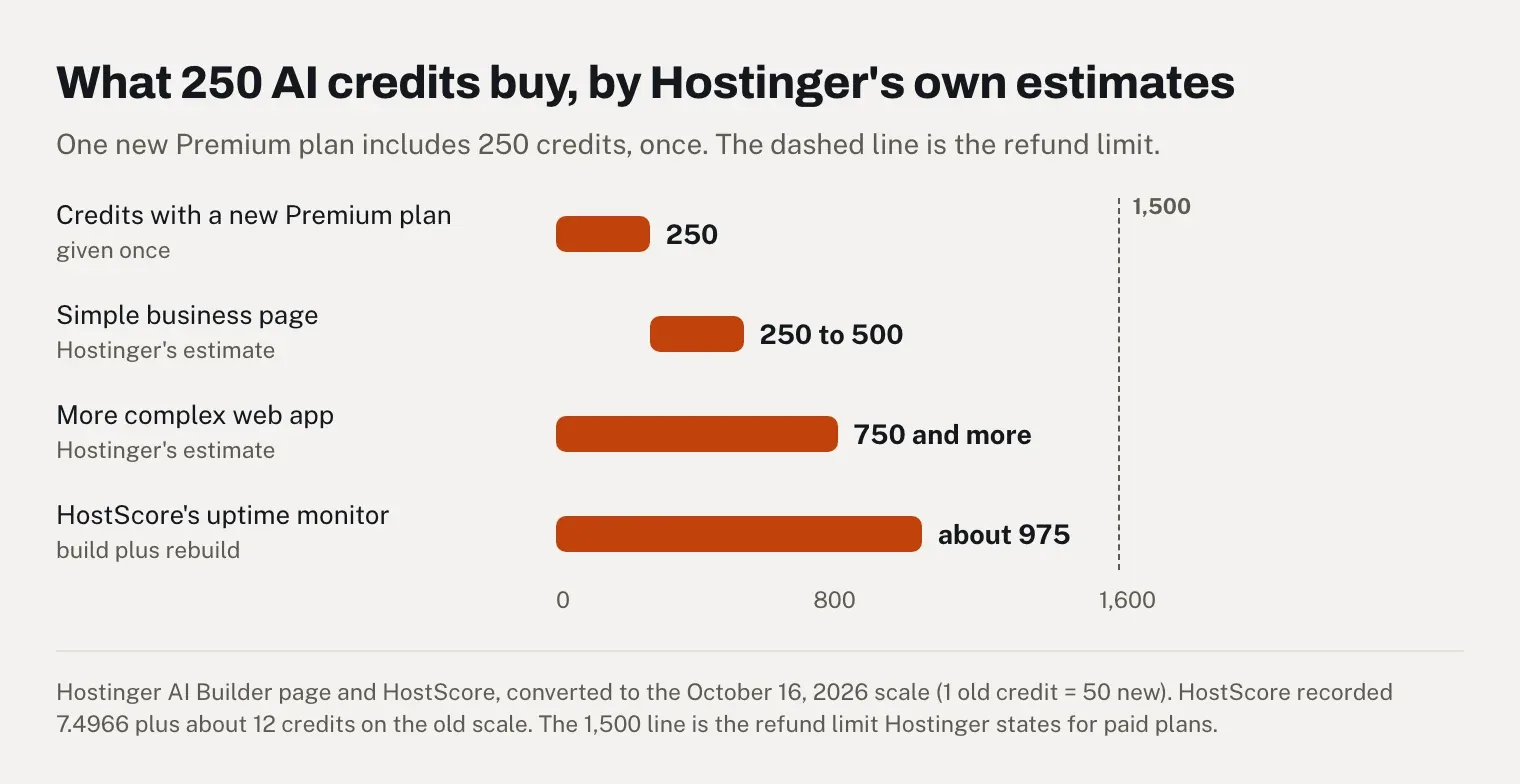
HostScore (September 14, 2026) got a working uptime monitor, with user accounts and a public status page, in about 16 minutes for 7.4966 credits, roughly 375 on today's scale. Then the reviewer left the browser session before publishing, came back to find that "the entire build and conversation had reset to the starting point," and spent "about 12 additional AI credits" (about 600 today) rebuilding it (HostScore).
WPShout (August 29, 2026) built a time-tracking app that looked finished. Its core feature, the timer, fell behind in a background tab: left running for about an hour, "it showed that only nine minutes had passed" (WPShout).
A Trustpilot reviewer (March 4, 2026) "wasted 3 hours and about 8 credits today, just trying to move the slider pagination dots from the top of a slider to the bottom." That's on the old scale; today it would read about 400.
How far 250 credits go
Here's what spends credits, according to Hostinger's plans and credits documentation: every chat message, "including ones that only answer a question," Ask to fix on detected errors, Select & edit (the point-and-comment tool), and AI features your visitors use on the live site. Saving text and image changes in Edit content is free, and so is editing the code yourself. Two rules are easy to miss. "Stopping a reply partway still uses the credits for the work already done," and "restoring an earlier version doesn't refund the credits used to make later changes." HostScore read the opposite in a Hostinger guide in September (credits "are reinstated" after Undo or Restore); the documentation updated on October 20 is the more recent source.
How many do you need? Hostinger's FAQ gives its own estimate: "a simple business page usually takes 250-500 AI credits, while a more complex web app… takes 750 AI credits or more on average" (AI Builder page). A new Premium plan includes 250. On October 16, 2026, Hostinger moved to a new scale where one former credit equals 50, which is why HostScore's 7.4966 now reads as about 375 (shared balance). The credits that come with a hosting plan are a one-time gift: renewals add none, and unused ones expire with the plan.
After that, you buy more. Top-ups start at 500 credits and cost more per credit than a subscription (Agentic mode credits), and additional credits expire three months after purchase. In September, HostScore's account showed the smallest pack, 10 credits on the old scale (500 today), at $4.99. Hostinger's checkout on October 28 valued the 500 Black Friday credits at $2.50.
Hostinger's pages don't agree on whether credits are monthly. The pricing page FAQ says plans "vary in both features and monthly AI credits." The help center says hosting-plan credits are given once, and that a monthly allowance needs "an AI credit plan" on top of hosting; another article names those plans Explorer, Starter, Hobbyist and Hustler. The pricing page doesn't show what they cost. I'd go with the help center: count on one batch, then pay as you go.
A one-way switch, and a partial export
Decide on the mode early. A Manual site can become an Agentic one, but "switching from agentic mode to manual mode is not supported" (Manual and Agentic compared). The switch creates a new site that counts against your plan's limit, and some sites can't make it at all: "Websites using Ecommerce, the Instagram element, or search are not supported for this switch" (switching to Agentic mode). Hostinger says the copy is "recreated 1:1," while its special terms warn that converted projects may lose "content, formatting, features or functionality." When a September 2026 r/Hostinger thread complained about the one-way switch, a reply confirmed that "the swap only works one way for now and the feedback has been passed to the related team" (r/Hostinger).
The export is real, with gaps. On a paid plan, an Agentic project downloads as a ZIP of the whole codebase, minus installed dependencies, build output, Git history "and database contents," and it's one-way: changes made elsewhere don't come back. "There's no GitHub sync and no FTP or SSH access," says the documentation. So the code can leave, while the data your site collected (accounts, form entries, orders, uploaded files) stays behind unless you extract it some other way. Our glossary explains what a full repository export should include, and how it differs from GitHub sync.
What each mode publishes: we checked 31 Hostinger sites
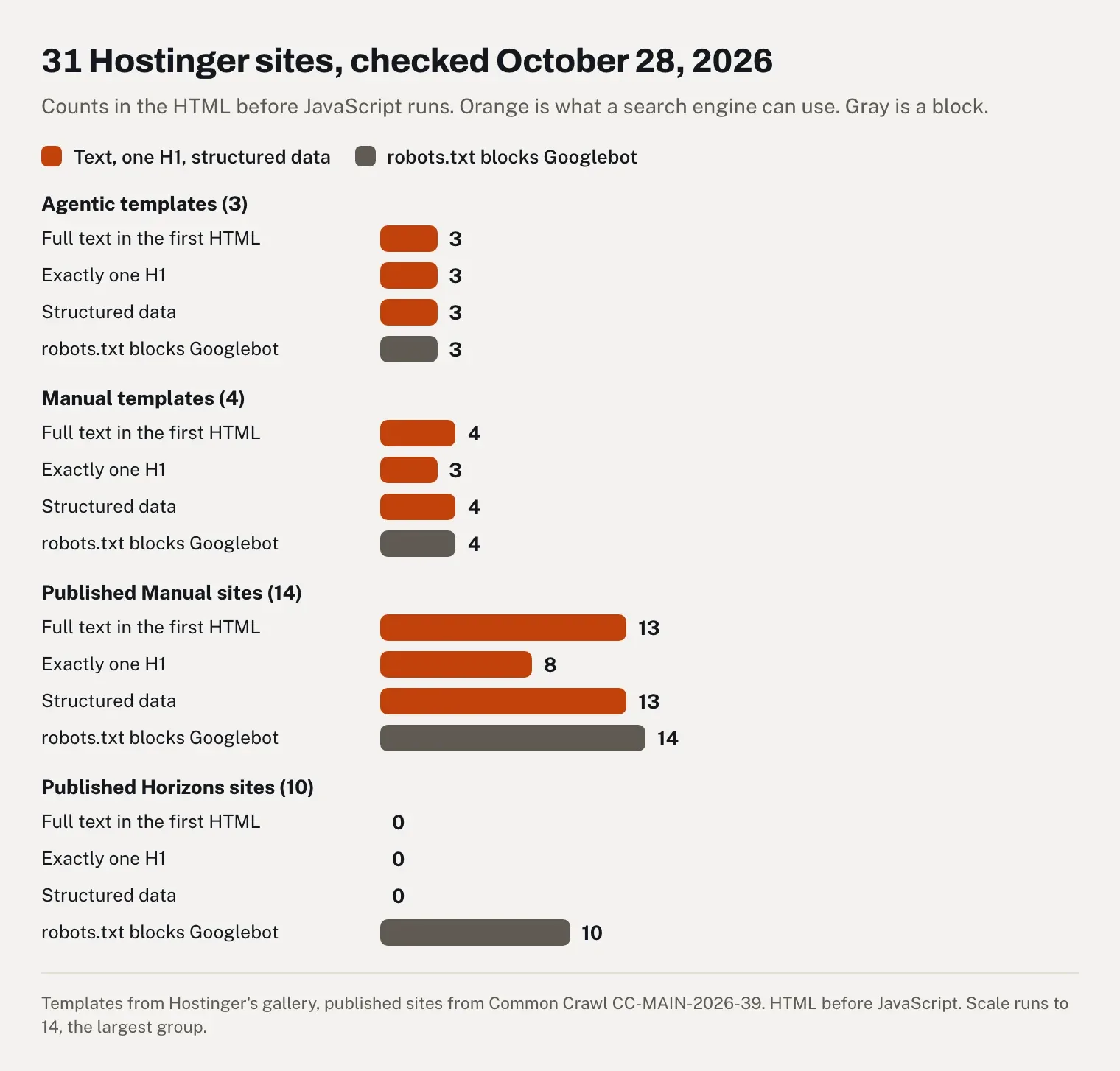
You can't judge search visibility from inside the editor, so we measured it. On October 28, 2026, our team loaded 31 sites built with Hostinger twice: once as a crawler that doesn't run JavaScript, once in Chrome. The set covered Hostinger's own trade templates in each mode: three Agentic plumbing templates, and four Manual templates for a plumber, a plumbing service, an electrician and a roofer. We added every hostingersite.com site in Common Crawl's September 2026 crawl whose generator tag named the Website Builder or AI Builder (14 sites) or Horizons (10 sites).
What we checked, October 28, 2026 | Agentic templates (3) | Manual templates (4) | Published Manual sites (14) | Published Horizons sites (10) |
|---|---|---|---|---|
Full text in the first HTML response | 3 | 4 | 13 | 0 |
Meta description | 3 | 0 | 12 | 0 |
Exactly one H1 | 3 | 3 | 8 | 0 |
3 (Plumber) | 4 (WebSite) | 13 (WebSite) | 0 | |
Compressed JavaScript per page | 132 to 175 kB | 381 kB | 452 kB (median) | 117 kB (median) |
robots.txt blocks Googlebot | 3 | 4 | 14 | 10 |
Counts are for the HTML before JavaScript runs.
New Agentic projects do what Hostinger's SEO documentation promises. The whole page, 964 to 1,201 words on the three plumbing templates, is in the first HTML response, with a title, a description, a canonical URL and structured data that marks the business as a Plumber (two of them add the City). That's server-side rendering done properly.
The 10 older Horizons sites are a different story. All of them sent an empty page to a crawler that doesn't run JavaScript, and 7 of the 10 carried "Hostinger Horizons" as their title until the script replaced it. Google renders JavaScript, later and less reliably, and several AI crawlers read only the raw HTML. Hostinger says older single-page projects "can be upgraded to the SSR structure"; if you built on Horizons, check yours first. Our guide to SEO for AI-generated websites explains why client-side rendering costs visibility.
Manual pages carry their text too (13 of the 14 published sites), tagged as a WebSite and not as a business. The headings are looser: 6 of the 14 published Manual sites had no H1 or several, one of them 19. And the four Manual templates had no meta description and left images without alt text, which you'd fill in on a real site; 12 of the 14 published Manual sites had a description.
We expected the heavier Manual pages to be slower. In Lighthouse's mobile test (median of three runs per page), they weren't: the four Manual templates scored 77 to 86 for performance and the three Agentic ones 69 to 76, with the largest element on screen appearing after 3.4 to 3.8 seconds and 4.0 to 5.5 seconds respectively. On the Chicago template, Lighthouse put the cost of render-blocking files at about 1.6 seconds. Scores move between runs (one Manual template scored 98 on a fourth try), so read these as ranges. Both groups are acceptable for a small business site, and neither is fast on a phone. Our glossary covers what Core Web Vitals measure.
The free address is closed to Google
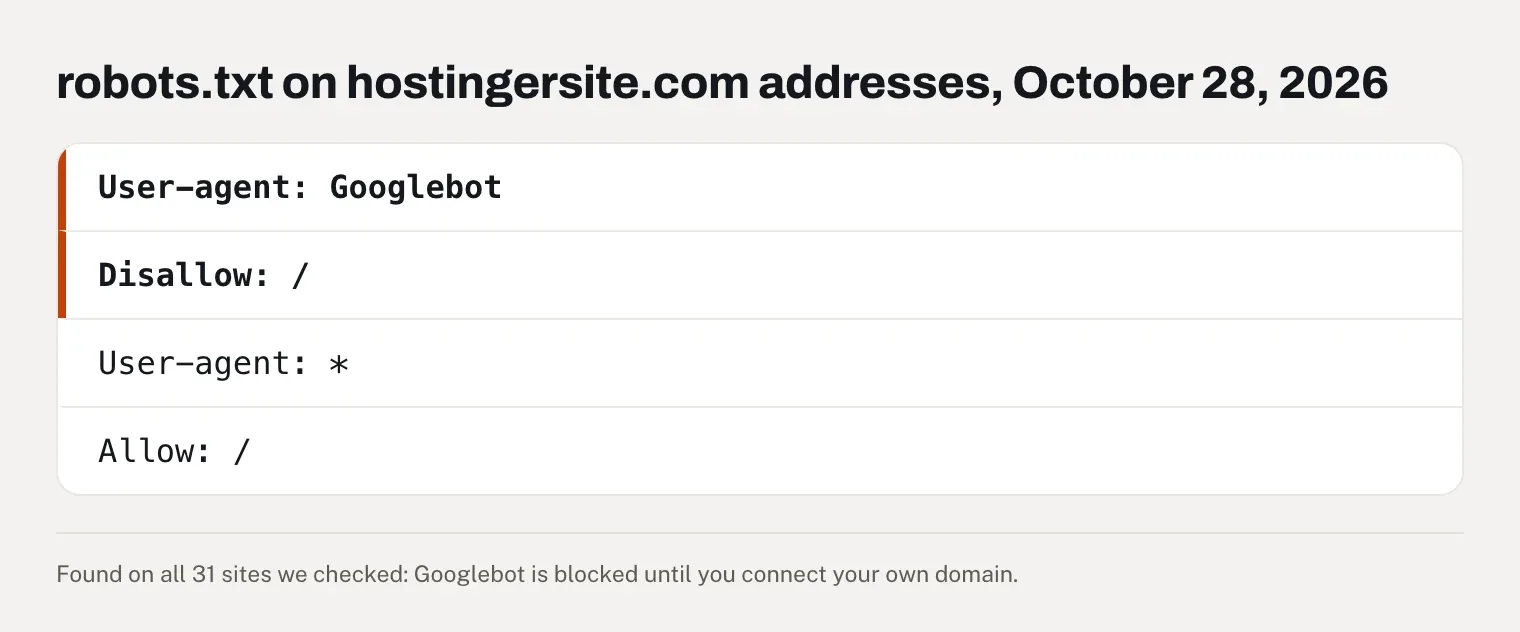
The finding that matters most for a small business: all 31 sites served a robots.txt telling Googlebot to stay out. That's Hostinger's policy for the free hostingersite.com address: "Search engines aren't invited to index the free subdomain" (publishing and domains). A site on the free address won't make it into Google's index, however good it is. You need your own domain, free the first year with an annual plan, then $19.99 a year for a .com at Hostinger (.com pricing). Once it's connected, run your key pages through our free indexability check to see what Google receives.
How much does Hostinger AI Builder cost?
On October 28, 2026, Hostinger AI Builder costs $2.49 a month on Premium, $3.49 on Unlimited and $7.99 on Cloud Startup, before tax. Those prices require a 48-month term paid upfront: $119.52, $167.52 or $383.52 at checkout. The plans renew at $10.99, $16.99 and $25.99 a month.
Plan, October 28, 2026 | 48-month price | Paid upfront | Renews at | Websites | AI credits with a new plan |
|---|---|---|---|---|---|
Premium | $2.49/mo | $119.52 | $10.99/mo | 3 | 250 (500 during Black Friday) |
Unlimited | $3.49/mo | $167.52 | $16.99/mo | Unlimited | 500 (1,000) |
Cloud Startup | $7.99/mo | $383.52 | $25.99/mo | Unlimited | 1,000 (2,000) |
Every plan includes hosting with SSL, plus a free domain and business mailboxes for the first year (two mailboxes per site on Premium). Unlimited and Cloud Startup add "Priority 24/7 expert support" and list ecommerce (AI Builder pricing). The page states that "Prices are listed without VAT," and the checkout adds tax based on where you live.
Four checkout terms for one plan
Premium term | Monthly price | First payment, before tax | What the checkout shows next |
|---|---|---|---|
1 month | $12.19 | $12.19 | $12.19 a month, no free domain |
12 months | $3.99 | $47.88 | $10.99 a month, for 12 months |
24 months | $3.49 | $83.76 | $10.99 a month, for 12 months |
48 months | $2.49 | $119.52 | $10.99 a month, for 12 months |
The checkout also puts a value on what it gives away: on the 48-month plan, the first-year domain at $13.99 and the 500 Black Friday credits at $2.50, both struck to $0.
What the plan price leaves out
Four lines to budget on top: the domain from year two ($19.99 a year for a .com), mailboxes after the first year (Hostinger's Business Email starts at $1.59 a month per mailbox on renewal), extra credits if you use Agentic mode, and a Hostinger Ecommerce subscription if you sell online. Our page on what a website costs puts these lines next to agency and freelancer quotes.
The renewal price, and what the next four years cost
This is the number the title promised. On Premium, the first four years cost $29.88 a year. From year five, the same plan costs $131.88 a year (12 × $10.99).
Premium, before tax | Plan | .com domain | Total |
|---|---|---|---|
Years 1 to 4 | $119.52 (48 × $2.49) | $59.97 (free in year 1, then 3 × $19.99) | $179.49 |
Years 5 to 8 | $527.52 (48 × $10.99) | $79.96 (4 × $19.99) | $607.48 |
The other plans follow the same curve. Unlimited goes from $167.52 for four years to $815.52 for the next four (48 × $16.99), and Cloud Startup from $383.52 to $1,247.52 (48 × $25.99). Shorter terms jump sooner: a 12-month Premium plan costs $47.88 the first year and $131.88 the second, 2.75 times more.
Even the renewal term is unclear. The pricing page says Premium "Renews at $10.99/mo for the same term." The checkout, the same day, said "$10.99/mo for 12 months" on the 12-, 24- and 48-month options. The terms of service allow a renewal equal to your last period, your first period "or any shorter subscription period." The monthly rate is $10.99 either way; what changes is whether you're charged $131.88 or $527.52 at once.
Renewal prices can still change
Nor is $10.99 locked in. The same terms say Hostinger "expressly reserves the right to change or modify its fees (including Services' renewal fees displayed at this Site at the time of your first purchase)." One Trustpilot reviewer from Paraguay describes the full cycle on October 21, 2026: "In 2021, I purchased the basic hosting plan at a promotional price of USD 143.52 for four years. In 2026, I renewed my subscription for another four years at the regular price of USD 335.52." A few months later, the price shown for the 2029 renewal had gone up "by 57.23% without any prior notice," they write. On Reddit in May 2026, a Business plan customer posted a similar sequence: $44.53 for the first year in 2023, renewals at $143.88, then a new rate of $203.88 "for the exact same services" (r/Hostinger). Another customer in that thread says support told them to renew for 24 or 48 months if they wanted the monthly rate to stay put.
To be fair to Hostinger, the renewal price is on the plan card and in the checkout before you pay, and one reply in that thread asked exactly that: "Isn't the renewal prices right there?" In the complaints above, the surprise came later: the rate shown for a later renewal was higher than the one listed at signup.
Watch the date too. Hostinger charges a renewal "from 30 (thirty) to 0 (zero) calendar days before" the end of the term, and has "the right, but not an obligation," to email you first; customers on monthly subscriptions "will not be informed." On October 13, 2026, a US reviewer on Trustpilot described a domain renewed "a month before it expired" and a refund refused because it was "a non-refundable purchase."
If you'll stay, the 48-month term at $2.49 is the cheapest way in, and even $10.99 a month sits below the $15 to $45 a month we found for no-code builder plans in September 2026 (website costs). Put the renewal date in your calendar six weeks ahead and check the price your dashboard shows. If you plan to leave, turn off auto-renewal before the 30-day charge window opens. Buying a fresh plan at the new-customer price doesn't carry the site over for free. Hostinger points Manual sites to its "automated paid migration tool," without store data, while Agentic sites can use a free duplicate feature; both need the original plan to be active (buying a new plan instead of renewing).
Refunds: 30 days, with exceptions
Hostinger's money-back window is 30 days, and the refund policy (revised October 15, 2026) carves out the parts an AI Builder buyer is most likely to touch:
"Hostinger AI Builder credits" are never refundable, top-ups included.
An Agentic plan is refundable only if "fewer than 30 messages/prompts (AI credits) have been used." The AI Builder page puts the same limit, in the new units, on all paid plans: fewer than 1,500 credits.
Free domains that come with a deal are non-refundable.
Hosting is refundable "except first payment after Free Trial." The policy doesn't say whether the seven-day AI Builder trial counts as that free trial, so ask support in writing before you pay at the end of one.
A refund also ends the service on the spot: "As soon as a refund is processed, the service is terminated, and all associated data is erased immediately" (cancelling a plan). Export what you can first.
Hostinger AI website builder review: pros and cons
What it does well
The entry price is low if you prepay: $119.52 covers four years of hosting, with a domain and mailboxes for the first year.
Manual mode is easy to pick up and uses no credits, so building a brochure site adds no AI costs to the plan.
New Agentic projects publish complete HTML, and Hostinger's three plumbing templates each came with a title, a meta description, a canonical URL and Plumber structured data.
Agentic mode builds real apps (user accounts, a database, Stripe payments, file storage), and you can edit the code and export it.
SSL and a CDN come set up, and published sites get daily backups (publishing and domains).
Plenty of customers are happy: 87.1% of its 73,531 Trustpilot reviews give five stars.
What's the downside of Hostinger AI Builder?
The main downside is the renewal: Premium costs 4.4 times more for its second four years than its first, and the terms let Hostinger change renewal prices. Then comes lock-in, since a Manual site can't take its design with it and an Agentic export leaves the database contents behind.
The renewal. $119.52 for four years, then $527.52 for the next four at today's prices, before tax. This matters if the site has to last.
Credits. 250 once, against Hostinger's own estimate of 250 to 500 for a simple business page. Top-ups expire after three months, and restoring a version refunds nothing.
Leaving. Manual sites export content only, and only to WordPress. Agentic projects export code without data, with no GitHub sync.
A one-way switch from Manual to Agentic, decided once per site.
The free address is invisible to Google. Its robots.txt blocks Googlebot, so a custom domain is mandatory in practice.
The training clause. Hostinger's terms let it use your prompts and the generated output "to develop and improve the Services, including as part of the design, training and development process for machine learning models."
A lapsed plan takes the site down at once. "Your project becomes unavailable immediately if your hosting plan expires, until you renew it." After a 30-day window, the AI Builder data is gone for good.
Is Hostinger legit?
Yes. Hostinger is a real, long-running company: founded in Lithuania in 2004, private, with more than 5 million customers by its own count and a 4.6 Trustpilot score. Its best-known security incident dates from 2019. The real concern is pricing: renewals cost several times the first term, and the terms let those prices change.
Hostinger began in November 2004 in Kaunas as a small company called Hosting Media, and it's now headquartered in Vilnius. It serves customers in more than 150 countries from data centers in Europe, North America (Phoenix, Boston and Asheville), Asia and Brazil. It has never been listed on a stock exchange, and a private equity firm holds a minority stake of around 30% (About Hostinger).
The incident dates from August 2019. An attacker used an authorization token found on one server to reach an internal API database holding "client usernames, emails, hashed passwords, first names, and IP addresses" for 14 million users. Hostinger reset every password and said payment data, handled by outside providers, wasn't touched (Hostinger's disclosure). The passwords had been hashed with SHA-1, which TechCrunch noted was outdated; a spokesperson told Threatpost that the reset passwords use SHA-256.
The product itself keeps moving: Hostinger publishes its product updates week by week, and the week 42 update, in mid-October 2026, separated test data from live data in Agentic projects, which answers one of the complaints you'll read below.
Hostinger AI Builder reviews on Reddit and Trustpilot
Trustpilot: 4.6 overall, a different picture on the builder
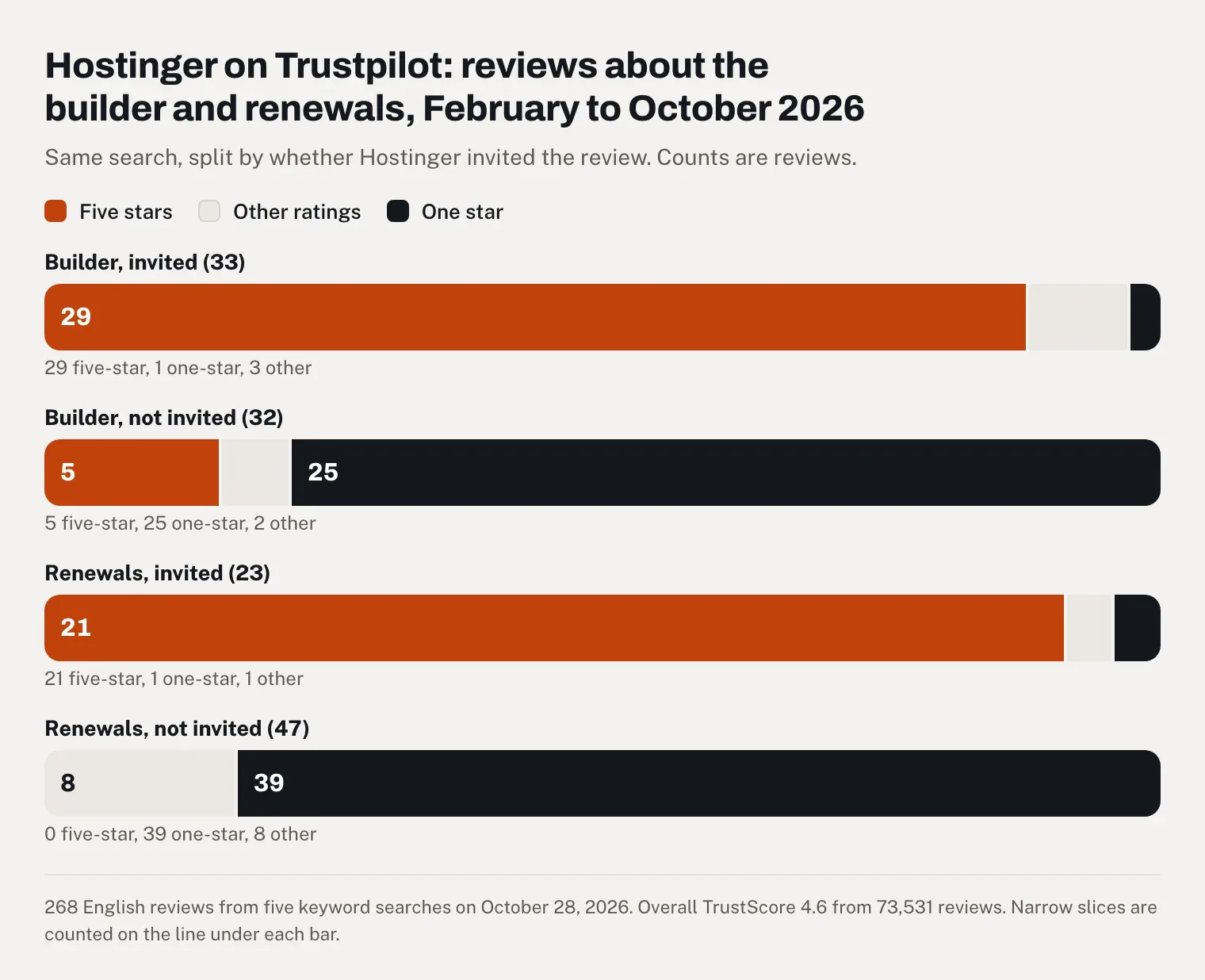
On October 28, 2026, Hostinger's Trustpilot page showed 4.6 out of 5 from 73,531 reviews, 87.1% of them five-star and 7.0% one-star, and Hostinger had replied to 1,696 of its 1,714 negative reviews. To see what that score says about the builder, we searched its English reviews for "website builder", "AI builder", "Horizons", "renewal" and "renew price," took the first three pages of each search and kept 268 unique reviews, dated February 27 to October 28, 2026. Trustpilot marks whether each review followed an invitation from the company.
Reviews that mention… | Invited by Hostinger | Not invited |
|---|---|---|
The builder (65 reviews) | 33: 29 five-star, 1 one-star | 32: 5 five-star, 25 one-star |
Renewals (70 reviews) | 23: 21 five-star, 1 one-star | 47: no five-star, 39 one-star |
This isn't a random sample, and unprompted reviews lean negative everywhere: an angry customer goes looking for a review site, a happy one waits to be asked. What the split shows is how the 4.6 is built. The satisfied voices mostly arrive by invitation, and the builder's critics mostly don't.
The complaints are specific. "The builder itself would confuse a genius it took 3 hours just to get an image to fit the page," a UK reviewer wrote on October 25, 2026. On October 16, a US reviewer described Horizons credits draining: "You'll use your whole monthly allowance (70 credits or now 3500 credits) just trying to do one thing." Another, who bought 100 credits for Horizons on May 21, 2026, had used a little under half and came back to find the rest gone: "there was no indication that they would expire." The praise is specific too. An invited US reviewer who had moved from Wix wrote in September: "it took me 8 hours to build it," adding that for the first time they didn't have to pay someone $1,500 for a website.
Reddit: praise for the speed, warnings about the exit
The thread that ranks for this search, "Is the Hostinger A.I Site Builder Worth It?", dates from July 2025, before the two modes merged. A non-technical user found it "worth for a non tech person like me." Another said the sites built with the regular editor couldn't be exported, while a Horizons user had exported the code "successfully multiple times." In September 2025, a developer answered "Absolutely NO," calling the designs "extremely generic" and the editing limited to "boxes you can drag along." Some of that now applies only to Manual mode, since Agentic mode has a code editor.
In January 2026, the warning in another thread was about money: "Hostinger sting you after the first year with MASSIVELY increased fees, and if you've used their AI builder, you can't even move your site without rebuilding it" (r/Hostinger). When someone replied that the four-year prepaid price avoids that, the same user answered: "Just pushes the problem 4 years down the line."
And in March 2026, a user whose "AI mode helped me build a nice static site for my non-profit in under an hour" hit a wall with forms and logins: no database export or backup, and a test database "corrupted by their AI" (r/Hostinger). Hostinger has moved since then. Its documentation now lists daily backups of published sites, database included, restored by support on request, and test and live data were separated in October.
Is Hostinger better than Bluehost?
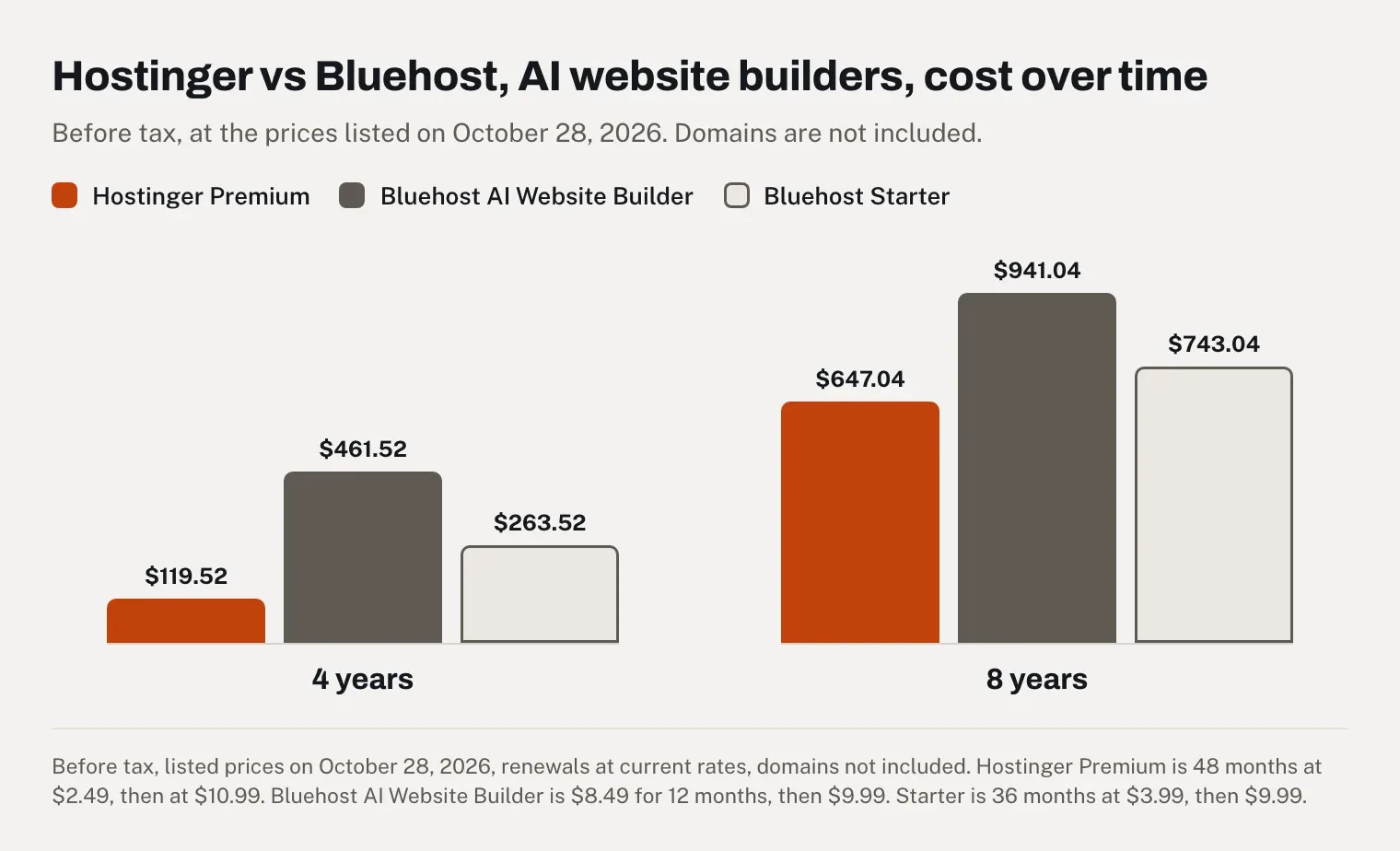
For an AI-built site you'll keep for years, Hostinger is cheaper: $119.52 for four years of Premium, against $461.52 for Bluehost's AI Website Builder over the same period at its listed rates, before tax. Bluehost answers with AI credits that renew every month and a WordPress-based plan with WooCommerce.
October 28, 2026, before tax | Hostinger AI Builder (Premium) | Bluehost AI Website Builder (Get Online) |
|---|---|---|
Free trial | 7 days, no card, one project, can't publish | 14 days, no card, temporary domain, 10 AI edits |
First term | $2.49/mo for 48 months ($119.52) | $8.49/mo for 12 months ($101.88), with a 15% offer that ends November 30, 2026 |
Next price | $10.99/mo | $9.99/mo on a 12-month term, per Bluehost's blog |
AI allowance | 250 credits once (500 during Black Friday) | 20 AI credits a month, plus 10 in the first month |
Four years | $119.52 | $461.52 |
Eight years | $647.04 | $941.04 |
Underneath | Hostinger's own editor (Manual) or React code (Agentic) | WordPress, with WooCommerce and Yoast SEO Premium |
Refund | 30 days; credits never refunded | 30 days on hosting; the free domain's regular price is deducted |
The math, at today's listed rates: Hostinger Premium costs $119.52 + $527.52 = $647.04 over eight years. Bluehost's AI Website Builder costs $101.88 the first year (12 × $8.49), then $119.88 a year if it renews at its 12-month rate of $9.99, so 101.88 + 3 × 119.88 = $461.52 over four years and $941.04 over eight (Bluehost AI Website Builder, Bluehost's cost guide). Bluehost's Starter shared hosting, which also includes its AI site creation tools, comes to $263.52 over four years (36 × $3.99, then 12 × $9.99) and $743.04 over eight (Bluehost pricing). Both companies can change their regular rates by renewal time, so treat year five onward as an estimate on both sides. The two AI allowances use different units. Compare what each includes, not the numbers.
Choose Hostinger if the total over four to eight years matters most and you're happy to stay. Choose Bluehost if you want WordPress underneath and AI edits that refill every month.
Is Hostinger worth it? The case of a plumber in Denver
Hostinger is worth it for a simple business site built in Manual mode and prepaid for 48 months by someone who expects to stay. It's poor value if you'll lean on Agentic mode, since a new plan includes one batch of 250 credits, or if you may want to leave after the first term.
Take a plumber in Denver who wants what most trades need: services with starting prices, the towns covered (Aurora, Lakewood, Littleton, Englewood), a number you can tap to call and a quote form. Manual mode covers that from one of Hostinger's plumbing templates, without spending a credit. Agentic mode would do it too, with better structured data on Hostinger's own templates, but each round of corrections costs credits, and Hostinger's estimate for a simple business page (250 to 500) already meets or exceeds what Premium includes.
The cost: four years on Premium, with a .com domain kept after the free first year, come to $179.49 before tax ($119.52 + 3 × $19.99), about $3.74 a month. Add a mailbox if you keep it after year one. The next four years come to $607.48 at today's renewal prices.
Settle two things before paying. Connect the domain on day one, because the free hostingersite.com address blocks Googlebot. And decide now whether this site may ever move: Manual mode's WordPress export takes the text and images and leaves the design. Our small business website builder page lists what a trade site should answer on its first screen, whichever tool you use.
Look elsewhere if you need an app whose data can leave with it; our reviews of Base44 and Replit Agent cover that ground, and our Lovable alternatives test compares how locked in each tool leaves you. If design comes first, read our Framer AI review. For a large store, Shopify or WooCommerce fits better.
Where Eqlo fits, if you'd rather not prepay four years
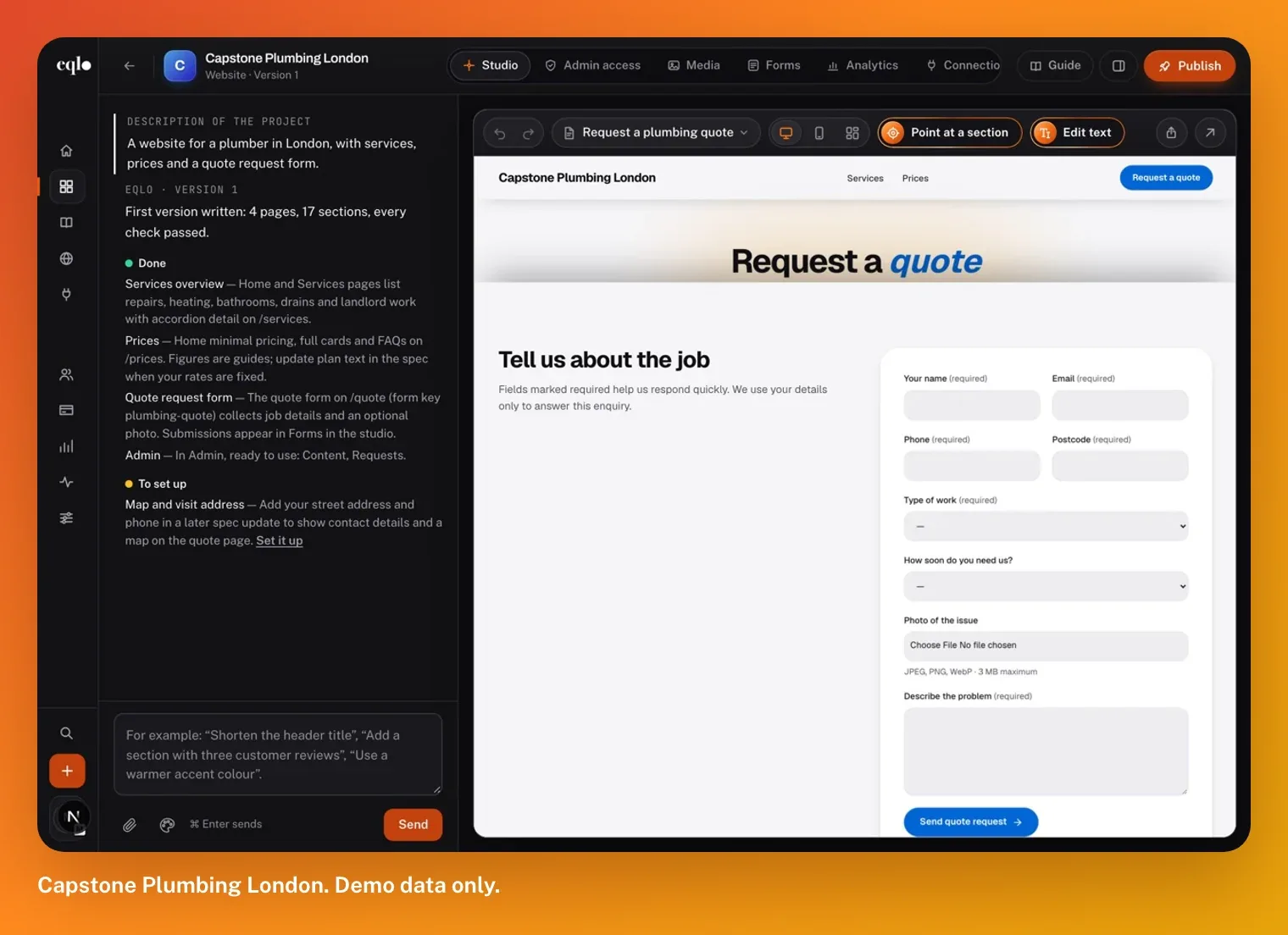
This is my product, so read this section as such. Eqlo is an AI website builder that starts from one sentence about your business, writes the pages and the copy, prices included, then publishes the site with its own admin. On our page for trades and home services, the sentence "A website for a plumber in London, with services, prices and a quote request form" produced four pages and seventeen sections, with a quote form that accepts a photo of the problem. Each request is emailed to you and stored in the site's admin.
Every page is checked before it goes live, a single H1 included, and the full HTML is there on the first load. A shop with Stripe and online bookings come with every plan, Eqlo takes no commission on sales, and every plan, Free included, can send a complete Next.js project to your GitHub.
On October 28, 2026, Free costs $0 for five projects on an eqlo.dev address with $3 of AI a month, with no card and no time limit. Plus costs $19 a month, billed monthly, with your own domain and $30 of AI each month (Eqlo pricing); the domain itself is billed separately. There's no multi-year prepayment, so four years of Plus cost 48 × $19 = $912, against $119.52 on Hostinger Premium. If the lowest four-year price is what you're after, Hostinger wins that comparison. What the $19 pays for is different. The AI budget refills every month, and layout tweaks or text edited in the preview don't touch it. If the budget runs out, only AI requests wait for the 1st of the month while the sites stay online, and if you stop paying, the site stays live on its eqlo.dev address.
Comparison established on October 28, 2026 from public offers. If you spot an error, write to hello@eqlo.app.
Frequently asked questions
Is Hostinger AI Builder free?
For seven days, without a card. The trial covers one project and includes AI credits for Agentic mode, but "trial projects can be built and previewed but not published, and a trial store can't take payments" (plans and credits). To keep the project and put it online, you buy a hosting plan.
Can you export a site built with Hostinger AI Builder?
Partly, depending on the mode. Agentic projects export as a ZIP of the full codebase on a paid plan, without the database contents and with no way to sync changes back. Manual sites export their pages, text, images and files to WordPress, while the layout, store, forms, submissions and SEO settings stay on Hostinger. There's no FTP, SFTP, SSH or GitHub sync in either mode.
Is Hostinger AI Builder good for SEO?
On your own domain, new Agentic projects are well set up: every page arrives as complete HTML with a title, a description, a canonical URL and structured data. Manual pages carry their text too. Older Horizons projects send an empty page until JavaScript runs, so ask Hostinger to move them to server-side rendering. The free hostingersite.com address blocks Googlebot on all 31 sites we checked. Hostinger generates the sitemap and robots.txt files and you can't edit them, and AI-training crawlers are blocked on custom domains (SEO documentation).
Can you switch from Agentic mode back to Manual mode?
No. Hostinger's help center says "switching from agentic mode to manual mode is not supported." The other direction works once: it creates a new Agentic copy of the Manual site, counted as an extra website on your plan, and sites with a store can't make the switch.
What happens to the site if you don't renew?
It goes offline the day the plan expires: "Your project becomes unavailable immediately if your hosting plan expires, until you renew it." Renewing within 30 days brings it back (reactivating an expired plan). After that, the data is deleted, and since AI Builder sites aren't part of Hostinger's downloadable backups, keep your own copy of the content while the plan is active.
Does Hostinger use your content to train its AI?
Its terms allow it. Hostinger's terms of service let it use what you type and what the AI generates "to develop and improve the Services, including as part of the design, training and development process for machine learning models." Separately, AI-training crawlers from other companies are blocked from AI Builder sites on a custom domain, according to the SEO documentation.
My verdict
Hostinger's AI Builder does two jobs at two very different prices. Manual mode is a fair deal for a small business site: cheap if you prepay, quick to learn, free of credit worries, and tied to Hostinger for as long as the site lives. Agentic mode is a capable app builder with sound technical choices underneath, sold with a credit allowance that Hostinger's own estimate uses up on one simple page. If you go ahead, pick Manual for a brochure site, connect your own domain on day one, prepay the 48 months only if you're sure you'll stay, and put the renewal date in your calendar six weeks early, because the second four years cost 4.4 times the first.
Sources: Hostinger's AI Builder page, AI Builder pricing page and checkout, .com domain and Business Email prices, help center articles (Manual and Agentic modes compared, switching to Agentic mode, exporting to WordPress, Agentic mode credits, the shared credit balance, hosting requirements, reactivating an expired plan, buying a new plan instead of renewing, cancelling a plan), AI Builder developer documentation (plans and credits, publishing and domains, SEO, code editor and export, updated October 20, 2026), refund policy (October 15, 2026), special terms, universal terms of service (September 29, 2026), About page, launch post of August 18, 2026, week 42 product update and 2019 security disclosure, all read on October 28, 2026; Bluehost's AI Website Builder page, pricing page and September 15, 2026 cost guide, read the same day; the reviews by Cybernews (updated October 20, 2026), HostScore (September 14, 2026), WPShout (August 29, 2026) and Website Planet; TechCrunch and Threatpost on the 2019 incident; r/Hostinger threads from July 2025 and from January, March, May and September 2026; 268 English Trustpilot reviews of Hostinger dated February 27 to October 28, 2026; my own test of both build modes; our check of 31 Hostinger sites on October 28, 2026, with Lighthouse mobile runs on the seven templates and published sites drawn from Common Crawl's CC-MAIN-2026-39 crawl. If you spot an error, write to hello@eqlo.app and we'll correct it.