

Lovable vs Replit: I built the same app in both, then compared the time and the price
Four published tests timed the same brief in Lovable and in Replit. Lovable reached a working app first every time. The year-one bill then depends on how each tool charges the fixes.

By David RieuFounder of Eqlo

If you're choosing between Lovable and Replit for an app, their pricing pages won't settle it: Lovable sells credits and Replit bills each request by the effort behind it, so neither tells you what one app will cost or how long it will take. Here is Lovable vs Replit measured on identical briefs. Lovable reached a working first version sooner in all four published tests that timed both tools, by margins from under a minute to 45 minutes. A single build cost between about $0.30 and $4 in the tests that priced one. After that, changes and fixes set the bill, and Replit's is the harder one to predict.
I founded Eqlo, which competes with both tools, so read what follows with that in mind. I built the same app in Lovable and in Replit, but I didn't time the builds or note the credits, and I won't quote numbers from memory. Every figure here has a published, dated source: tests run by other people, user reports, the tools' own pages (read on October 22, 2026) and two checks our team ran on live apps. Those tests found the four things that surprised me: how fast Lovable puts a first version on screen, how quickly Replit's credits go once its agent works alone, the loops where each fix breaks something else, and how much search work both tools leave to you. For each tool on its own, see our Lovable review and our Replit Agent review.
Lovable vs Replit: the quick verdict
Choose Lovable if:
you want a working web app on screen within minutes, and its looks matter;
you'd like a rough idea of what a request costs before you send it;
nobody on your team will open a terminal;
the app is a standard web app with sign-ups, a database, a dashboard and payments.
Choose Replit if:
the app is really a server: scheduled jobs, a bot, webhooks from other services or a worker that runs all day;
you want the agent to read its own error logs and repair what it broke;
you'll open the code and the terminal yourself when the agent stalls;
you need a mobile app that shares the web app's database.
My short version: Lovable for a web app, Replit once the backend is the product.
The comparison at a glance
Lovable | Replit | |
|---|---|---|
Time to a working version, 4 timed tests | First in all four | Behind by under a minute to 45 minutes |
Fixing its own errors | You paste the error, with 10 free "Try to fix" uses | Reads its logs and repairs itself (3 of 6 tests) |
Cheapest build measured | 1.20 credits, about $0.30 | 31% of a day's free credits, no dollar figure |
Design scores | 9 of 10 and 10 of 10 | 5 of 10 and 8.5 of 10 |
Entry plan on October 22, 2026 | Pro, $25 a month or $250 a year | Core, $20 a month or $216 a year |
Price of a request | Example prices published | Set by the effort, after the work |
What it builds | React web apps with a built-in backend | Web and mobile apps in many languages, with servers that run all day |
How I compared them
I started from the five pages that rank for this search, then looked for every other report of one app built in both tools. Six tests publish the brief and at least one dated measurement, and they're listed below. Superblocks' comparison says it built the same dashboard in both tools but gives no times or costs, and its two incidents read almost word for word like DesignRevision's, so I count that test once. The Level Up Coding test describes Replit's checkpoint pricing, replaced in June 2025, so I only quote what it says about fixes.
Two caveats. Each test is a single run per tool, and the same prompt can take a few minutes more or less on another day. Some authors also sell something nearby: Tessellate Labs sells a $5,000 production hardening sprint, and DesignRevision a code generator. That doesn't make their timings wrong, but you should know it.
Six tests, one brief each
Test | The app | Lovable | Replit |
|---|---|---|---|
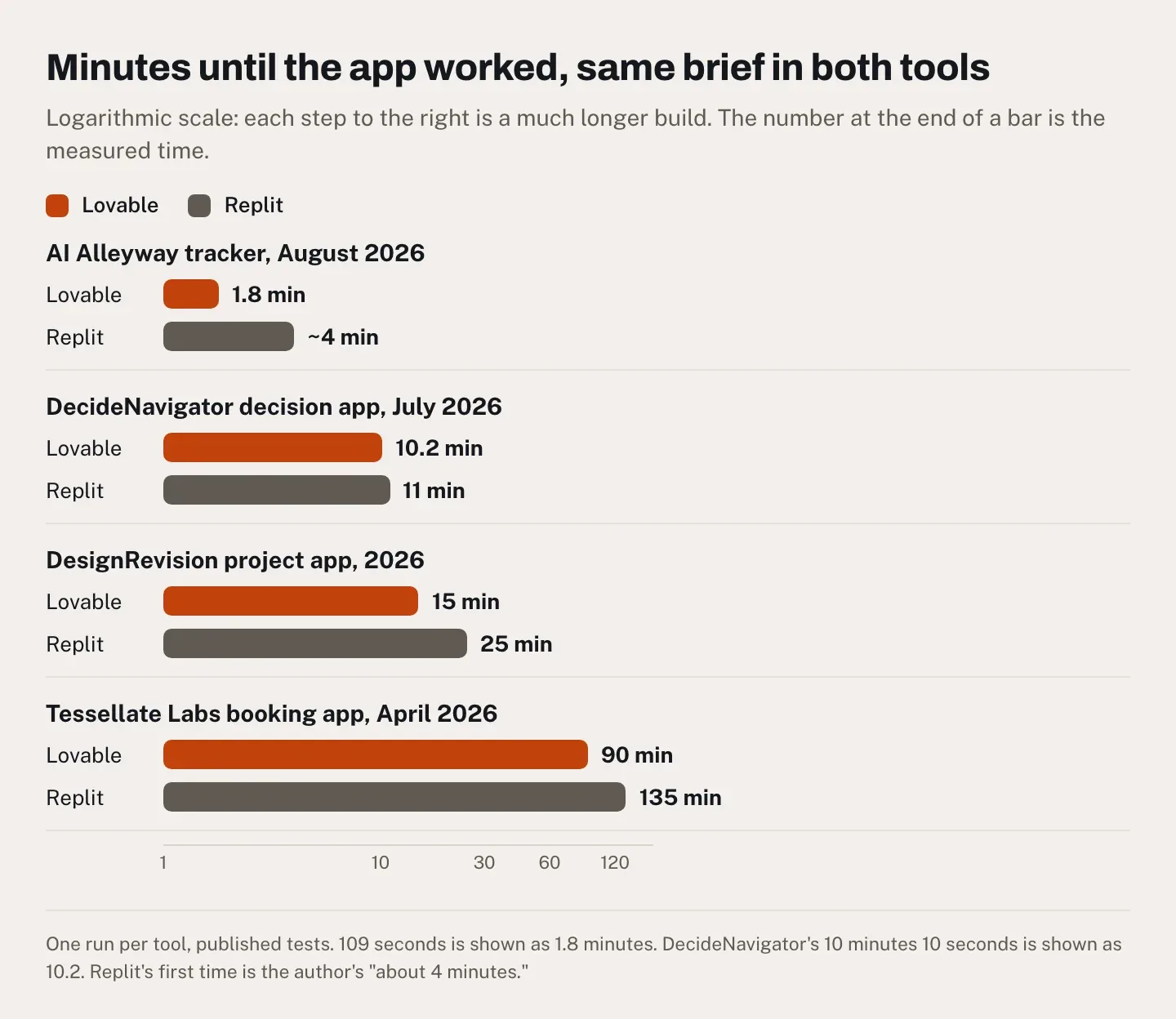
AI Alleyway, August 12, 2026 | Subscription tracker with 6 requirements, one prompt | 109 seconds, 1.20 credits, 6 of 6 met | About 4 minutes, 31% of a day's free credits, 6 of 6 met |
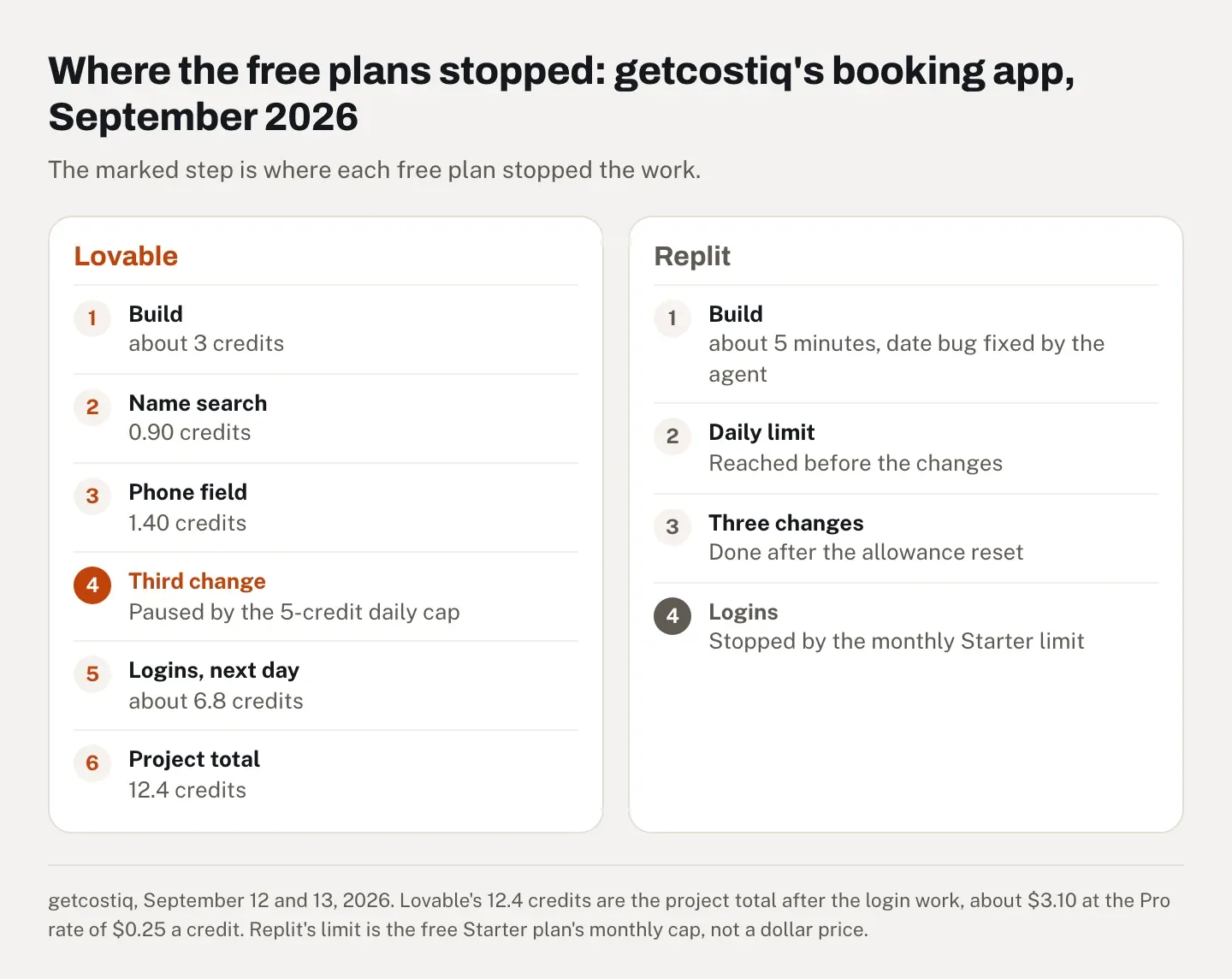
getcostiq, September 12 and 13, 2026 | Booking app with an admin table, and an AI Q&A app | About 3 credits per app, no errors | About 5 minutes per app, then the daily limit |
DecideNavigator, July 29, 2026 | Private decision app with logins and weighted scores, on free plans | 10 minutes 10 seconds, all 5 daily credits | 11 minutes, the day's single Agent credit |
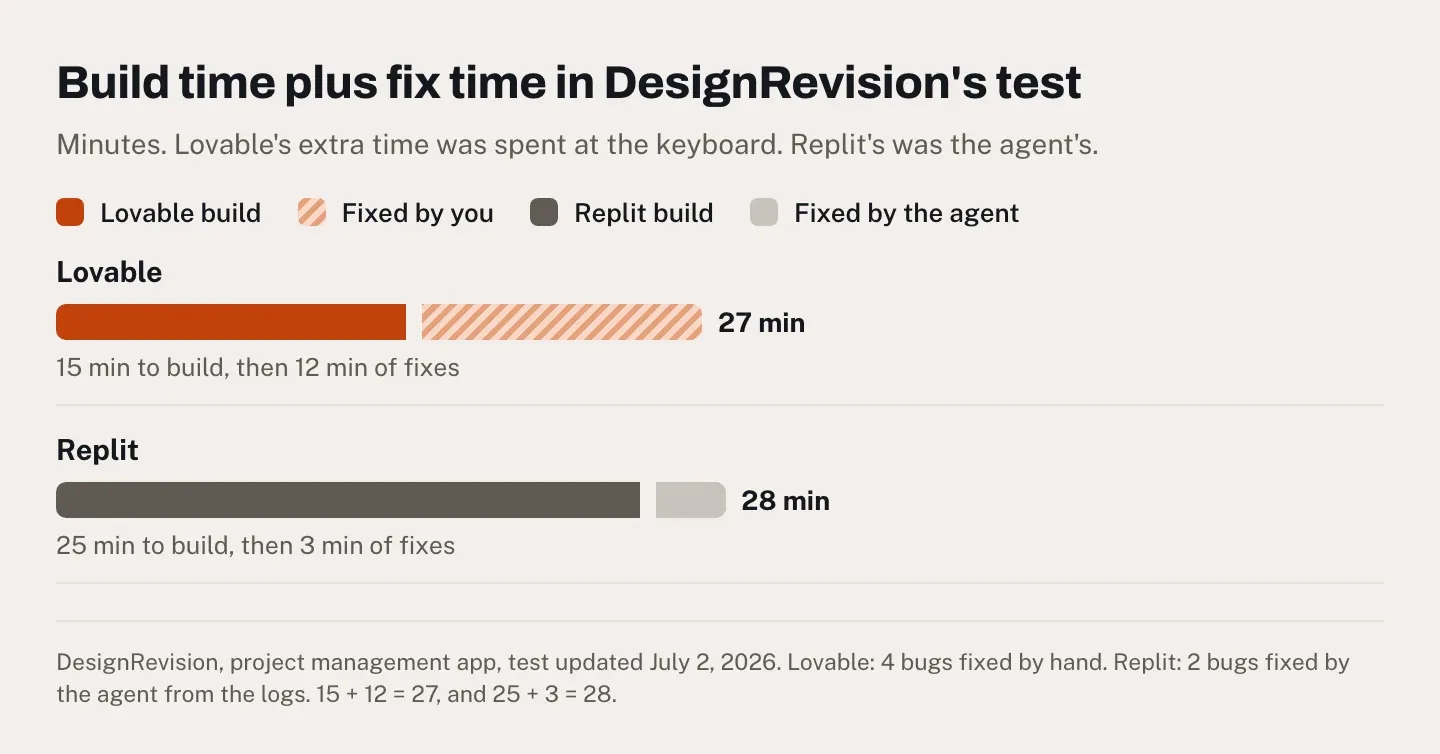
DesignRevision, updated July 2, 2026 | Project management app with logins, stats, a project list and settings | 15 minutes, then 4 bugs fixed by hand in 12 | 25 minutes, then 2 bugs fixed by the agent in 3 |
Tessellate Labs, run in April 2026 | Booking app for coaches: Google login, a public page, Stripe payment and email | 90 minutes and 22 prompts to a shippable version | 135 minutes and 31 prompts |
Pawel Jozefiak, October 17, 2025 | Task manager with logins | Prototype in 90 seconds, $78 for the whole project | $127 for the whole project |
Lovable came first in every test that timed both tools, but the margin varies a lot: under a minute at DecideNavigator, about 2 minutes at AI Alleyway, 10 at DesignRevision and 45 at Tessellate Labs. The gap was widest in the tests that needed many rounds after the first prompt. Tessellate counted 22 prompts for Lovable against 31 for Replit.
The head start comes from how Lovable works. It always starts from the same web stack, React with a backend built on Supabase's open-source foundation (Lovable docs), and its first screen appeared in 45 seconds at DesignRevision. Replit builds a frontend and a backend together by default (Replit docs) and isn't tied to one stack. Its first screen took 3 minutes. That speed was my first surprise. For an app with a lot happening on the server, Replit's slower start buys something back.
Is Lovable faster than Replit?
Yes, to a first working version. In the four published tests that timed both tools on the same brief, Lovable finished first every time, from 109 seconds against about 4 minutes on a small tracker to 90 minutes against 2 hours 15 minutes on a booking app with payments. Count the fixes, though, and the gap can close.
DesignRevision shows how. Lovable's app had four bugs, and the tester spent 12 minutes pasting errors into the chat. Replit's had two, and its agent fixed them from the logs in 3 minutes. That makes 15 + 12 = 27 minutes for Lovable against 25 + 3 = 28 for Replit. The difference is whose minutes they were: Lovable's 12 were a person's, at the keyboard, and Replit's 3 needed nobody.
Replit repaired itself in two other tests. At DecideNavigator, it hit a version mismatch between two code libraries, fixed it without a prompt and carried on. At getcostiq, it caught its own date-format bug. Lovable built both of those apps without a visible error.
What did the same app cost in each tool?
A first build cost little in both. AI Alleyway's tracker used 1.20 Lovable credits, about $0.30 at the Pro plan's rate, and nearly a third of a day's free Replit allowance, with no dollar figure shown. DesignRevision put its full app at about $4 on Lovable and $2 on Replit. The difference shows up later, in the fixes.
The conversion: Lovable Pro costs $25 for 100 monthly credits, so a credit is worth $25 ÷ 100 = $0.25, and 1.20 credits come to 1.20 × $0.25 = $0.30. Replit's free plan counts usage as a share of the daily allowance, not in dollars.
getcostiq's booking app is the closest to what a small business would build. Lovable built it in one pass, then charged 0.90 credits for a name search and 1.40 for a phone field, before its 5-credit daily allowance paused the third change. Logins with private data took about 6.8 more credits after three clarifying questions. The project then stood at 12.4 credits, or 12.4 × $0.25 = $3.10 at Pro rates. Replit built the app in about five minutes and fixed a date bug it spotted itself. It made the three changes after its daily allowance reset, then hit its free plan's monthly limit while setting up logins. For the second app, an AI question-and-answer tool, Replit asked for your own OpenAI key or the Core plan.
The one test that kept going shows where the money goes. In October 2025, Pawel Jozefiak built the same task manager in Lovable and in Replit. Lovable gave him a working prototype in 90 seconds, then he used up his included credits in about two hours of refinements. His total was $78: the $25 subscription plus $53 of extra credits, spent on debugging loops. On Replit, he watched the meter pass $35 while the agent was still working, and the project ended at $127. Both figures are his own, from before Replit's Free Mode.
That pace of spending was my second surprise. Replit prices each request by the effort behind it, after the work. Its recap of that change, from July 2025, says simple requests "may cost as little as $0.06" while more involved ones "will usually cost more than $0.25, sometimes resulting in charges of multiple dollars depending on the size of the work." Since August 2026, Free Mode covers everyday requests at no credit cost within limits, and Replit asks you to confirm before a paid action starts (AI billing docs). Lovable doesn't show a price in advance either, but it publishes examples to estimate from: 0.50 credits to make a button gray, 1.20 to add authentication (Lovable pricing).
Lovable vs Replit pricing: month one and year one
These are the plans that matter for one person building one app, from Lovable's pricing page, Replit's pricing page and Replit's Starter plan documentation, on October 22, 2026.
Lovable | Replit | |
|---|---|---|
Free plan | 5 credits a day, 30 a month at most | Starter: daily Agent credits up to a monthly cap, light builds only |
Not on the free plan | Your own domain, and access to the code (editing, download) | Full builds, Stripe and other connectors, Plan Mode, more than 1 published app |
Entry plan | Pro: $25 a month or $250 a year, 100 credits plus 5 a day | Core: $20 a month or $18 billed yearly, with $20 of credits and Free Mode (up to 30 hours of chat) |
Next plan up | Business: $50 a month for the same credits, plus single sign-on | Pro: $100 a month or $90 billed yearly, $100 of credits |
How requests are billed | Credits by complexity, 1 credit per Plan mode message | By effort, after the work |
When credits run out | Building stops and apps on Lovable Cloud pause until new credits arrive | On Core, extra usage is billed, up to the budget limit you set |
Our Lovable pricing guide details what each credit buys.
One year of the same booking app
Take getcostiq's booking app and keep it online on your own domain for a year.
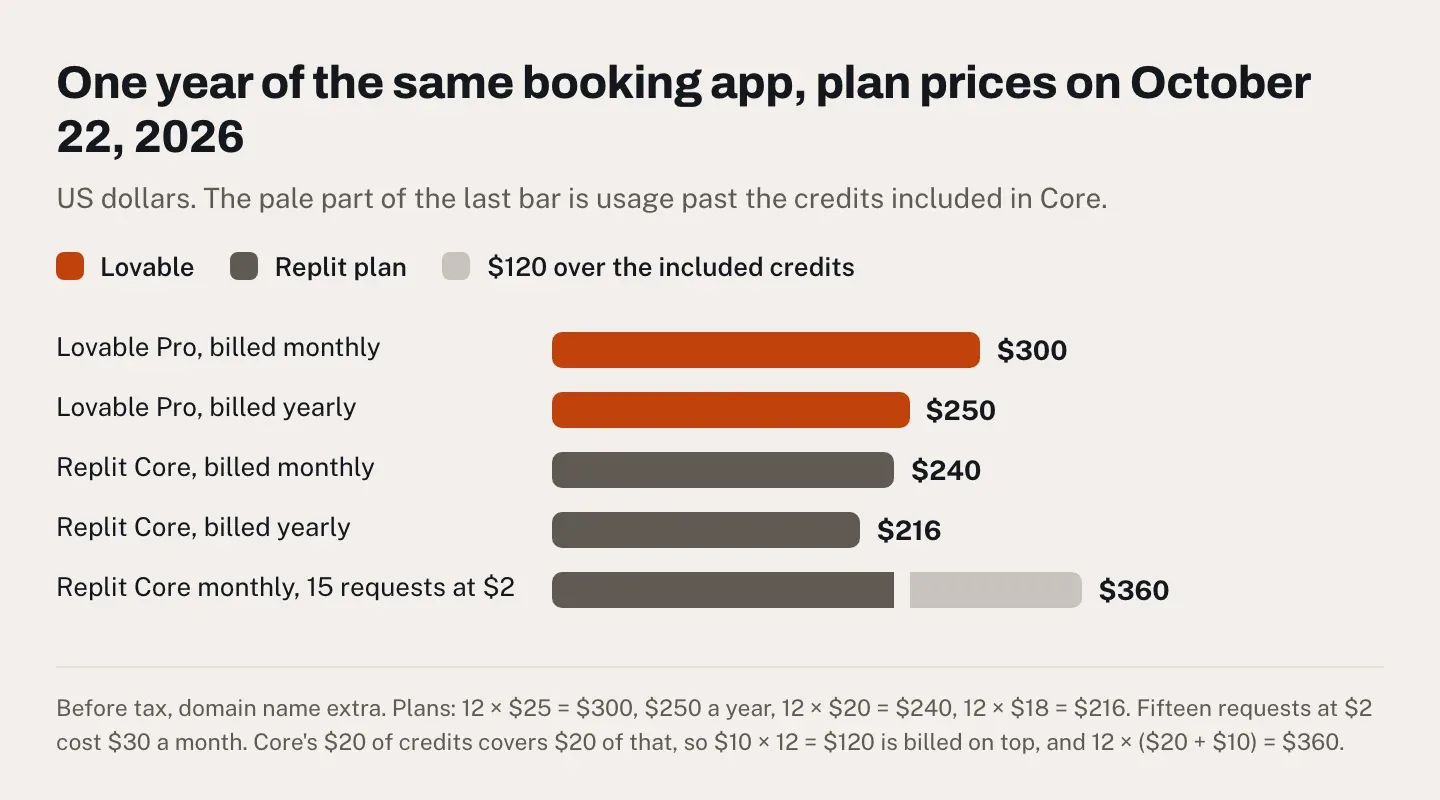
On Lovable, the build fits the free plan: 12.4 credits, spread over three days at 5 a day. Your own domain needs Pro, at 12 × $25 = $300 billed monthly or $250 billed yearly. Its 100 monthly credits then cover 71 to 111 changes the size of getcostiq's (100 ÷ 1.40 and 100 ÷ 0.90), and Lovable says hosting for small apps is usually covered by its monthly Cloud allowance.
On Replit, the free plan can't finish it: logins hit the monthly Starter limit, and the one free published app goes offline after 30 days. Core costs 12 × $20 = $240 billed monthly or 12 × $18 = $216 billed yearly, with $20 of credits a month for publishing and paid agent work.
On plan price, Replit is cheaper by $34 to $60 a year ($250 − $216, or $300 − $240). Usage decides whether that holds. Take 15 paid agent requests a month on Core, the pace we used in our Replit review. At about $0.45 each, the figure Replit Support gave on Reddit for its cheaper paid mode, they cost 15 × $0.45 = $6.75, inside the $20 of credits. At $2 each, the average one Reddit user reported in November 2025, they cost $30, which is $10 over. A monthly-billed year then reaches 12 × ($20 + $10) = $360. Free Mode now keeps some everyday requests off the meter.
Lovable's version of that risk is the message that runs long. In a July 2026 r/lovable thread, a member counted 113 credits for 32 messages, about 3.5 a message. At that rate, Pro's 100 monthly credits last about 28 messages, and 50 more cost $15 as a top-up.
When the AI gets stuck: loops on both sides
Both tools loop. Replit is better at catching its own errors during a build, and Lovable gives you more brakes on a message that runs away. Loops were my third surprise, and most tests that went past the first prompt hit one.
On Lovable, you're the one feeding errors back to the chat. DesignRevision's Stripe bug took three attempts and three credits, and a request for role-based permissions set off a bug loop. The App Builder Index cites a reviewer who spent 40 credits on a row-level security policy a developer would have fixed in nine minutes. Jozefiak writes that the AI would often "CLAIM it fixed something without actually implementing the fix." Lovable's safeguards help, within limits:
"Try to fix" on build errors is free 10 times per account (a quota shared with security fixes), and each use comes back after 24 hours. Beyond that, fixes are billed like any message (chat documentation). One ranking comparison says Lovable doesn't charge when its AI fixes its own mistakes, which holds for those ten only.
A message that passes 20 credits pauses and asks before going on.
You see what a message cost while it runs and afterward, never before.
Going back to an earlier version refunds nothing: "messages you later revert still count" (version history).
On Replit, the loop belongs to the agent and runs on your budget. It fixed its own errors in three of the six tests, and Tessellate Labs found that Replit "recovered fastest because its terminal lets you fix things directly." The risk is the long unattended run. Jozefiak's agent built a complex data-fetching system where a simple API call would have done, then "spent another $30 fixing performance issues IT created." In May 2026, an r/replit user posted that planning while building turned 23 requests into 770 tasks, which they put at $6,376. Both amounts are self-reported.
What helped, in the tests and the documentation:
one change per message, described precisely;
on Lovable, "Try to fix" once or twice, then Plan mode to find the cause, as the debugging guide suggests;
on Replit, a budget limit before a long task and a new chat for each task, the advice Replit Support gave a user stuck on 45 task plans;
in both, a GitHub connection from day one, so every working version has a copy outside the tool.
What Google sees in apps from both tools
Lovable's newer apps send search engines full pages, while many Replit apps send an empty one until JavaScript runs. Both leave the rest of the search work to you, which was my fourth surprise. None of the six tests checked this, so here is what the documentation says and what we measured.
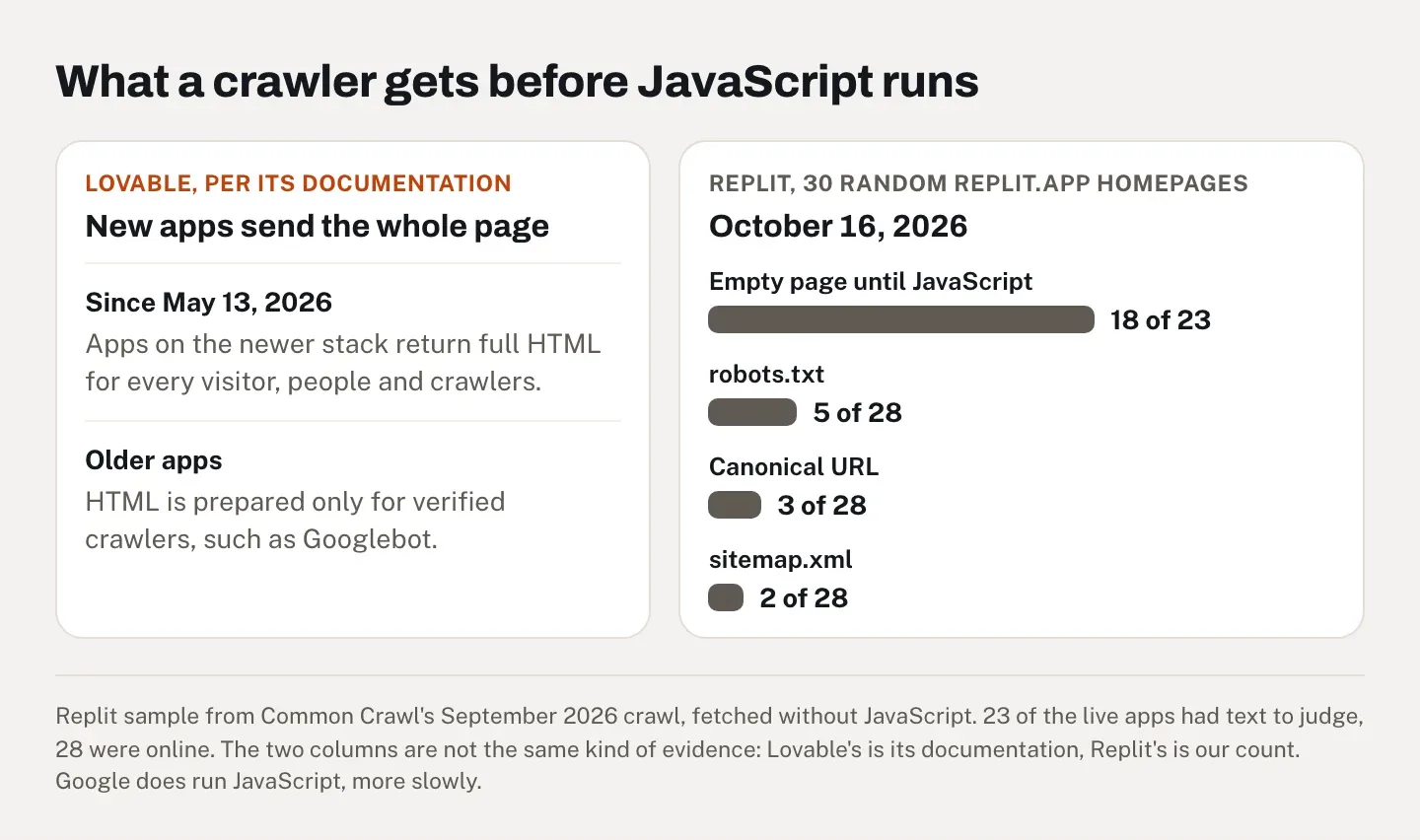
Lovable. Since May 13, 2026, new apps use TanStack Start with server-side rendering, and "every request returns fully rendered HTML, for humans and crawlers." Older React + Vite apps are pre-rendered only for verified crawlers such as Googlebot. The SEO documentation adds that Lovable "creates a robots.txt with every new project, but not always a sitemap, and the starting metadata is generic," and its SEO review doesn't rerun on its own when you publish. Of the ten indexed Lovable sites we checked for our review, all had a robots.txt, four a sitemap and three a canonical URL, and one meta description still read "Lovable Generated Project."
Replit. On October 16, 2026, we fetched the homepages of 30 random replit.app apps from Common Crawl's September crawl, the way a crawler does before running JavaScript. Of the 23 live apps with text, 18 sent an empty page until JavaScript ran, which is client-side rendering. Of the 28 online, three had a canonical URL and two a sitemap.xml. Replit rates SEO after each publish, and on paid plans its SEO Agent turns the audit into fixes for titles, descriptions, robots.txt, sitemap.xml and social tags (Replit SEO guide). The guide also recommends Static Deployments, which serve pre-rendered HTML, for content-heavy sites, but another page says they aren't compatible with apps created by the Agent (deployment types). For an Agent-built app, that tip doesn't apply.
The samples aren't directly comparable: ours from Replit is random, while the Lovable sites were already indexed, which favors the better-kept ones. Google does run JavaScript, more slowly, and some other crawlers don't. Our free index check tool shows what Google reads on your pages, and our guide to SEO for AI-generated websites covers the fixes.
Which one for your project?
A demo for investors on Friday. Lovable. It was first in every timed test and scored higher on design wherever design was rated: 9 against 5 at DesignRevision, 10 against 8.5 at DecideNavigator.
A booking app for your own business. Either can build it, as getcostiq showed. Lovable gets further on the free plan, then charges $25 a month for your own domain. Replit needs Core at $20 for an app that stays online and for Stripe. If the app is mostly a public site with a booking form, read the Eqlo section below first.
A product that is mostly a server. Hourly data collection, a queue, an API other apps call or a bot that stays connected: Replit runs these on Reserved VM and Scheduled deployments, which keep a machine on or run a job on a timetable (Replit docs). Lovable's edge functions and scheduled jobs suit webhooks, emails, payments and AI calls better than a process that runs all day. Our guide to building a SaaS MVP lists what a first version needs.
You write code and want control. Replit gives you a terminal and the full file tree, in the language you choose. For an agent inside your own editor, see Cursor and Claude Code below.
Start in one, finish in the other. Export the Lovable project to GitHub and import it into Replit, which brings across the code, styles, assets, backend logic and database schema, though not your Supabase data or secrets (Replit import docs). A mobile app can then share the web app's database in the same project (Replit artifacts).
What Reddit says about Lovable vs Replit
The thread that ranks for this search, "Replit or Loveable or Bolt?" on r/LLMDevs, opened in December 2024 and was still getting replies in January 2026, so it reads like a timeline. In January 2025, a non-coder paying for all three tools wrote that Replit stalled on her project and that Lovable was "wayyyyy better" at helping her figure out what to do. A year later, another member wrote that Replit "has gotten way way better in the last 6 months," and described how he splits the work: Lovable for landing pages and simple sites, Replit for new full-stack projects. An April 2025 r/replit thread about starting with Replit adds the usual reservation, that it "lacks in ui design."
The cost threads are harsher, and their numbers are self-reported. On r/lovable, a member building a complex production app reported 1,364 credits in 30 days in September 2026 and asked Lovable to show what had used them. On r/replit, the 770-task post is the extreme case. The advice that keeps coming back there, one narrow change per prompt and a spending limit, applies to Lovable too.
Lovable vs Replit vs Bolt, Base44, Cursor, v0 and Claude Code
These five come up in the same searches. Each gets the one fact that matters for this comparison and a price checked on October 22, 2026. Our list of Lovable alternatives goes further.
Bolt
Bolt was first to a live address in Tessellate Labs' booking test, in about 4 minutes against 8 for Lovable and 10 for Replit, and last to a shippable version, after 2 hours 40 minutes, "mostly because Stripe + email needed more babysitting." In getcostiq's test, it ran out of daily tokens after the first change. Pro costs $25 a month, or $18 billed yearly, for 10 million tokens (Bolt pricing). More in our Bolt.new review.
Base44
Base44 needed few messages in getcostiq's test: about 2 to build both apps, 2 for the three changes and 3 for private logins, plus 16 integration credits while the AI app ran. The free plan gives 25 message credits a month and Starter 100, for $16 a month billed yearly. GitHub integration starts with the Builder plan, listed at $40 a month (Base44 pricing).
Cursor
Cursor is a code editor with AI agents: you work in the code and handle deployment yourself. Lovable vs Replit vs Cursor isn't a fair fight, since Cursor competes with Replit's workspace more than with Lovable's chat. New subscribers get it through The X Subscription: Plus at $8 a month runs Grok models only, and Premium at $30 adds third-party models at API list price. Older Cursor plans keep working (Cursor docs).
v0
v0, from Vercel, builds web apps and deploys them to Vercel. In Jozefiak's October 2025 test, it was the only one of his three tools to produce a working app from a single prompt, for $23 in total, though front end only at the time. The free plan now allows 7 messages a day, and Plus costs $30 per user per month with $30 of credits (v0 pricing).
Claude Code
Claude Code is Anthropic's coding agent. It works in your terminal, on code you host yourself. In AI Alleyway's seven-tool run of the tracker brief, it was one of two tools to write and run a real test suite (28 assertions), while Lovable and Replit wrote none. It comes with Claude Pro, at $17 a month billed yearly or $20 monthly, and with Max from $100 a month (Claude pricing).
Where Eqlo fits, if your app is mostly a website
This is my product, so read this section as such. If you're building a business website with bookings or a shop, a full app may be more than you need. Eqlo's AI app builder creates that site from one sentence and hosts it, with an admin, bookings, a Stripe shop and forms on every plan. Pages are checked for search engines before they go live, and the code exports to GitHub as a Next.js project, free plan included.
On October 22, 2026, Free costs $0 for five projects on an eqlo.dev address with $3 of AI a month, and Plus costs $19 a month for your own domain and $30 of AI (Eqlo pricing). If the AI budget runs out, only AI requests wait for the 1st of the month, and sites stay online. See how it handles a booking website, or compare it on our Lovable alternative page. For a complex web app, I'd still point you to Lovable, and to Replit for a product that lives on the server.
Frequently asked questions
Is Lovable better than Replit?
For a web app you want on screen quickly, yes: Lovable won on speed and design in every published test I found. Replit is the stronger pick when the app needs a real server or a mobile version, or when you want to work in the code yourself.
Is Replit cheaper than Lovable?
On plan price, by $5 a month: Core costs $20 and Lovable Pro $25, or $216 and $250 a year. On usage, it depends on your requests, since Replit prices each one after the work. In the one test that tracked a whole project, Lovable came to $78 and Replit to $127, in October 2025.
Can you use Lovable and Replit together?
Replit documents the route: export the Lovable project to GitHub, then import it on Replit. The code and database schema come across, but Supabase data and secrets have to be moved by hand.
Is the free plan enough to build the same app in both?
To build a first version, usually. DecideNavigator built its decision app on both free plans, and it took all five of Lovable's daily credits and Replit's only Agent credit of the day. To finish a real app, rarely: getcostiq's booking app paused on Lovable's daily cap and stopped on Replit's monthly Starter limit before logins worked.
Which is easier if you can't code?
Lovable. DecideNavigator gave it 5 of 5 for ease of first build against 4.5 for Replit, and the non-coder in the Reddit thread above reached the same conclusion. Replit keeps the code editor and the terminal within reach, which helps once you know what you're looking at.
My verdict
If you want a web app working this week, start with Lovable: it got there first in every timed test, and its published examples let you estimate a request before you send it. Pick Replit when the server is the product or when you'll want the terminal, and set a budget limit before the first long task. Whichever you choose, connect the project to GitHub early. It's your way out if the bill or the tool stops suiting you.
Sources: six published tests and the tools' own pricing pages and documentation, checked on October 22, 2026. The crawl figures come from our checks of live apps on October 15 and 16, 2026. I built the same app in both tools but didn't record times or credits, so no figure here comes from my own builds. If you spot an error, write to hello@eqlo.app and we'll correct it.