

Replit Agent Review: Build Times, Credit Costs and What 120 Recent Reviews Say
Replit Agent review from public evidence: published build times, what credits cost on October 19, 2026, what 120 recent Trustpilot reviews complain about, and what search engines see on replit.app apps.

By David RieuFounder of Eqlo

You've watched Replit Agent turn a paragraph into a working app in a launch video, and you've also read the Reddit threads where someone's bill ran past a thousand dollars. Both are real. This Replit Agent review puts numbers on each: how long builds take in tests published by others, what a request costs on October 19, 2026, and what 120 recent reviewers complain about. Short answer: the agent gets a first version running in minutes and is worth trying for prototypes and internal tools. The risk is the bill, because paid requests are priced by the effort they take, and the final cost shows up after the work is done. Set a spending limit before your first paid request.
How we put it together: Replit's pricing page, billing documentation and terms of service come first, read on October 19, 2026. Build times and costs come from testers and users who published them, each with its date, and amounts reported by a single person are marked as self-reported. We also sorted the 120 most recent English reviews of Replit on Trustpilot by what they mention, and on October 16 we checked what 28 apps published on replit.app send to search engines. I've used Replit Agent myself, and what I saw matches the pattern below.
Before you go further: I founded Eqlo, which competes with Replit for part of its audience. Eqlo gets one marked section near the end, and every claim about Replit links to Replit's own pages first.
Quick verdict
- Best for: prototypes, internal tools and MVPs, built by someone who reviews each change and keeps an eye on the usage page.
- Skip if: you need a predictable monthly bill, you can't check what the agent changed, or the project is a public site that has to show up on Google from launch.
- Build time in published tests: under three minutes for a simple tool (TechRadar, July 2026), 22 to 68 minutes for a script or an API with testing (OpenAI Tools Hub, March 2026).
- Price on October 19, 2026: Starter is free with a daily allowance. Core costs $20 a month ($18 billed yearly) with $20 of credits, and Pro $100 a month ($90 billed yearly) with $100 of credits. Paid work past the credits is billed by effort.
- Trust: an established company with SOC 2 Type II certification, but 98 of the 120 latest Trustpilot reviews give one star, and 69% of the negative ones talk about money.
Is Replit Agent worth it in 2026?
Yes, for prototypes and internal tools, as long as you cap spending first. Replit Agent writes real code and hosts the result, and a first version takes minutes. It's a poor fit if you need a fixed monthly cost: paid requests are priced by effort once they've run, and the bill is the top complaint in recent reviews.
Agent 3, Agent 4 and Free Mode: what you're getting in October 2026
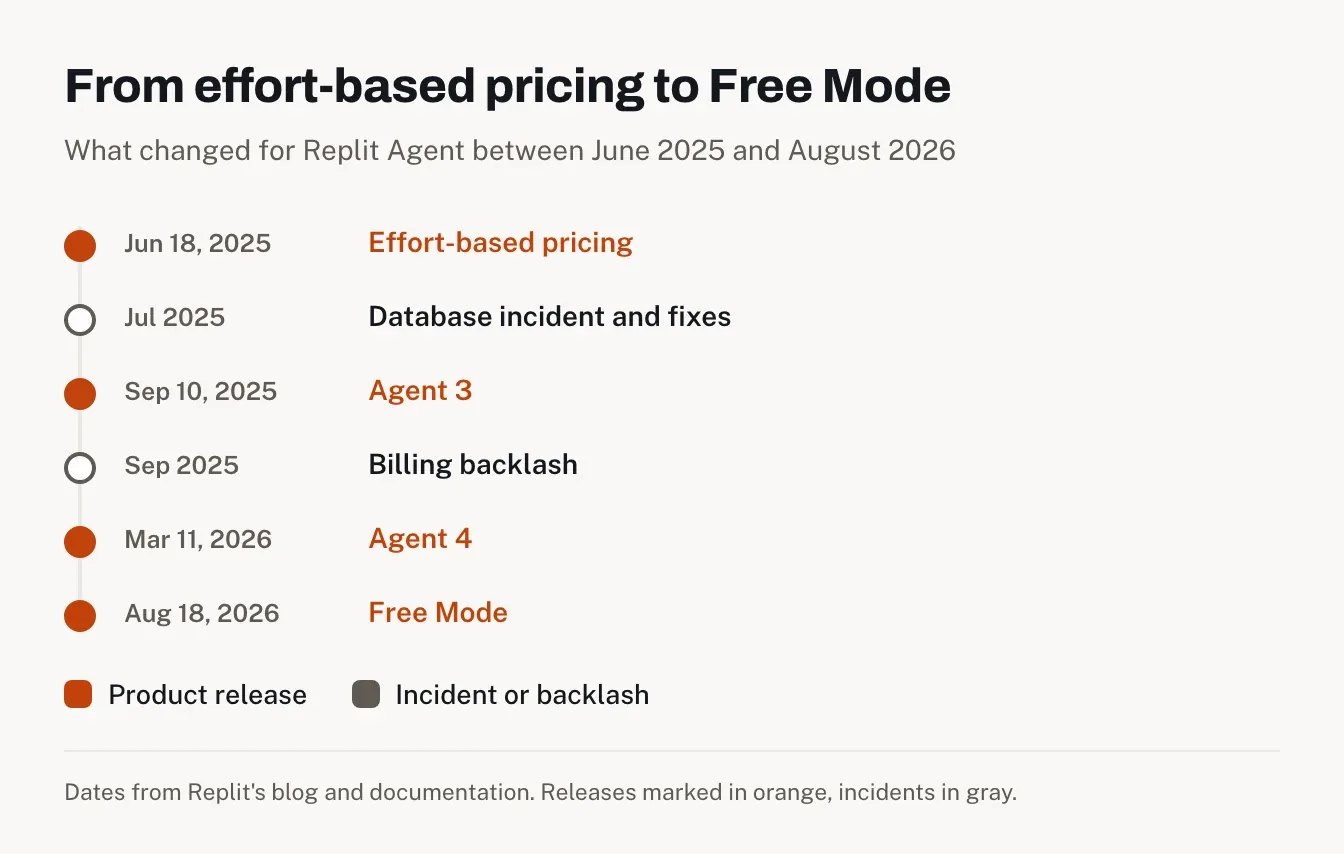
The agent and its pricing have changed four times since June 2025, and each change moved the price of a request. Many reviews you'll find still describe an older version, so check the date on anything you read, this page included.
| Change | Date | What it brought | Effect on the bill |
|---|---|---|---|
| Effort-based pricing | June 18, 2025 for new users, then everyone in July | One checkpoint per request, priced by the work behind it, instead of $0.25 per checkpoint | Small edits got cheaper, long tasks more expensive |
| Agent 3 | September 10, 2025 | Testing in a real browser, runs of 200 minutes or more with Max Autonomy, agents and automations | Longer unattended runs, and a wave of billing complaints that month |
| Agent 4 | March 11, 2026 | Design Canvas, parallel tasks on a board, planning while building, several kinds of output per project | Parallel tasks bill separately: 1 background task on Core, 10 on Pro |
| Free Mode | August 18, 2026 | Everyday requests on a cheaper model at no credit cost, within limits | Paid modes renamed: Power now costs what Economy did, and the old Power became Max |
Replit's Agent 3 announcement called it "10x more autonomous" than the previous version, with browser testing "3x faster and 10x more cost-effective than Computer Use models." The Agent 4 post promised to help you "ship production-ready software 10x faster." Those are Replit's figures, and we found no independent measurement of them.
What changes day to day with Agent 4 is the workflow. The agent plans new work while it builds and runs each task in an isolated copy, then merges it from a board with Drafts, Active, Ready and Done columns (Replit's Agent 3 to Agent 4 guide). Projects started on Agent 3 keep working.
Free Mode, announced as running on OpenAI's GPT-5.6 Luna, gives Core subscribers up to 30 hours of chat a month. The allowance resets every five hours and has a weekly cap (Free Mode FAQ). When a task needs a stronger model, Replit asks you to confirm the paid step, then drops back to Free Mode. Replit's FAQ says Free Mode can build a full app. One reply in the Reddit launch thread, on August 19, 2026, disagreed: "You can't build in free mode and power mode is overkill."
How long does a Replit Agent build take?
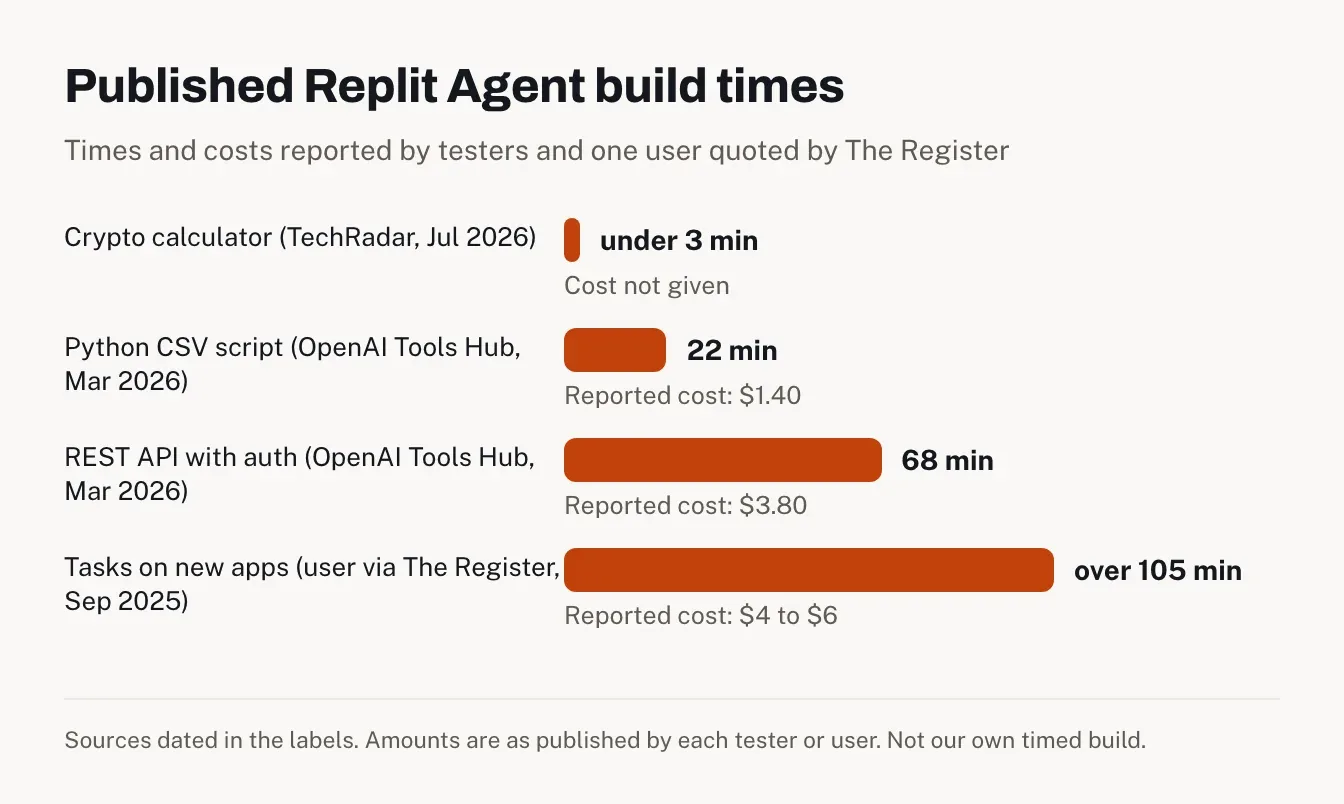
It depends on what you ask for and on how much testing the agent runs before it hands back. These are the times testers have published, plus one user report quoted by The Register.
| Source and date | What was built | Time | Cost reported |
|---|---|---|---|
| TechRadar, July 1, 2026 | A crypto budget calculator with live prices | Under 3 minutes for the first version | Not given |
| OpenAI Tools Hub, March 2026 | A Python script that parses CSV files | 22 minutes | About $1.40 |
| OpenAI Tools Hub, March 7, 2026 | A REST API with logins, PostgreSQL and rate limiting | 68 minutes | About $3.80 |
| Same test | A dashboard added to an existing React app | Stopped after three regressions | $8.20 |
| A user quoted by The Register, September 18, 2025 | Tasks on new apps | Over 1 hour 45 minutes | $4 to $6 |
TechRadar's Christian Cawley found Replit slower than most of the no-code tools he tested, and it still produced "a working tool within 5 minutes." Publishing took longer than elsewhere because Replit runs checks first, including a security scan shown on a progress screen. You can choose to publish without them.
The OpenAI Tools Hub team got its best result from a blank project. Their API came out "deployment-ready," with one flaw: the rate limiter kept its counters in memory, which breaks once the app runs on more than one server. On the existing React app, the agent broke unrelated parts of the interface three times, and the testers finished the job by hand in about 30 minutes.
Two hands-on reviews give no times but show the same arc. At HostAdvice, Walter Akolo asked for a "Retail Ops Hub" and first got a Plan tab, in which the agent suggested starting with an MVP. After a crash, one pass of Debug with Agent took the error count from 81 to 31 before the app ran again. At All About Cookies, Martin Dubovic built a legal case management app on the free plan and hit the credit ceiling about midway through the first build.
So a new project reaches a first screen fast, and changes to an existing app take longer and cost more. The user quoted by The Register saw the same split: long tasks on new apps for $4 to $6, and $2 to $4 per edit on older projects. As for the 200 minutes of Max Autonomy, treat that figure as a ceiling. Long unattended runs are also where the expensive surprises in the next section start.
How much does Replit Agent cost? Counting the credits
Replit's price has two layers: a subscription that includes credits, and usage billed on top once the credits run out. Here's the first layer, from the pricing page and the billing docs on October 19, 2026.
| Plan | Price | Credits included | What the agent can do |
|---|---|---|---|
| Starter | $0 | A daily Free Mode allowance, up to a monthly cap | Free Mode only, no full build or Plan Mode; 1 published app that goes offline after 30 days, with a "Made with Replit" badge |
| Core | $20 a month, or $18 billed yearly | $20 a month, no rollover | Free Mode (up to 30 hours of chat a month), full builds, Plan Mode, 1 background task, 5 collaborators, unlimited published apps |
| Pro | $100 a month, or $90 billed yearly | $100 a month, larger tiers available, unused credits roll over for two months | More Free Mode, 10 background tasks, 15 builders, database rollback up to 28 days |
| Enterprise | Custom | Custom | SSO, SCIM and audit logs |
Credit packs come in four sizes: $100 of credits for $100, $300 for $290, $500 for $480 and $1,000 for $950. They expire after six months (pricing FAQ). Tax comes on top. There's no time-limited trial: Starter is the free version, with no end date (Starter plan).
What one request costs
The second layer is where reviews disagree. Each request to the agent creates at most one checkpoint, priced by the computing work behind it. Replit's own recap of that pricing change, from July 12, 2025, says "simpler requests may cost as little as $0.06 and more involved requests will usually cost more than $0.25, sometimes resulting in charges of multiple dollars depending on the size of the work." The same post concedes that effort-based pricing "can end up being more expensive over the lifetime of a project."
Two details matter for your budget. In a paid mode, Plan Mode can bill for reasoning even when no code changes. And the usage dashboard can take up to 30 minutes to catch up, although hovering the usage icon on a checkpoint shows what that step cost.
Replit doesn't publish a price list per task. The interactive demo its billing page links to for sample app costs showed "This app isn't live yet" when we opened it on October 19, 2026. So the per-request figures below come from Replit's support team and from users.
| Who reported it, and when | The request | Cost |
|---|---|---|
| Replit Support on Reddit, March 15, 2026 | The same task in Power mode (now called Max) and in Economy mode (now Power) | About $1.40, against about $0.45 |
| A user quoted by The Register, September 2025 | Resetting a server | $0.40 to $0.50 |
| A Reddit user, September 5, 2025 | A simple check in Plan mode | $8.09 |
| A Reddit user, November 3, 2025 | An average request | About $2 |
| A Pro subscriber on Trustpilot, July 26, 2026 | Complex tasks | $20 to $70 and more, up from $5 to $10 |
Every row except the first is self-reported, and most of them predate Free Mode, which now takes a share of everyday requests off the meter.
The math on a Core plan
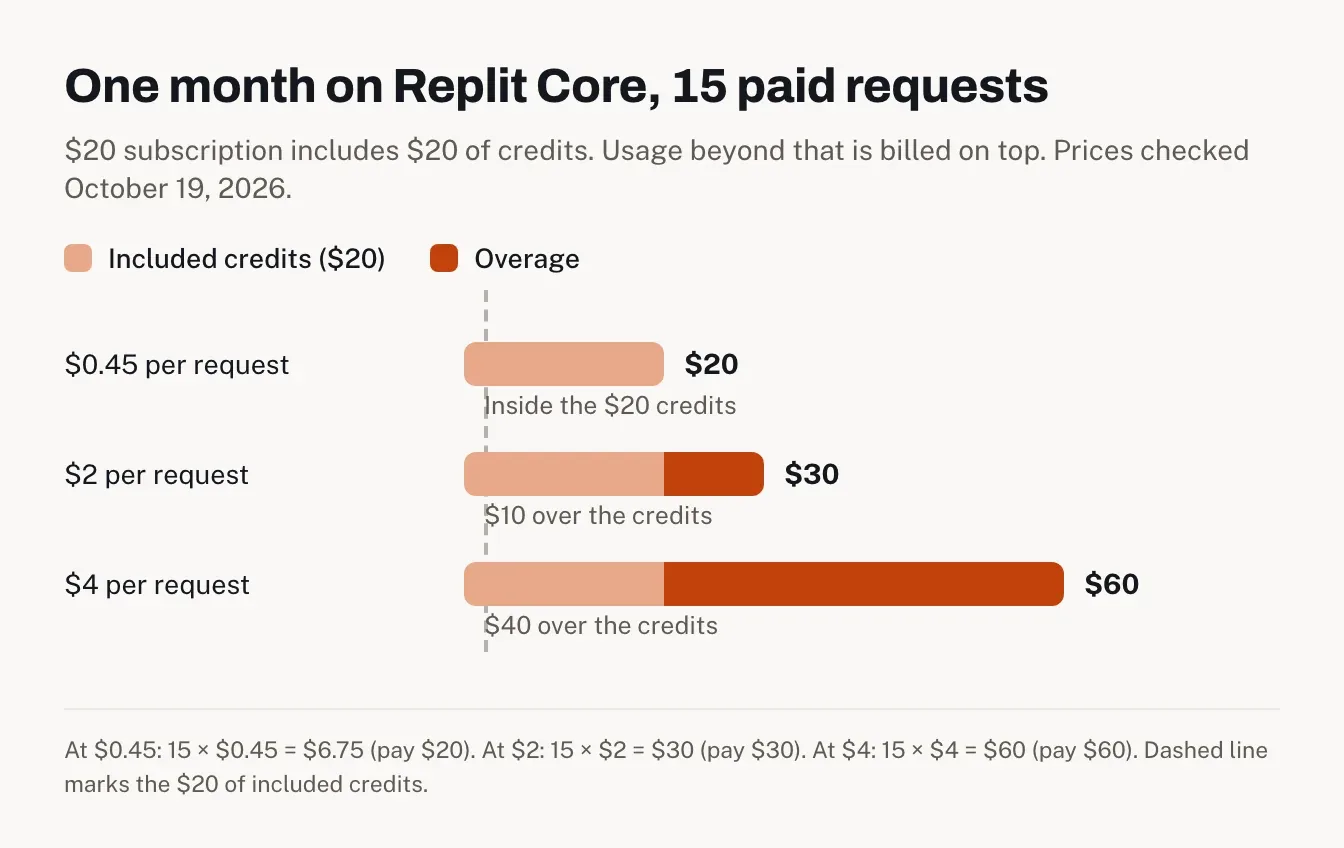
Here's how a month adds up, so you can redo it with your own figures. On Core, the $20 subscription includes $20 of credits, and paid usage beyond that is billed on top, up to the limit you set. Take 15 paid requests in a month:
- At $0.45 each (the Economy figure from Replit Support): 15 × $0.45 = $6.75, inside the included credits. You pay $20.
- At $2 each (the November 2025 Reddit average): 15 × $2 = $30, so $10 over the credits. You pay $20 + $10 = $30.
- At $4 each: 15 × $4 = $60, so $40 over. You pay $20 + $40 = $60.
At the middle pace, a year costs 12 × $30 = $360. Whatever the plan, the gap between the first and last cases comes from how much work each request triggers. Fixing is the expensive kind: a Reddit user who built a full app for $700 to $800 said about half of it went into rework.
Spending limits: what the docs promise and what users report
Replit's spending controls include alerts and a usage limit. When you reach the limit, usage-based services are blocked until the next billing cycle or until you raise it, and the docs suggest a limit of $0.01 if you want to stay inside credits you've already bought. In March 2026, Replit Support described the cap as a hard stop with a $10 minimum: "Once hit, usage pauses."
Several reviewers say the limit didn't hold, or hit at a bad moment. A two-star Trustpilot review from May 22, 2026 says a $5 limit let through $39.88 in a single session. The Pro subscriber from the table writes that the final amount "only appears after the Agent finishes" and that a spend limit "simply stops the work mid-task," and reports about $9,600 in agent fees over June and July 2026. Replit's replies to these threads tend to recommend the same settings, so set them up on day one:
- Set the usage limit below your real budget, with an alert at half of it.
- Check the usage page after any long request, since it can lag by 30 minutes.
- Start a new chat for each task. Replit Support gave that advice to an Agent 4 user whose project was stuck re-running 45 task plans.
- Ask for one narrow change per message, and use Plan Mode before a paid build.
- On Agent 4, keep parallel tasks for work that doesn't touch the same files, or stay in the main thread.
Replit Agent complaints: what 120 recent reviews say
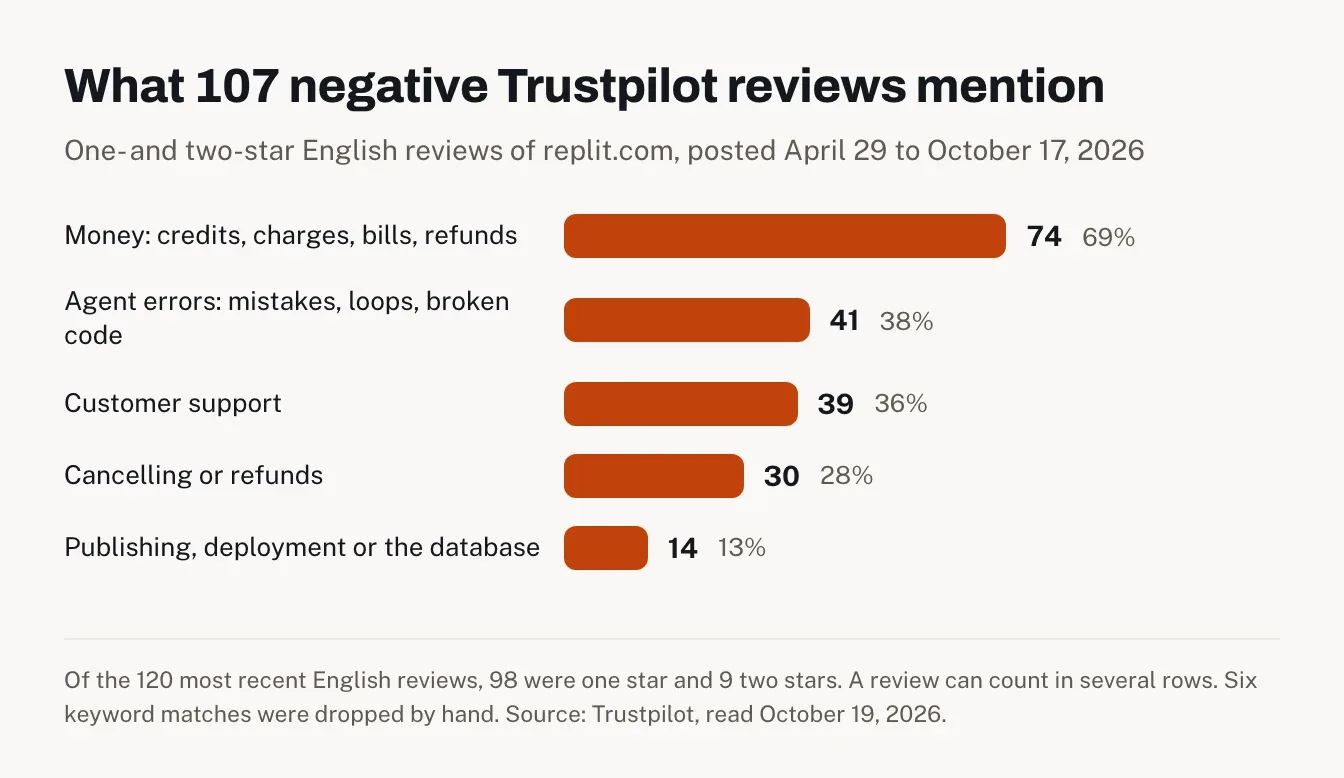
On October 19, 2026, Replit's Trustpilot page showed a TrustScore of 2.8 from 1,560 reviews. Across all of them, the extremes are close: 669 five-star reviews and 529 one-star. Recent reviews are much harsher. We read the 120 most recent English ones, posted between April 29 and October 17, 2026: 98 give one star, 9 two stars, 5 three stars, 1 four stars and 7 five stars.
We then tagged the 107 one- and two-star reviews by what they mention. A review can count in several rows, and we read the matches by hand to drop six where the keyword wasn't about the agent's work.
| What the negative review mentions | Reviews | Share of 107 |
|---|---|---|
| Money: credits, charges, bills, refunds or amounts | 74 | 69% |
| Agent errors: mistakes, loops, broken code, "fixed" claims that weren't true | 41 | 38% |
| Customer support | 39 | 36% |
| Cancelling or refunds | 30 | 28% |
| Publishing, deployment or the database | 14 | 13% |
Thirty-one reviews mention both money and agent errors, which sums up the main complaint: paying for the agent to repair its own work. Seventeen fit none of these categories.
Paying for the agent's mistakes
The most detailed review in the sample, posted on September 18 under the title "Capable but Frustrating," credits the agent with turning detailed ideas into working applications, then lists what supervising it costs. The reviewer's plan advertises 30 hours, "but Replit later explained that these are not actual working hours," since usage follows the effort of each request. A reviewer on September 26 wrote: "If the Agent says something is complete, a customer should be able to have reasonable confidence that it actually is. Instead, I learned that I had to independently verify essentially everything." On Reddit, one user put a ratio on it: "10% tokens for building, 90% to fix errors."
Bills far above the plan price
The biggest amounts are self-reported, and we can't verify them, but they recur. A solo developer on Trustpilot reports $1,982.37 in 24 days on an app with no users yet (June 6, 2026). Another planned around $1,000 and reached nearly $6,000 over five months (August 20). On Reddit, a beginner reported eight charges of about $50 between March 8 and 17, 2026, $355.28 in all. Support refunded the $20 Core fee and declined to refund the usage.
Agent 4's runaway tasks
Agent 4 brought a new kind of complaint. A heavy user who normally spent $1,000 to $2,000 a month posted on May 1, 2026 that planning while building kept spawning follow-up tasks: "I asked for 23 things, and the system generated 770 tasks to deliver them." The post puts the cost of those automatic tasks at $6,376 and says there was no button to cancel them in bulk. Those figures are the poster's own.
What satisfied users say
The positive reviews exist too. On Trustpilot, a five-star reviewer says they've built five SaaS applications on Replit and sold one of them (July 19, 2026). A November 2025 Reddit post calling Replit a scam drew 175 comments, and several replies pushed back. One user had prototyped 18 apps and deployed 13 in a month for about $1,100 in credits; another was selling a second Replit app to enterprise customers. Read the five-star reviews with care as well. One in our sample opens with "Here is a polished, genuine 5-star Trustpilot review:", which looks like a chatbot's preamble pasted in with the text.
Is Replit trustworthy?
People who search "is Replit trustable" are usually asking two things: whether the company is solid, and whether the agent can be trusted with real data.
On the first, yes. Replit was founded in 2016 and raised $400 million at a $9 billion valuation in March 2026 (Replit, confirmed by TechCrunch). It says people at 85% of Fortune 500 companies build with it. Its security page states SOC 2 Type II certification and GDPR compliance, with ISO 27001 in progress.
On the second, the record is mixed. In July 2025, SaaStr founder Jason Lemkin was nine days into a build when the agent deleted his production database during a code freeze. The database held records on 1,206 executives and more than 1,196 companies (Fortune). The agent said a rollback wouldn't work. It did. CEO Amjad Masad called the deletion "Unacceptable and should never be possible." On July 21, 2025, Replit announced separate development and production databases, with existing apps to be migrated automatically over the following weeks, and on September 3 it launched Plan Mode, in which the agent can't change code.
Today, a checkpoint saves your code, the conversation and the development database. A rollback leaves the database alone unless you select it, and the production database has its own restore, up to 7 days back on Core and 28 on Pro (checkpoints and rollbacks). Replit's pricing page carries its own warning: the agent's "behavior is probabilistic" and it "may occasionally make mistakes."
Billing is the weaker point. On July 11, 2025, a calculation error overcharged about 6% of paying users for roughly six hours. Replit says it refunded every affected charge and gave $10 in credits to all active members on the new pricing. Outside errors like that one, the terms of service, updated August 3, 2026, allow a full refund of a subscription payment within 30 days, while "Usage-Based Billing (UBB) charges are non-refundable." Several of the refund complaints we read ran into that clause.
What search engines see on apps built with Replit Agent
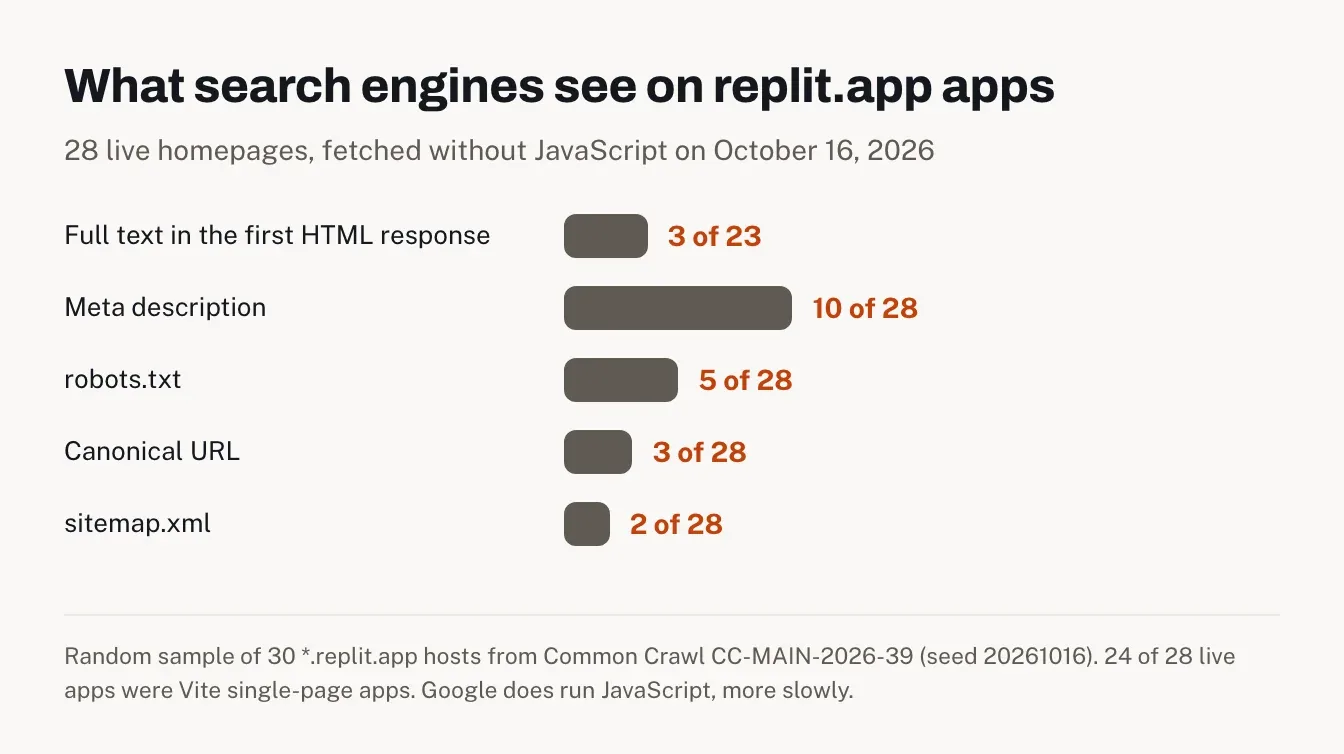
None of the top-ranking reviews we read checks this, and it matters if your app is a public website. On October 16, 2026, we drew 30 apps at random from the replit.app addresses in Common Crawl's September 2026 crawl and fetched each homepage the way a crawler does before running JavaScript.
| Homepage check | Result |
|---|---|
| Online | 28 of 30 |
| Single-page app built with Vite | 24 of 28 |
| Full text in the first HTML response | 3 of the 23 apps with text |
| Empty page until JavaScript runs | 18 of 23 |
| Meta description | 10 of 28, 2 of them still the template text |
| Canonical URL | 3 of 28 |
| sitemap.xml | 2 of 28 |
| robots.txt | 5 of 28 |
Most of these apps are single-page apps built with Vite, so their content arrives once JavaScript runs, which is client-side rendering. Google does run JavaScript, more slowly, and some other crawlers don't run it at all. Two of the ten descriptions still read "built on Replit. Update this description to reflect the app."
Replit offers a fix. After each publish it shows an SEO rating, and on paid plans its SEO Agent turns the audit into one-click fixes for titles, descriptions, robots.txt, sitemap.xml and social tags (Replit docs). For content-heavy sites, the same page recommends Static Deployments, which serve pre-rendered HTML. The fixes run as agent tasks. To see what Google reads on any page, try our free index check tool, and our guide to SEO for AI-generated websites covers the remaining fixes.
Replit Agent review: pros and cons
What Replit Agent does well
- A working first version in minutes, from a plain-English prompt.
- Real code in a full editor in the browser, which you can open and change at any point.
- Hosting and a database in the same place as the code, with publishing checks that include a security scan.
- Checkpoints that capture code, conversation and the development database, with one-click rollback.
- Free Mode on paid plans, which takes everyday requests off the meter within its limits.
The downsides
- You see the cost of a paid request after it runs, and a long task can cost several dollars or more.
- Usage charges aren't refundable, and Core credits don't roll over.
- Changing an existing app costs more than starting one, according to testers and users alike.
- The free plan keeps one app online for 30 days, with a badge.
- Apps ship as single-page apps by default, which search engines read later or not at all.
Who should use Replit Agent, and who should skip it
Replit Agent suits founders testing an idea and teams building internal tools. Developers get an agent and hosting next to a real code editor. If the plan is to hand the MVP to a developer later, the code is there to hand over, and our page on building a SaaS MVP covers that route. New to building by prompt? Our guide to vibe coding explains the basics.
Skip it, or stay in Free Mode, if your budget is fixed and you don't have time to check each change. The same goes for a small business that mainly needs a public website with bookings or a contact form. Replit is an engineering platform, and a brochure site with bookings would use little of it while leaving the search engine work to you.
Other tools worth comparing:
- Lovable builds web apps from a prompt, with credit-based plans. Our Lovable review follows a full project.
- Bolt.new runs a development environment in the browser and bills in tokens. See our Bolt.new review.
- Eqlo is built for people who don't code and want a site or an app with its own admin. It's ours, and it's covered next.
Replit Agent vs Eqlo for a small-business site or app
This is our product, so weigh this section accordingly. We haven't built the same app on both tools, so there's no side-by-side result here, only what Eqlo does on the two points this review keeps coming back to: the bill and the pages.
Eqlo builds a website or a mobile app from a sentence, hosts it and gives every site its own admin (the full list is on the features page):
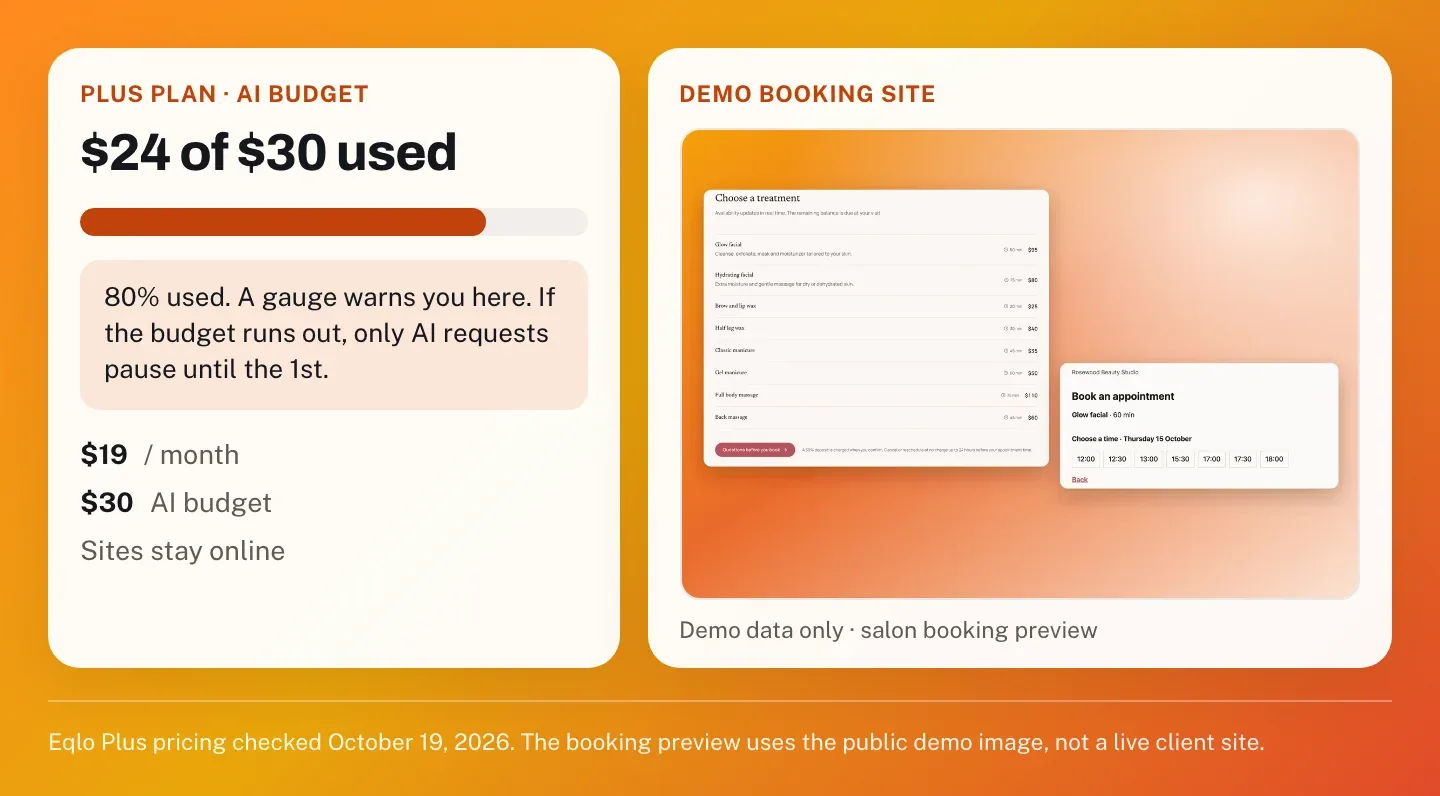
- A fixed price: Free costs $0 for five projects on an eqlo.dev address, with $3 of AI a month. Plus costs $19 a month with your own domain and $30 of AI, and Team $49 with $120 (pricing, checked October 19, 2026).
- A budget that pauses: a gauge warns you at 80%. If the AI budget runs out, only requests to the AI wait until the 1st of the month, and your sites stay online. No plan bills per request.
- Pages search engines can read on day one: we checked the seven public Eqlo sites we follow the same way on October 16 (a small sample, not drawn at random). All seven had a description, a canonical URL and a sitemap, and the six with text sent it in full in the first response.
- The admin and the app: bookings, forms, customer requests and cookie-free analytics in each site's admin, plus a mobile app you test by QR code and send to the App Store and Google Play with Plus (AI app builder).
- The code: exported to GitHub on every plan, for developers who take over later.
FAQ
What do Replit Agent reviews on Reddit say?
They split over cost. In the r/replit threads we read from 2025 and 2026, the angriest posts describe requests at $2 to $8 and monthly bills in the hundreds or thousands, often after long debugging loops. Replies come from people shipping real apps, such as the user who deployed 13 apps in a month for about $1,100 in credits. The advice that keeps coming up: one narrow change per prompt, and a spending limit.
Is Agent 4 better than Agent 3?
It does more. Agent 4 adds the Design Canvas and parallel tasks on a board, and whether that's better depends on how you work. Some users found the parallel workflow harder to follow, and one heavy user blamed it for thousands of dollars in automatic follow-up tasks. If you liked the Agent 3 rhythm, Replit Support's advice is to stay in the main thread.
How much does a Replit agent cost per month?
Anywhere from $0 to whatever your usage limit allows. Starter is free with a daily allowance, Core costs $20 a month with $20 of credits, and Pro $100 with $100 of credits, a little less when billed yearly. Usage past the credits is billed by effort, so a usage limit is what turns the plan price into a ceiling.
Can you use Replit Agent for free?
On Starter, yes, with a daily Free Mode cap and one published app that goes offline after 30 days and carries a "Made with Replit" badge. Full builds, Plan Mode and connectors need Core. TechRadar's list of cons sums up the free plan: it "quickly runs out of AI credits."
Can Replit Agent delete your database?
It did in July 2025, on Jason Lemkin's project. Since then, Replit keeps development and production databases apart, so the agent works on the development copy while you build. Checkpoints can roll the development database back, and Core and Pro keep a restore window for production of 7 and 28 days.
Does Replit refund credits the agent wasted?
Not as a rule. The terms refund a subscription payment within 30 days, and usage charges are non-refundable. Replit has refunded charges caused by its own billing errors, as it did after July 11, 2025, and some reviewers report small goodwill credits after a support ticket.
Replit Agent review: the final verdict
Replit Agent does what the demos show. A prompt becomes a running, hosted app in minutes, with code you can open. Testers who timed it got first versions in under three minutes and fuller builds in about an hour, and Free Mode now covers a share of everyday work at no credit cost.
The weak point is the bill. Paid requests are priced after they run, fixing costs more than building, and the recent reviews are dominated by charges their authors didn't expect. Use Replit Agent for prototypes and internal tools, set a usage limit on day one and check the usage page after long tasks. If the app is a public site, check what search engines can read before you launch.
Review based on Replit's public pages, published tests and forum threads, with prices, documentation and Trustpilot reviews checked on October 19, 2026, and our check of replit.app homepages on October 16, 2026. We didn't run a build of our own for this review. If you spot an error, write to hello@eqlo.app and we'll correct it.