

Lovable Review 2026: I Built the Same Site in Lovable and in Eqlo, Side by Side
I built a plumber's website and a baby products store in Lovable and in Eqlo on October 15, 2026. Lovable was about 30 seconds faster and stays the pick for complex apps. For a small business site, here's what Google receives, what the credits cost and what Shopify adds.

By David RieuFounder of Eqlo

You've watched the Lovable demos, you have a real business site to ship, and you want to know whether Lovable holds up when the brief is a plumber's website or a small online store instead of a weekend prototype. Here's the short answer from this Lovable review, based on a side-by-side test: Lovable is fast and capable, and for complex web apps it's one of the strongest tools available. For a small business site that needs to be found on Google, it leaves more of the setup to you than its speed suggests, and a store selling physical products runs through Shopify.
One thing before you read on: I founded Eqlo, which competes with Lovable. That's why I ran a side-by-side test instead of writing from memory: I built the same two projects in both tools, a brochure site for a plumber and an online store for baby products. Every claim about Lovable below comes from its own documentation or from public pages we measured, with the date.
Quick verdict
- Best for: founders and makers building a web app with accounts, data and logic, who like iterating in a chat and are comfortable reviewing what the AI wrote.
- Skip if: you need a local business website that search engines can read correctly from launch day, or a store with stock and shipping, and you don't want to spend time on SEO fixes or pay for a Shopify plan.
- What I measured: Lovable delivered the first version about 30 seconds faster than Eqlo. On every other point I compared, I preferred the Eqlo result. Keep my bias in mind and check the sources linked below.
- Price on October 15, 2026: free to start, Pro at $25 a month or $250 a year for 100 monthly credits, and a paid plan is required to connect your own domain.
Is Lovable worth it in 2026?
Yes, if you're building a web app. Lovable turns a chat into a working React app, hosts it, and serves new projects with full HTML for search engines. For a local business site or a store, it's worth it only if you budget time for SEO setup, a paid plan for your domain, and a Shopify subscription for physical products.
What is Lovable?
Lovable is an AI app builder. You describe what you want in a chat, and it writes a web app you can preview, edit and publish to a URL. It's the best-known name in what people now call vibe coding.
Two changes this year matter if you're reading older reviews. The first is rendering. According to Lovable's SEO documentation, apps created from May 13, 2026 use TanStack Start with server-side rendering, and "every request returns fully rendered HTML, for humans and crawlers." Older React + Vite apps are pre-rendered on request, but only for verified crawlers such as Googlebot. The second is SEO tooling: each project now has an SEO and AI search review, plus keyword research with Semrush data.
Billing works in credits. Each message costs a fraction of a credit or several credits depending on the work involved, and that's the part of Lovable that most user reviews complain about. I'll come back to the numbers.
How I ran the test
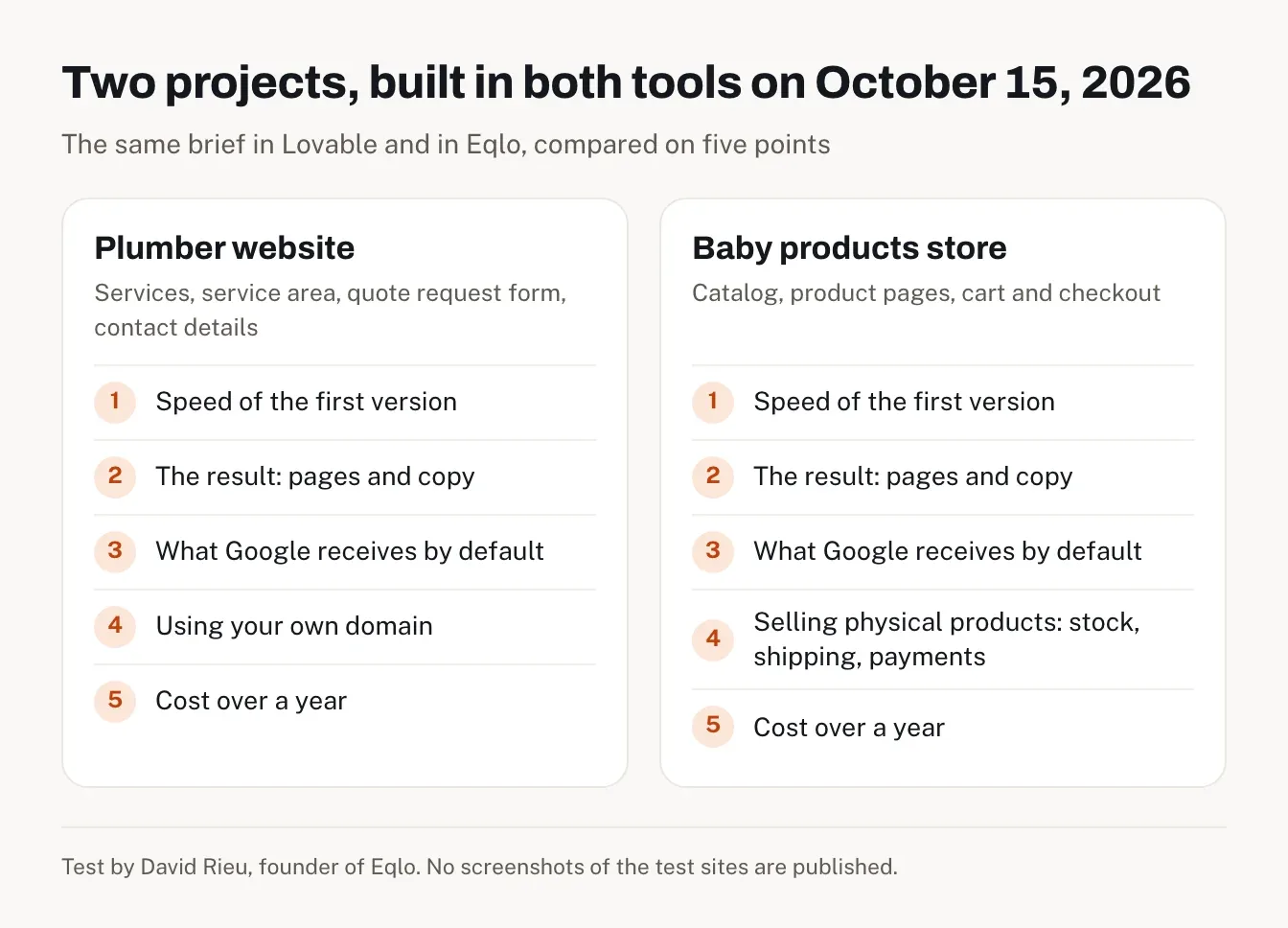
On October 15, 2026, I built two projects in each tool from the same brief:
- A plumber's brochure website, with services, a service area, a quote request form and contact details.
- An online store for baby products, with a catalog, product pages, a cart and checkout.
I compared five things: how fast the first version arrived, how good it looked and read, what a search engine receives by default, what it takes to use your own domain (for the plumber) or to sell physical products (for the store), and what each project costs over a year. I'm not publishing screenshots of the test sites. The images in this article are charts and product captures we made for it.
Two projects are a thin sample, so our team also measured ten public sites built with Lovable (five plumbers, five baby stores) and seven sites published on Eqlo. The results are further down.
Round 1: the plumber's website
Speed. Lovable won. Its first version was ready about 30 seconds before Eqlo's, so if time to first preview is what you care about, Lovable is quicker.
The result. On everything else I looked at, from the pages and the copy to what was ready to publish, I preferred what Eqlo produced. Discount that as you see fit, given who's writing. The differences I can document come next.
What search engines get by default. This is where the two tools differ most, and both sides publish how they work. Lovable's documentation says it plainly: "Lovable creates a robots.txt with every new project, but not always a sitemap, and the starting metadata is generic." Its answer is the SEO and AI search review. The first scan starts on its own after your first edit, it checks the sitemap, robots.txt, metadata, structured data, headings, alt text and canonical tags, and "Lovable can fix most of them in one click." That's a good tool. The catch is in the same page: "Lovable does not run the review again on its own when you publish." Scanning again after each round of changes is your job, and fixes are applied in the chat like any other edit.
Eqlo works the other way around. Every published site comes with full HTML pages, a title, a description, a canonical URL and a language on each page, plus a sitemap, a robots.txt and an llms.txt file for AI search engines. Publishing stops until each page has a single H1, unique titles and descriptions, working internal links and a description on every image. For a plumber who'll never open an SEO tab, that's the difference that counts. Our page on SEO for AI-generated websites explains these checks in more detail.
The domain. On Lovable's free plan, the site lives on a lovable.app address, and a custom domain requires a paid plan. Eqlo follows the same logic: the free plan publishes on an eqlo.dev address, and your own domain comes with Plus.
Round 2: the baby products store
Speed. Same pattern as the first round: Lovable's first version arrived about 30 seconds sooner.
Selling physical products. For clothes, gear and other physical goods, Lovable points you to its Shopify integration. Lovable creates a development store, which you must claim within 30 days. Claiming starts "a separate 120-day free trial on a Shopify subscription," and after that "you'll need a paid Shopify plan to continue selling products online." Shopify's Basic plan costs $39 a month, or $29 a month billed yearly (Shopify pricing, US, checked October 15, 2026). Lovable's built-in payments are designed for digital products and software. Stripe can take payments for physical goods too, but the documentation notes that "inventory and logistics will need to be managed separately."
If you already like Shopify, none of this is a drawback. It's a proven commerce engine. It does mean a baby store built with Lovable runs on two subscriptions and two dashboards.
Eqlo's store is part of the site: a catalog with up to 100 variants per product, each with its own price and stock, up to 20 shipping rates, orders with tracking numbers, and card payments on the owner's own Stripe account with no Eqlo commission. Cash on delivery is available too. Our page on building an online store with AI walks through the setup.
Product pages and search. On Eqlo, each product page carries Product structured data with its price. We checked a live Eqlo store and found Product and Offer markup on its product page. In our Lovable sample, the one store on the newer server-rendered stack loaded its product grid in the browser: the HTML sent by the server contained category links and placeholder cards, but no products. Google does run JavaScript, only more slowly, so this delays what Google sees rather than blocking it. It's still worth checking on your own store.
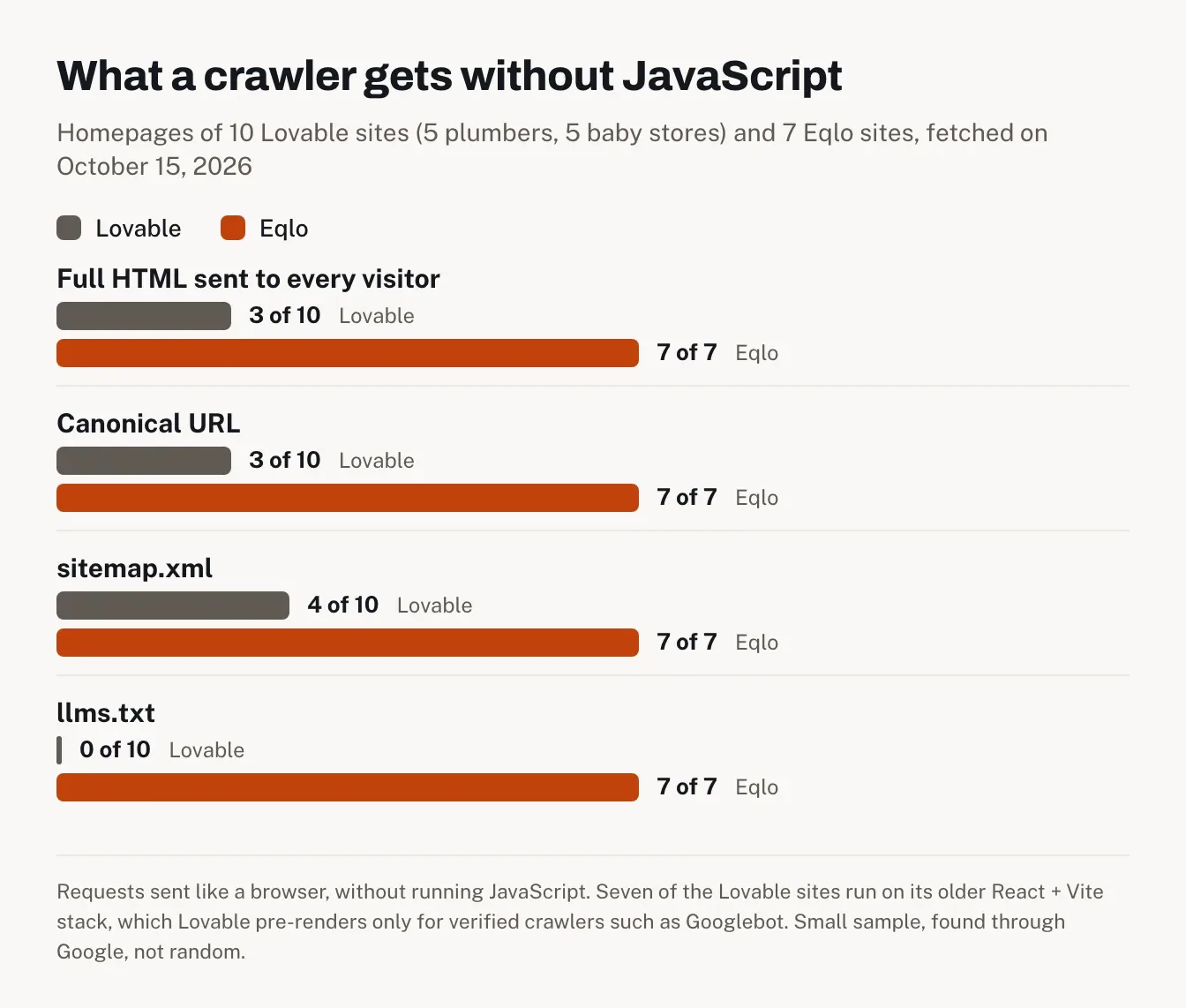
What Google receives from 10 real Lovable sites
My two builds are one data point each, so we measured public sites. On October 15, 2026, we fetched the homepages of ten Lovable sites found through Google (five plumbing businesses and five baby stores, all on lovable.app) and of seven sites published on Eqlo. We requested each page the way a browser does, without running JavaScript, then looked for the files search engines use.
| Homepage check | Lovable, 10 sites | Eqlo, 7 sites |
|---|---|---|
| Full HTML sent to every visitor | 3 | 7 |
| Exactly one H1 in that HTML | 3 of 3 | 7 of 7 |
| Meta description | 10, one reading "Lovable Generated Project" | 7 |
| Canonical URL | 3 | 7 |
| sitemap.xml | 4 | 7 |
| robots.txt | 10 | 7 |
| llms.txt | 0 | 7 |
| Structured data on the homepage | 2 | 2 |
Here's how to read the table fairly:
- The seven Lovable sites without HTML run on the older React + Vite stack. Lovable pre-renders them for verified crawlers, so Googlebot does receive HTML. Our request, like any unverified tool, got an empty page. The three newer sites are server-rendered for everyone, as the documentation says.
- The sample is small and not random. These sites are indexed by Google, which already favors the better-maintained ones.
- Structured data is a tie on homepages. Eqlo adds business markup only when the site knows the address and phone number, and most of our sample didn't include them.
The pattern matches Lovable's documentation. The newer stack sends good HTML, and the gaps that remain (sitemap, canonical URL, generic metadata) are exactly what its review is built to catch, once someone runs it. You can see what Google reads on any page with our free index check tool.
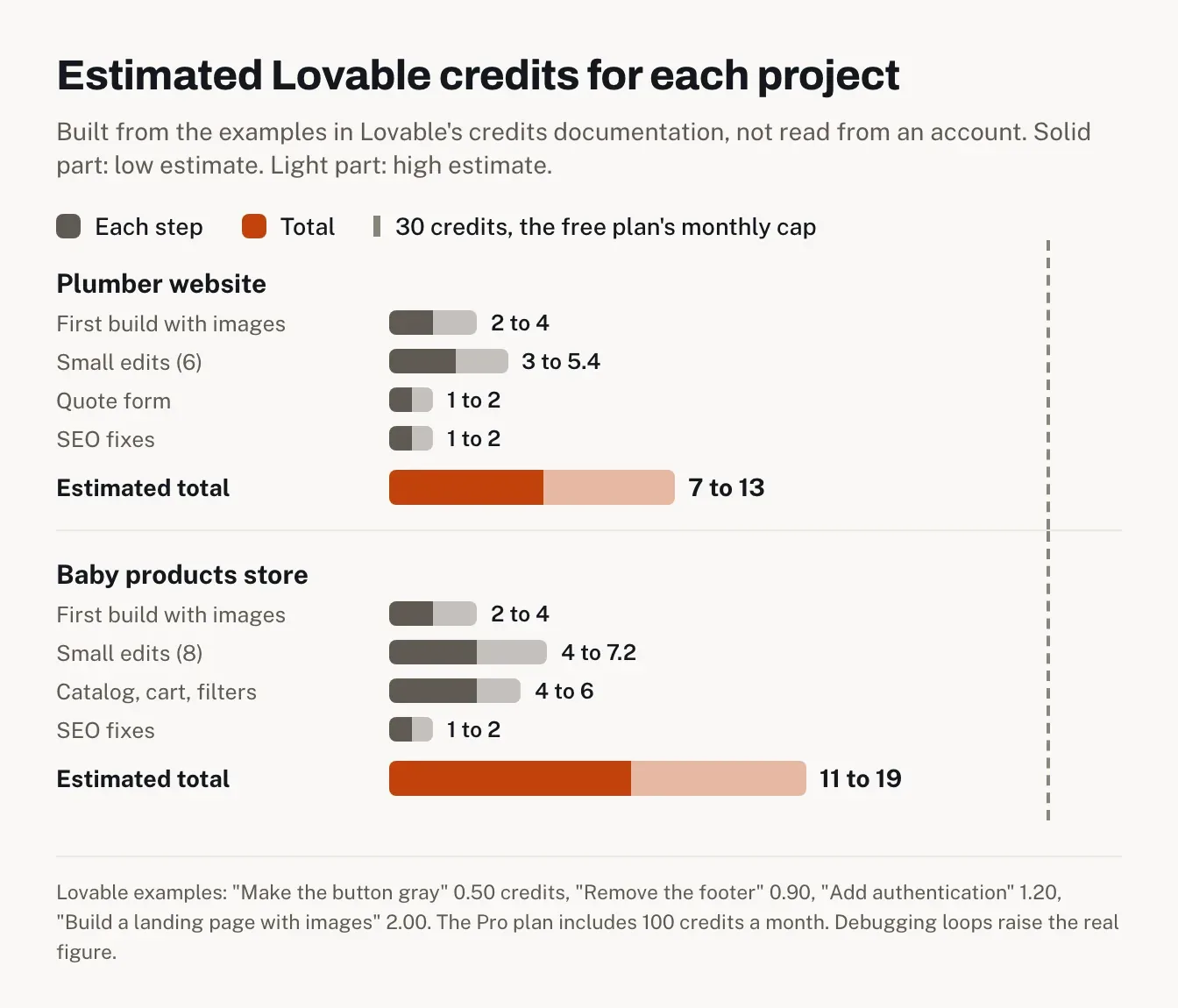
How many credits would these two sites cost on Lovable?
I didn't note my credit usage during the test, so here's an estimate built from Lovable's own examples, not a reading of my account. The credits documentation prices "Make the button gray" at 0.50 credits, "Remove the footer" at 0.90, "Add authentication" at 1.20 and "Build a landing page with images" at 2.00. A Plan mode message costs 1 credit.
| Step | Assumption | Plumber site | Baby store |
|---|---|---|---|
| First build with images | larger than the 2.00 landing page | 2 to 4 | 2 to 4 |
| Small edits (text, colors, phone number) | 0.50 to 0.90 each | 6 edits: 3.0 to 5.4 | 8 edits: 4.0 to 7.2 |
| Feature work | about 1.20 per feature, like "Add authentication" | quote form: 1 to 2 | catalog, cart, filters: 4 to 6 |
| SEO fixes after the review | one or two changes across several files | 1 to 2 | 1 to 2 |
| Estimated total | about 7 to 13 credits | about 11 to 19 credits |
On paper, both projects fit inside the 100 monthly credits of the Pro plan, and even inside the free plan's 30 a month if you spread the work over several days at 5 credits a day. The estimate breaks down when the AI gets stuck, because every message in a debugging loop costs credits again. Lovable's own safeguard is telling: by default, it pauses a single long-running message once it passes 20 credits and asks whether to continue. To see your real figure, open Workspace settings, then Plans & credit usage, then Usage details, and view usage by project.
For these two sites, then, credits aren't the main cost. The plan you need to use your own domain is.
Lovable pricing in 2026
Figures from Lovable's plans documentation and pricing page, checked on October 15, 2026, in US dollars before tax:
| Plan | Price | Credits | What it adds |
|---|---|---|---|
| Free | $0 | 5 a day, up to 30 a month | publishing on a lovable.app address |
| Pro | $25 a month, or $250 a year | 100 a month plus 5 a day, with higher tiers up to 10,000 | custom domain |
| Business | $50 a month | 100 a month plus 5 a day | features for teams |
Extra credits cost $15 per 50 on Pro and $30 per 50 on Business. Unused monthly credits roll over while your subscription is active, but they expire two months after they were issued.
What the two sites cost per year
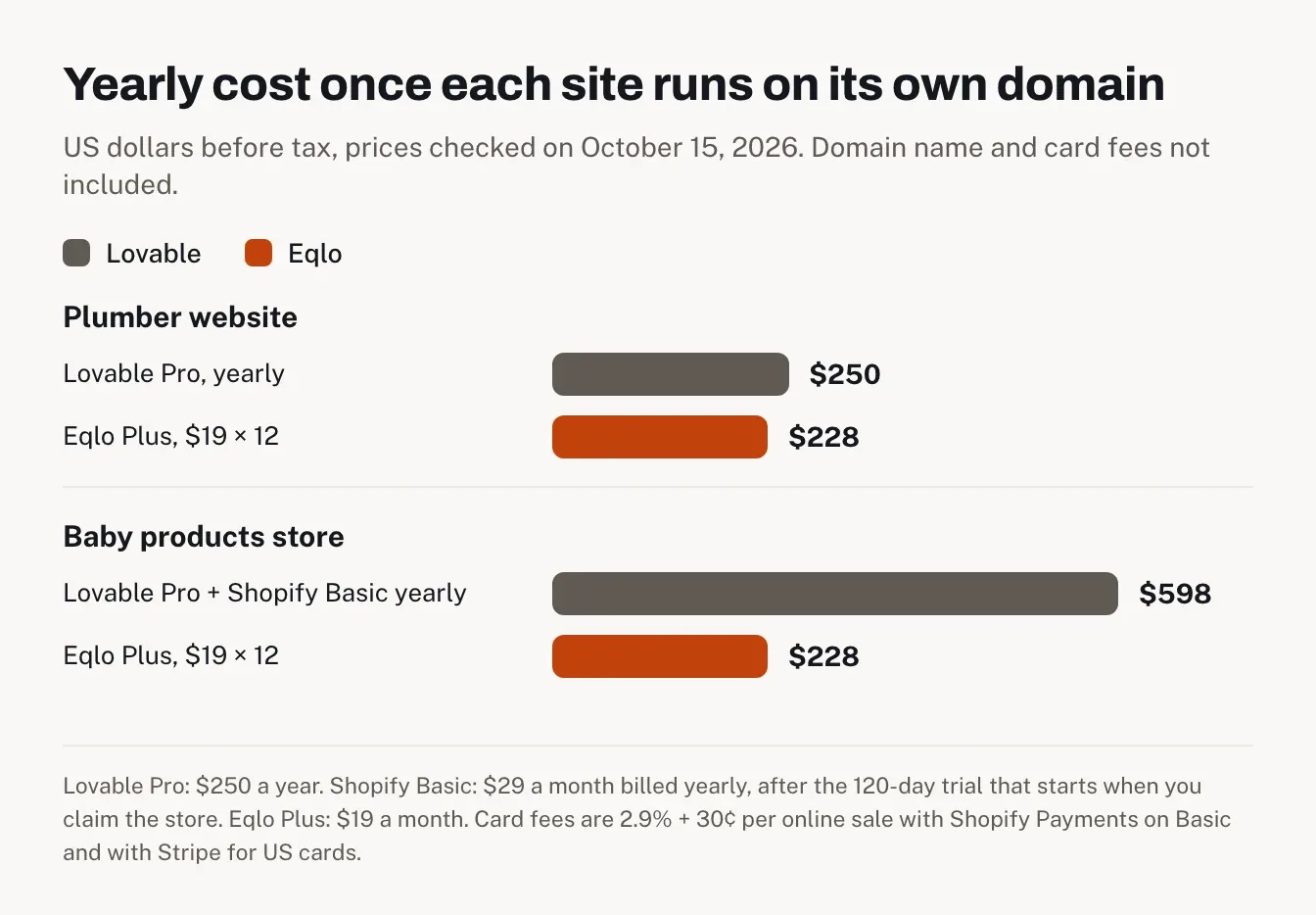
Here's the yearly bill once both projects are live on their own domain, at prices checked on October 15, 2026. The domain name is extra in every case.
| Project | Lovable | Eqlo |
|---|---|---|
| Plumber website | Pro, yearly: $250 | Plus: $19 × 12 = $228 |
| Baby store, after the Shopify trial | Pro $250 + Shopify Basic yearly $29 × 12 = $348, so $598 | Plus: $228 |
| Card fees on each sale | Shopify Payments on Basic: 2.9% + 30¢ online | Stripe: 2.9% + 30¢ for US cards, no Eqlo commission |
For the brochure site, the two prices are close: $250 against $228. The gap opens with the store, because Lovable's route for physical products adds a Shopify plan. If you'd rather stay on Lovable without Shopify, its Stripe payments avoid that second subscription, and you handle stock and shipping yourself.
Eqlo Plus includes $30 of AI usage a month instead of credits. If that budget runs out, only new AI requests wait until the first of the month, and the site stays online. The pricing page lists what each plan includes, and our guide to website costs puts these numbers next to agency and builder prices.
Lovable pros and cons
What Lovable does well
- First versions arrive fast, about 30 seconds ahead of Eqlo in both of my builds.
- It handles accounts, databases, logic and integrations, so it scales well past a brochure site.
- New projects have been server-rendered since May 13, 2026, so crawlers get full HTML.
- Its SEO review explains each issue and fixes most of them in one click, and Semrush keyword data costs nothing extra through November 30, 2026.
- Your code can sync to GitHub in both directions, so you can move the project elsewhere.
Where it asks more of a small business
- Search basics depend on running the review and applying the fixes, since the starting metadata is generic and a sitemap isn't guaranteed.
- Stores selling physical products go through Shopify, which means a second subscription once the trial ends.
- The cost of a message is hard to predict before you send it, even if Lovable shows it afterward.
What is Lovable AI best for?
Lovable is best for web apps with real logic: a SaaS MVP, an internal dashboard, a tool with user accounts and roles, a marketplace prototype. That's where I recommend it, and where its speed and range pay off. For a very complex project, it's the tool I'd pick over Eqlo.
A local business site asks a different question. What a plumber's site needs is pages that Google reads, a quote form that lands in the owner's inbox, and a phone number visitors can tap. Lovable can build all of that, but you bring the SEO discipline and, for a store, the Shopify account.
Lovable vs Eqlo for a small business site
This is our product, so read this section with that in mind. Eqlo builds a website or a mobile app from a sentence, hosts it, and gives every site its own admin. It was designed for the cases in this test: a plumber in a given city, a shop with forty products.
Here's what that changes in practice:
- Pages search engines can read on day one. Titles, descriptions and the sitemap are written with each page, and publishing stops if a page lacks an H1 or has a broken link.
- A store inside the site. Catalog, stock, shipping rates and orders, with payments on your own Stripe account and no commission.
- An admin for every site, at the site's address followed by /admin, with quote requests, orders and analytics that don't use cookies.
- A fixed price. Free for five projects on an eqlo.dev address, then $19 a month for your own domain, with a monthly AI budget instead of credits.
- Your code. The full Next.js project exports to GitHub on every plan.
If you run a trade business, start with our small business website builder or the page for home services. If you're weighing Lovable specifically, our Lovable alternative page sets out the differences point by point.
FAQ
Is Lovable trustable?
Lovable is a widely used platform, and you keep control of your work: the code syncs in both directions with a GitHub repository you own, so you can host it elsewhere. As with any AI builder, review what it generates before launch, especially database access rules if your app stores customer data.
Is the Lovable subscription worth it?
For a web app you're actively building, Pro at $25 a month is fair value, since 100 credits cover a lot of small edits. For a brochure site you'll rarely touch, you're mostly paying for the custom domain, so compare it with fixed-price website builders.
Can Google index a Lovable site?
It can. Apps created since May 13, 2026 are server-rendered, and older apps are pre-rendered for verified crawlers like Googlebot. Whether pages rank then depends on the basics, such as a sitemap, specific titles and descriptions, and a custom domain, which Lovable's review checks when you run it.
Can you build an online store with Lovable?
You can. For physical products, Lovable recommends its Shopify integration, which needs a paid Shopify plan after a 120-day trial. Its built-in Stripe or Paddle payments suit digital products, software and services better.
What is the difference between Lovable and ChatGPT?
ChatGPT answers in a conversation and can write code that you then have to run and host somewhere. Lovable writes the app, runs it in a live preview, hosts it and publishes it to a URL, so you go from a prompt to a working site without setting anything up.
Which is faster, Lovable or Eqlo?
In my test on October 15, 2026, Lovable delivered the first version about 30 seconds sooner on both projects. For a business site, most of the time comes afterward: reviewing pages, fixing search issues and setting up the store.
Final verdict
Lovable has earned its reputation. It's fast, it handles complex apps that most builders can't, and since May 2026 its new projects send search engines real HTML. If you're building a product with accounts, data and logic, I'd pick it.
For the two projects in this test, a plumber's website and a baby products store, I preferred Eqlo on everything except raw speed. What decided it: search engine basics delivered by default, a store that doesn't need Shopify, and a fixed price. You can try Eqlo free with five projects and no card, then run the same brief through both tools before you decide.
Comparison made on October 15, 2026 from Lovable's public documentation and pricing. If you spot an error, write to hello@eqlo.app and we'll correct it.