

Lovable alternatives: 8 tools compared, free plans and lock-in included
Eight Lovable alternatives checked on free plans, first-month cost, lock-in and phone apps. Also, what Google receives from apps already published with these tools, measured on October 16, 2026.

By David RieuFounder of Eqlo
By David Rieu, founder of Eqlo. Comparison made on October 16, 2026 from each tool's public pricing pages and documentation.
You've hit Lovable's monthly credit cap, or a client wants the app in the App Store, or you've started to wonder what happens to your project the day you stop paying. So you're looking at Lovable alternatives, and every list hands you ten names with no common yardstick. This one checks eight tools against a single brief, using each tool's own pricing page and documentation on October 16, 2026.
The short answer: Bolt.new and v0 are the closest swaps if you want standard React code. Replit puts code, database and hosting in one cloud workspace, and Base44 handles the backend for you. Dyad and Claude Code leave nothing to be locked into. Bubble suits people who never want to read code, and Rork fits when the phone app is the product.
One thing before you read on: I founded Eqlo, which competes with every tool on this list. Eqlo gets its own section near the end, apart from the eight. Every claim about another tool links to that tool's own page, and if a price has changed or I've got something wrong, write to hello@eqlo.app and I'll correct it.
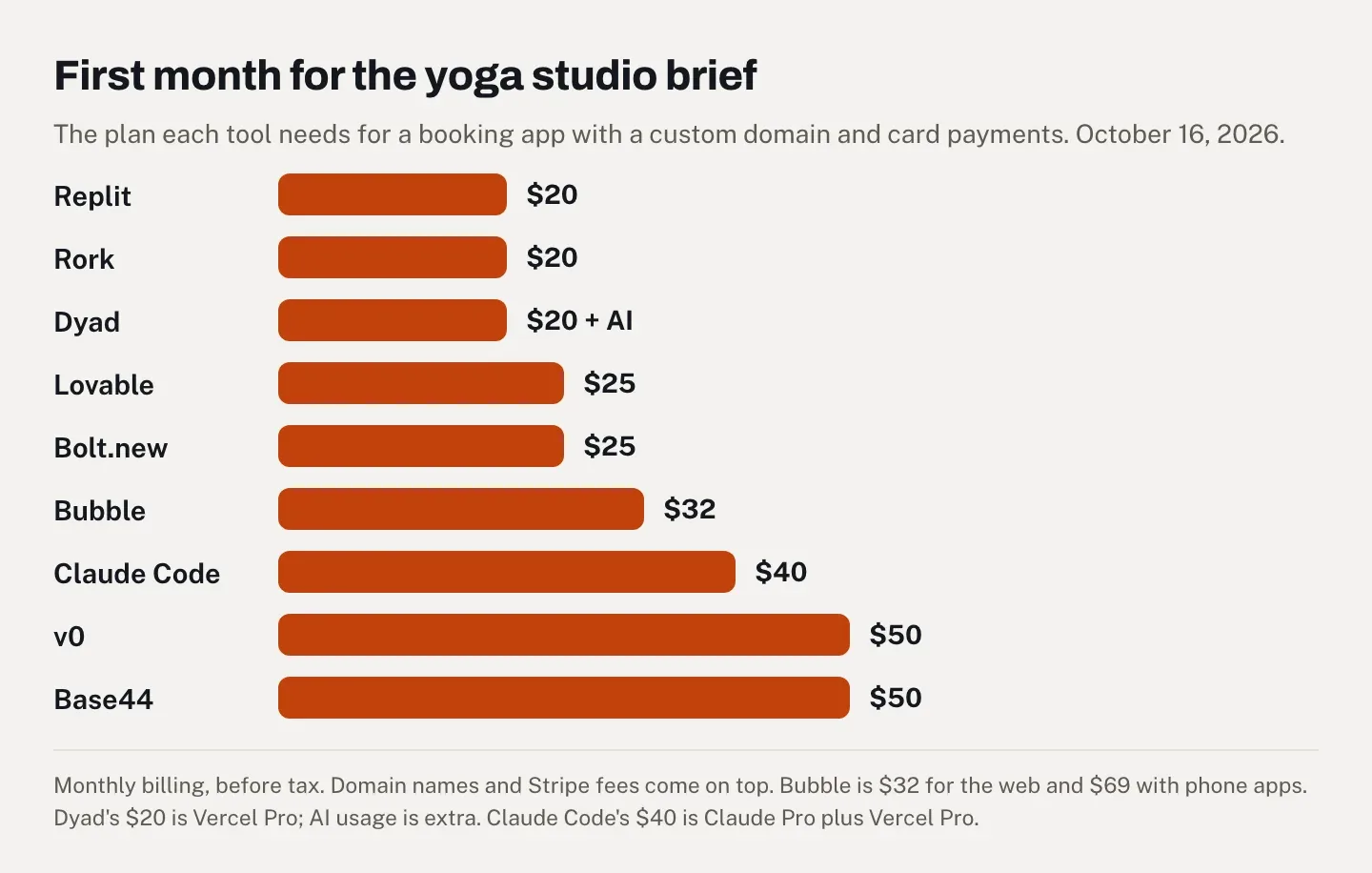
Lovable alternatives at a glance
| Tool | Pick it if | Free plan, for this brief | First month for the brief | Lock-in | Phone app |
|---|---|---|---|---|---|
| Lovable (baseline) | you like the chat-to-web-app flow | publishes on lovable.app, 30 credits a month at most, no own domain | $25 (Pro) | low for code, medium for the backend | no store path in its docs |
| Bolt.new | you want to see and edit standard React code | bolt.host address with a badge, no Supabase | $25 (Pro) | low | Expo, to both stores |
| v0 | you're on Vercel or want Next.js | $5 of one-time credits, hosting for non-commercial use only | $50 (Plus and Vercel Pro) | low | no store path in its docs |
| Replit | you want code, database and hosting in one place | one app, taken down after 30 days, no Stripe | $20 (Core), plus usage past the included credits | low for code | Expo, App Store through Replit |
| Base44 | you want the backend handled for you | 25 message credits, no Stripe, no code edits | $50 (Builder) | medium to high | web-view wrapper, Builder plan |
| Dyad | you want free, local and open source | the app is free, you pay for AI and hosting | about $20 with Vercel Pro, plus AI usage | none | experimental (Capacitor) |
| Bubble | you'd rather build visually | no live site | $32 for the web, $69 with phone apps | highest: no code export | iOS and Android plans |
| Rork | the store app matters most | web apps only | $20 (Pro) | medium | native Swift and Kotlin |
| Claude Code | you can read code and want full control | not in Claude's free plan | about $40 (Claude Pro and Vercel Pro) | none | whatever you build |
Monthly billing, US dollars before tax, checked October 16, 2026. Domain names and Stripe fees come on top for every tool. Publishing a store app adds Apple's 99 USD per membership year (Apple Developer Program) and Google Play's "US$25 one-time registration fee" (Play Console help).
How we compared them: one brief, checked against each tool's docs
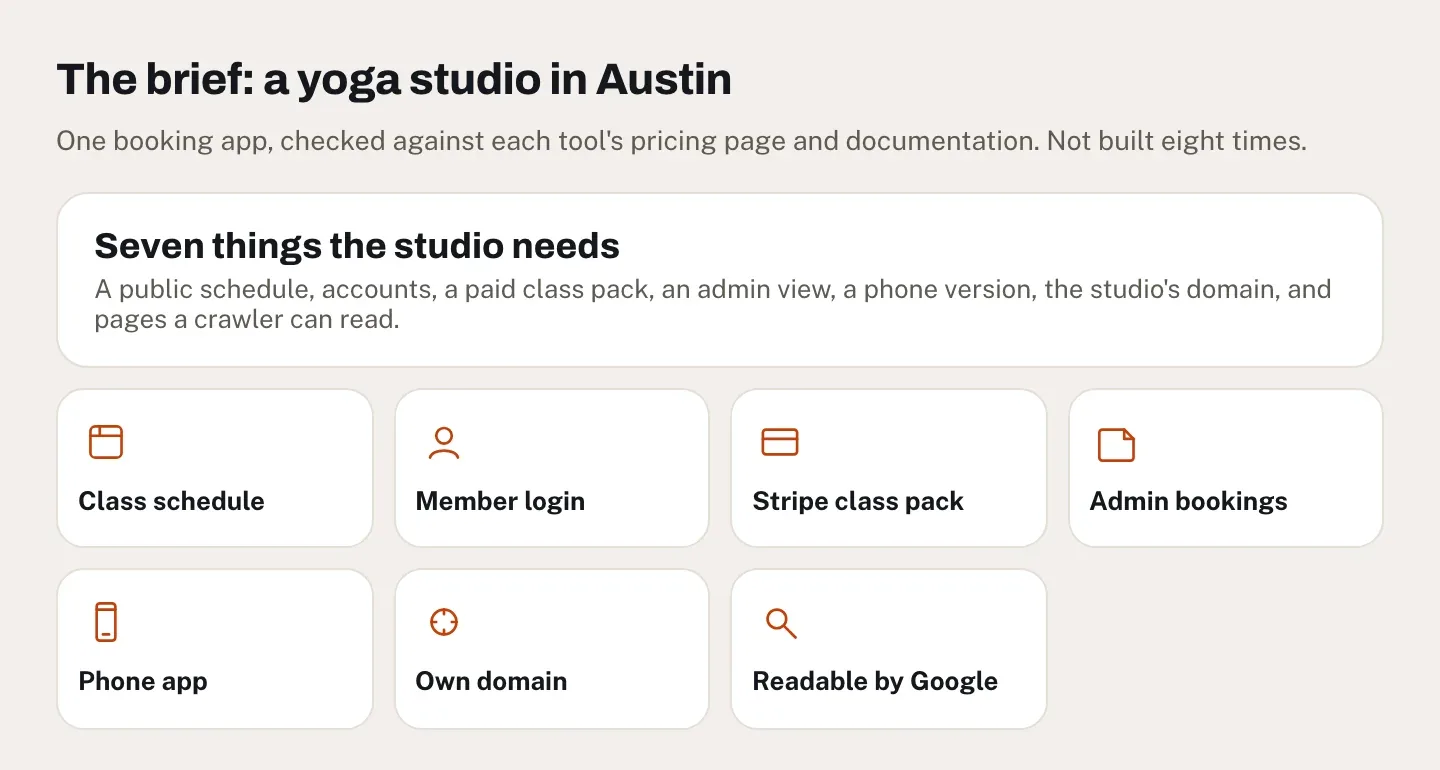
The brief is a booking app for a yoga studio in Austin:
- a public class schedule;
- member sign-up and login;
- Stripe payment for a 10-class pack;
- an admin view of bookings;
- a version for phones, ideally in the App Store and Google Play;
- the studio's own domain;
- pages Google can read.
For each tool, we read the pricing page and the documentation and noted five things: the plan this brief needs, the first month's cost with every line shown, what the free plan allows, what you can take with you if you leave (code, database, sign-in, hosting), and the route to a phone app.
What we didn't do: build the studio app eight times. Hands-on use would tell you things documentation can't, like how many credits a booking flow burns or how tidy the generated code is, and the sections below say where that gap matters. Two of these tools have a hands-on review on this blog: our Lovable review and our Bolt.new review.
We also measured something the top-ranking lists skip: what search engines receive from apps people have published with these tools. The method and its limits are in the measurement section.
Why people leave Lovable
The reasons repeat across forums and reviews, and four of them shape this comparison.
- Credits. Lovable's Free plan grants 5 build credits a day, capped at 30 a month, and Pro starts at $25 a month for 100 credits (Lovable plans). A booking app with sign-in and payments takes more messages than a landing page.
- Control. On r/lovable, the thread titled "Robust alternatives to Lovable?" opens with "I know about Bolt and Replit, but they feel the same." The poster wants a tool where you may go slower but can't break things (Reddit).
- A store app. Lovable's documentation describes a Lovable app for iOS and Android that lets you build from your phone. We found no page on shipping your own project to the App Store or Google Play.
- Leaving. Lovable says moving the app is "a deployment change rather than a rewrite", and that's true for the code. The backend is where the work is, as the lock-in section shows.
Lovable, the baseline
Lovable writes a React web app from a chat, hosts it and gives it a built-in backend it calls Cloud. It's one of the main vibe coding tools, and the one every tool below gets compared with.
For the studio brief, Pro at $25 a month (or $250 a year) is the floor: custom domains, code editing, code download and removal of the "Edit with Lovable" badge all start there. The Free plan still publishes on a lovable.app address and includes Git sync with GitHub, GitLab or Bitbucket, which Base44 and Rork keep for paid plans (Lovable plans).
On search, Lovable changed its stack this year. Apps created from May 13, 2026 use TanStack Start with server-side rendering, and older React + Vite apps are pre-rendered for verified crawlers (Lovable SEO docs). Keep that date in mind when you read older reviews.
The eight tools, one by one
Each tool gets the same grid: the plan the brief needs, the free plan, lock-in, and the phone app. Then a comparison with Lovable.
1. Bolt.new: standard code in a browser editor
Bolt.new, from StackBlitz, writes a full-stack web app in your browser and lets you open every file it creates.
- For the brief: Pro at $25 a month, billed monthly. It adds a custom domain, removes the "Made in Bolt" badge, drops the daily token limit (from 10M tokens a month) and lists "SEO boosting", Bolt's pre-rendering for search engines (Bolt pricing).
- Free plan: 1M tokens a month with a 300K daily limit, hosting on a bolt.host address with the badge, no custom domain, and no Supabase database, which needs Pro or Teams. Free hosting stops at 10 GB of bandwidth and 333,333 requests a month for the whole account, and sites over the limit "stay offline until usage resets at the start of the next billing cycle" (Bolt billing, hosting plans).
- Lock-in: low. You can download a project or sync it with GitHub. New projects run on a Bolt database, and switching an existing project to a separate Supabase database isn't supported, but Pro and Teams accounts can claim the Bolt database into their own Supabase account (database settings).
- Phone app: Bolt builds Expo apps and documents publishing to TestFlight, the App Store and Google Play. Its docs warn that "projects created for web do not easily switch over to mobile", so put "mobile app" in your first prompt (Bolt and Expo).
Compared with Lovable: same entry price, and both need it for the studio's domain. Both publish on their free plans, but Bolt's free sites go offline once the account hits its traffic cap. In our measurement, 1 of 11 Bolt sites sent full HTML before JavaScript, from a sample found through search rather than drawn at random. The Bolt.new review goes deeper into tokens and code.
2. v0 by Vercel: Next.js code, Vercel hosting
v0 is Vercel's AI builder. It writes Next.js apps and deploys them to Vercel.
- For the brief: about $50 for the first month. The free plan's $5 of one-time credits for new users and its 7-message daily limit won't carry a booking app with sign-in and payments, so we priced Plus at $30 per user per month, which includes $30 of monthly credits (v0 pricing). Hosting is a separate Vercel bill. The free Hobby plan "restricts users to non-commercial, personal use only", so a studio needs Pro: a $20 monthly platform fee with $20 of usage credit included (Hobby, Pro). $30 + $20 = $50.
- Free plan: enough to try v0 and to host a personal project, with GitHub sync and Vercel deployment included.
- Lock-in: low. You get a standard Next.js project that syncs to GitHub on the free plan, and databases such as Neon or Supabase connect through the Vercel Marketplace under your own accounts.
- Phone app: we found no App Store or Google Play path in v0's documentation.
Compared with Lovable: the costliest first month of the code-first tools here, because hosting bills separately. Its output did best of the random samples in our measurement, though: 21 of 24 v0 sites sent full HTML, since Next.js renders pages on the server. Few had a canonical URL (3) or a share image (5).
3. Replit: code, database and hosting in one workspace
Replit is an online development environment whose Agent builds and deploys apps for you.
- For the brief: Core at $20 a month, or $18 a month billed yearly. Core includes $20 of monthly credits that pay for the Agent, publishing, data transfer and database storage (Replit pricing, Core plan). Usage past those credits is billed on top.
- Free plan: Starter publishes one app, and "this published link will automatically go down after 30 days." It carries a "Made with Replit" badge, and external connectors, Stripe included, need Core (Starter plan). The studio can't take payments on it.
- Lock-in: low for code. Replit runs on Git and syncs with GitHub (version control).
- Phone app: Replit builds Expo apps and walks you through TestFlight and App Store submission with your Apple Developer account (publish to iOS).
Compared with Lovable: a cheaper entry ($20 against $25) and a real coding workspace, but the free plan amounts to a 30-day trial for one app. In our random sample, 19 of 23 Replit apps were client-side apps built with Vite, and 3 of 23 sent full HTML.
4. Base44: the backend handled for you
Base44 builds the front end, database, sign-in and backend functions from a prompt, and runs the backend on its own platform.
- For the brief: Builder at $50 a month, or $40 a month billed yearly. Stripe "is available on the Builder plan and above" (setting up Stripe), and so is GitHub two-way sync (GitHub integration, Base44 pricing).
- Free plan: 25 message credits and 100 integration credits a month, for up to five apps. You can read your app's code, but editing it takes a paid plan (developer tools), and connecting a domain starts at Starter ($20 a month, or $16 billed yearly).
- Lock-in: medium to high. Base44's pricing FAQ says you own your code and that GitHub sync "exports the full source code to your own repo at any time." Its developer docs also describe "a fully managed backend", with the Base44 SDK as "your interface to all Base44 backend services" for data, auth and integrations (app code introduction). Leaving means replacing those calls with another backend.
- Phone app: the store version "runs your published Base44 app inside a secure web view", and downloading the submission files takes Builder or higher (submitting to app stores).
Compared with Lovable: twice the price for this brief because of the Stripe requirement, and a backend that's harder to move. On search basics, though, it was the most complete of our random samples: a sitemap and a robots.txt file on 19 of 23 sites, structured data on 15. Base44 says it "serves crawlers a rendered version of your app" (SEO docs). Sending Googlebot's user agent, we received the full text on 7 of 23 sites, against 5 with a browser's.
5. Dyad: free, local and open source
Dyad is a desktop app that builds React apps on your own computer, with the AI model you choose.
- For the brief: about $20 a month, plus AI usage. Dyad is "free forever", with a Basic Agent limited to 20 messages a day; you bring your own API key or a ChatGPT subscription, and Dyad Pro starts at $20 a month for 200 AI credits (Dyad Pro). Hosting is up to you. Dyad's guide uses GitHub and Vercel (publishing your app), and since Vercel's free plan is non-commercial, a studio on Vercel needs Pro at $20. Supabase or Neon hold the data under your own account.
- Free plan: the app itself. You pay for the model, the host and the database.
- Lock-in: none. "Each app is just a regular Git repo on your computer," says Dyad's FAQ. The code is under the Apache 2.0 license, apart from the Pro features, which use the Functional Source License (GitHub repository).
- Phone app: experimental. Dyad can turn a React and Vite app into a hybrid iOS and Android app with Capacitor (mobile app guide).
Compared with Lovable: no subscription required and nothing to leave, at the cost of setting up hosting, a database and API keys yourself. Dyad doesn't host apps, so it isn't in the measurement.
6. Bubble: visual no-code, no code export
Bubble is the long-standing visual builder, now with an AI agent. You assemble pages and workflows instead of reading code.
- For the brief: Web Starter at $32 a month ($29 billed yearly) for a live site on your own domain. With phone apps, Web & Mobile Starter costs $69 a month ($59 yearly) and includes 5 store build submissions a month (Bubble pricing).
- Free plan: a development version only. The live website and the custom domain start at Starter.
- Lock-in: the strongest on this list. Bubble's manual is direct: "Bubble apps can only be run on the Bubble platform; there's no way of exporting your application as code." Your data exports as CSV files or through the Bubble API, and moving off means rebuilding the logic (application and data ownership).
- Phone app: separate Mobile plans for iOS and Android, with on-device testing on Free and store submissions from Starter.
Compared with Lovable: a higher bill and no code to take with you, in exchange for an editor where you never read code. In our random sample, none of the 20 Bubble sites sent its text before JavaScript ran, and 17 still used Bubble's stock description. Our page on when to leave Bubble for an AI builder covers the trade-off from the other side.
7. Rork: when the store app is the product
Rork builds native phone apps, SwiftUI for iPhone and Kotlin with Jetpack Compose for Android, plus web apps in Vite and React (build your first app). It used to build Expo apps and moved new projects to native code because "internal benchmarks showed the agent writes better Swift apps" (what happened to Expo).
- For the brief: Pro at $20 a month, for 100 credits, iPhone and Android apps, web apps and private projects (Rork pricing). Rork builds and uploads the iPhone app on its own machines, so you don't need a Mac (publishing FAQ).
- Free plan: web apps only, 35 credits a month and 5 a day at most.
- Lock-in: medium. Code export goes through Rork's GitHub integration, a two-way sync, on paid plans (code export). The Rork Cloud backend is free during its beta, and Rork documents a transfer to your own Supabase (Rork Cloud).
- Phone app: the core of the product. The web part publishes on a your-app.rork.app address, with a custom domain after the first publish (Rork Web).
Two details matter for the studio. Rork's payment guides cover RevenueCat for in-app purchases, and we found no Stripe guide for selling class packs. And the iPhone and Android versions are "two separate native apps" that "can still drift", in Rork's own words, so every change has to land in two codebases.
Compared with Lovable: built for the stores first. Rork even imports a Lovable project through its GitHub repository and rebuilds it as a native app (Lovable to mobile app). We found no public rork.app site to measure.
8. Claude Code: the route Reddit keeps recommending
Claude Code is Anthropic's coding agent. It "reads your codebase, edits files, runs commands, and integrates with your development tools", in the terminal, an IDE, a desktop app or the browser (Claude Code overview). It doesn't host anything.
- For the brief: about $40. Claude Code comes with Claude Pro, $20 a month or $17 a month billed yearly, and the free Claude plan doesn't include it (Claude pricing). Add a host, Vercel Pro at $20 for commercial use, and a database plan.
- Free plan: none for Claude Code.
- Lock-in: none. The code lives in your own repository.
- Phone app: whatever you build, Expo or native, under your own developer accounts.
Compared with Lovable: no preview pane and no hosting, and you need to read a diff and run commands. What you get back is control, which is why it keeps coming up on Reddit. If that's your path, our page for developers describes working from a GitHub repository.
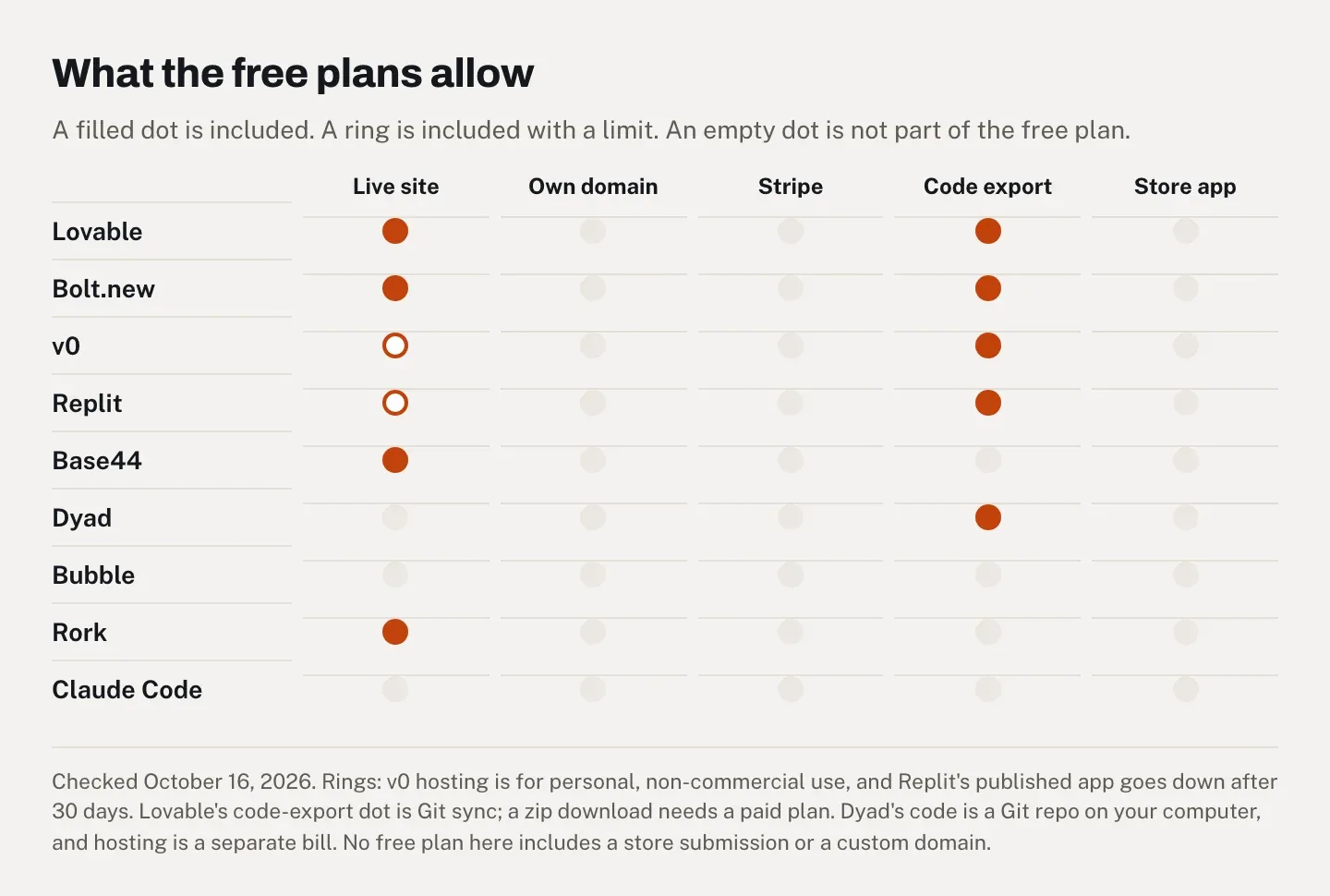
Lovable alternatives with a free plan: what each one lets you launch
None of the free plans covers the whole brief. Lovable, Bolt.new and Replit publish a working app for free, with a badge and limits. Base44 publishes too but can't take Stripe payments. Dyad itself costs nothing, and you pay for hosting and AI. Bubble's free plan has no live site, and Claude's doesn't include Claude Code.
| Tool | Free plan on October 16, 2026 | What blocks the studio brief |
|---|---|---|
| Lovable | 5 credits a day, 30 a month at most, lovable.app address, Git sync | no own domain, badge, no code download |
| Bolt.new | 1M tokens a month, 300K a day, bolt.host hosting | badge, no domain, no Supabase, offline past the traffic cap |
| v0 | $5 of one-time credits, 7 messages a day | Vercel Hobby is for non-commercial use |
| Replit | one published app, badge | the app goes down after 30 days, no Stripe |
| Base44 | 25 message credits a month, up to 5 apps | no Stripe, no code edits, no domain |
| Dyad | free app, 20 agent messages a day, your own AI key | nothing, if you pay for hosting and AI |
| Bubble | development version, 50K workload units | no live website |
| Rork | 35 credits a month, web apps only | no phone app, no code export |
| Claude Code | not included in Claude Free | no access |
If "free" means a usable test, Lovable's free version holds up well: a real address and Git sync, within a cap of 30 credits a month that limits how far you get. If "free" means no subscription at all, Dyad is the answer, as long as you accept setting up a host and paying a model provider. For the studio, every hosted tool needs a paid plan as soon as the domain and Stripe come in.
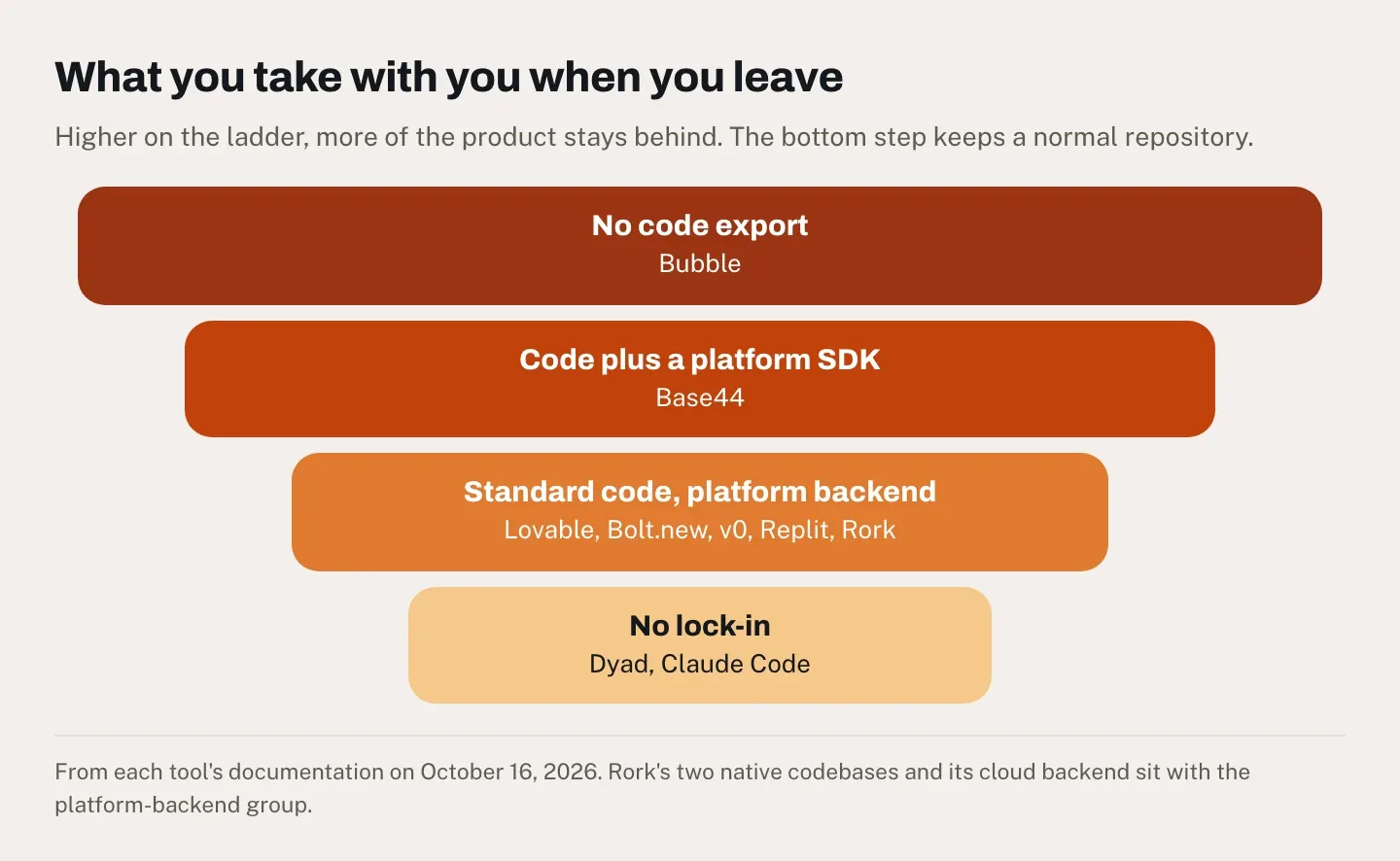
Lock-in: what you take with you when you leave
Owning your code and being able to leave aren't the same thing. The code is usually the easy part. The database, the sign-in system and the backend functions are what tie a project to a platform.
| Tool | Code | Database and sign-in | What leaving takes |
|---|---|---|---|
| Lovable | Git sync on every plan, .zip download on paid plans | built-in backend (Cloud) | moving the backend to managed or self-hosted Supabase |
| Bolt.new | download or GitHub sync | Bolt database, claimable into your Supabase on Pro | claiming the database, then redeploying the code |
| v0 | Next.js, GitHub sync on Free | your own providers | redeploying on another Next.js host |
| Replit | Git and GitHub sync | Replit-hosted database | exporting the data |
| Base44 | GitHub sync from Builder | fully managed by Base44, through its SDK | replacing data, auth and integration calls |
| Dyad | a Git repo on your computer | your Supabase or Neon | nothing |
| Bubble | no code export | CSV export and Data API | rebuilding the app |
| Rork | GitHub sync on paid plans | Rork Cloud or your Supabase | taking two native codebases with you |
| Claude Code | your repository | your choice | nothing |
If you're leaving Lovable, its documentation lays out the path (deployment, hosting and ownership):
- Connect Git sync, available on every plan, or download the .zip on a paid plan.
- Deploy the front end on another host. Lovable lists Netlify, Cloudflare Pages and Vercel among the options, and the built-in backend can stay where it is while you test.
- Move the backend if you want to cut the tie completely. The supported destinations are managed Supabase and self-hosted Supabase, and "moving the PostgreSQL database alone does not move authentication, storage, realtime, or Edge Functions."
- Replace AI features and app connectors that run through Lovable, then point your domain at the new host.
Steps 1 and 2 are ordinary deployment work. Step 3 is the real project. The glossary entry on repository export explains what a synced repository contains.
What Google receives from apps built with these tools
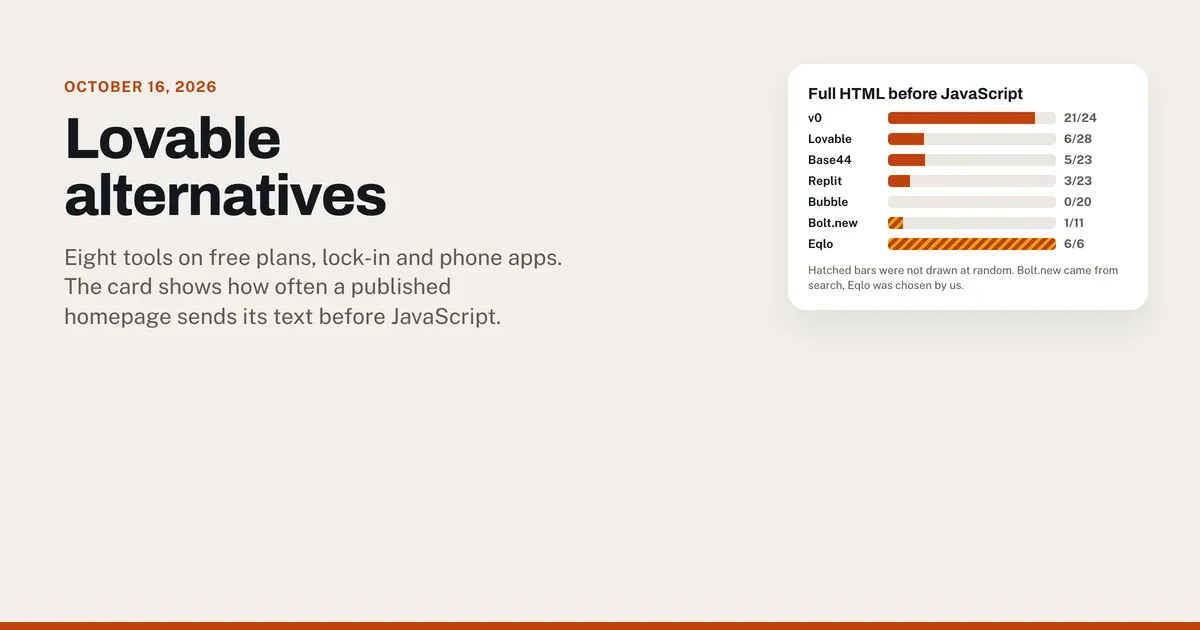
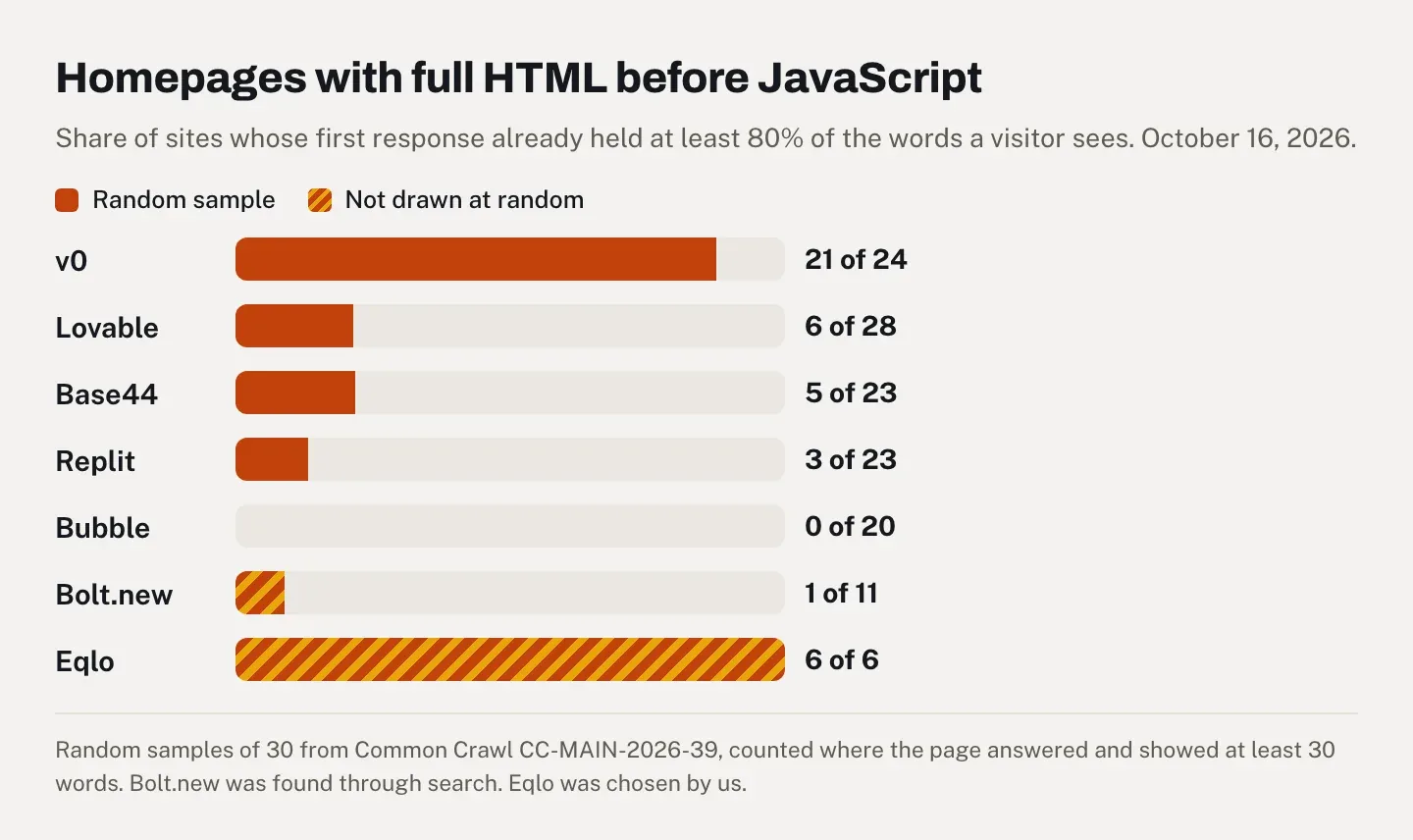
A crawler that doesn't run JavaScript receives little or no text from most apps built with these tools. Across our five random samples, 35 of 118 homepages sent their full text in the first response: 21 of 24 on v0, 6 of 28 on Lovable, 5 of 23 on Base44, 3 of 23 on Replit and none of 20 on Bubble. All six Lovable sites with full HTML ran on its newer stack, and Base44 says it serves crawlers a rendered version.
How we measured. On October 16, 2026, we drew a seeded random sample of 30 published apps per platform from Common Crawl's September 2026 index (CC-MAIN-2026-39). The pools held 5,704 lovable.app hosts, 513 replit.app, 997 base44.app, 225 bubbleapps.io and 182 vercel.app addresses starting with "v0-", the default name v0 gives a project deployed on Vercel. We fetched each homepage the way a crawler that doesn't run JavaScript would, once with a browser's user agent and once with Googlebot's, then loaded it in Chrome to count the words a visitor sees. "Full HTML" means the first response already held at least 80% of those words. The table counts sites that answered and showed at least 30 words. The samples only include apps on each platform's default address, so apps moved to their own domain, often the more finished ones, aren't in them.
Three platforms needed a different route. Common Crawl's index holds no bolt.host page, so for Bolt we measured 12 sites found through web search, which leans toward sites Google already indexes. We found no public rork.app site at all. Dyad and Claude Code don't host apps. For reference, we ran the same checks on seven public sites published on Eqlo, chosen by us rather than drawn at random.
| Homepage check | Lovable | v0 | Replit | Base44 | Bubble | Bolt.new (search sample) | Eqlo (chosen by us) |
|---|---|---|---|---|---|---|---|
| Sites measured | 28 | 24 | 23 | 23 | 20 | 11 | 6 |
| Full HTML without JavaScript | 6 | 21 | 3 | 5 | 0 | 1 | 6 |
| Meta description written for the site | 23 | 21 | 8 | 21 | 2 | 4 | 6 |
| Canonical URL | 5 | 3 | 2 | 19 | 1 | 0 | 6 |
| Share image (og:image) chosen for the site | 21 | 5 | 5 | 21 | 4 | 1 | 0 |
| Structured data | 4 | 1 | 2 | 15 | 0 | 0 | 2 |
| sitemap.xml | 4 | 1 | 1 | 19 | 2 | 0 | 6 |
| robots.txt | 22 | 0 | 3 | 19 | 20 | 0 | 6 |
| llms.txt | 3 | 0 | 1 | 14 | 0 | 0 | 6 |
Bolt.new sites were found through web search and Eqlo sites were chosen by us, so neither column is a random sample. Platform defaults don't count as a description or a share image: "Lovable Generated Project" (5 sites), "Created with v0" (2), Bubble's stock description (17), and the default share images of Lovable (7), Bolt.new (5) and Bubble (15).
What the numbers say, platform by platform:
- Lovable: the 6 full-HTML sites were all on TanStack Start, the stack Lovable uses for apps created since May 13, 2026 (6 of the 7 TanStack apps in the sample). The 20 older React + Vite apps sent an empty page shell to our requests. Lovable says it pre-renders those for verified crawlers such as Google's, and a request that only borrows Googlebot's name can't check that claim. Every site had a meta description and a share image, though 5 descriptions still read "Lovable Generated Project" and 7 images were Lovable's default.
- v0: Next.js renders on the server, so the text was there. The finishing work often wasn't: 3 canonical URLs, 5 share images and 1 sitemap in 24 sites.
- Replit: 19 of the 23 apps were client-side apps built with Vite, which send an empty shell until JavaScript runs.
- Base44: the most complete search setup of the random samples, in line with what its docs describe. The full text came through for 7 of 23 sites when we sent Googlebot's user agent, against 5 with a browser's. Four of the 23 carried a noindex directive, which asks search engines to leave the page out.
- Bubble: pages are drawn by JavaScript, and none of the 20 sent its text in the first response. All 20 had a robots.txt file, but 17 kept Bubble's stock description and 7 kept a default title such as "Bubble | No-code apps". Two of the 30 sites refused our requests. Many sites in the sample were plugin or template demos, which fits a bubbleapps.io address, since a live site on a paid plan can use its own domain.
- Bolt.new: 10 of the 11 sites were client-side apps built with Vite. Bolt's Pro plan lists "SEO boosting", and we can't tell from outside which sites use it.
- Eqlo: full HTML, canonical URL, sitemap, robots.txt and llms.txt on all six sites with text. None had a share image, and two had structured data.
An empty first response doesn't mean Google never sees the page. Google processes JavaScript apps in three phases, crawling, rendering and indexing, and "Googlebot queues pages for both crawling and rendering" (Google Search Central), so the text can arrive later. AI assistants are a different story: Vercel's analysis of AI crawler traffic found that "none of the major AI crawlers currently render JavaScript", naming OpenAI's, Anthropic's and Perplexity's among others (Vercel). For those crawlers, only server-side rendering or pre-rendering gets the text through. To see what Google reads on your own pages, run our free indexability check, and our guide to SEO for AI-generated websites covers the fixes.
Open-source Lovable alternatives
Two projects publish the source code of the builder itself, so you can read it, change it and run it on your own machine.
Dyad is a desktop app under Apache 2.0, with its Pro features under the Functional Source License, which converts to Apache 2.0 later. It runs your app locally and works with any model you connect, including Gemini's API, whose free tier Dyad's FAQ points to.
bolt.diy is the open-source sibling of Bolt.new, maintained by StackBlitz Labs under the MIT license. Its repository describes it as a way to "prompt, run, edit, and deploy full-stack web applications using any LLM you want" (GitHub). You install and run it yourself from the repository.
With either one, you still pay a model provider and a host, and updating the tool falls to you.
Lovable alternatives for mobile apps
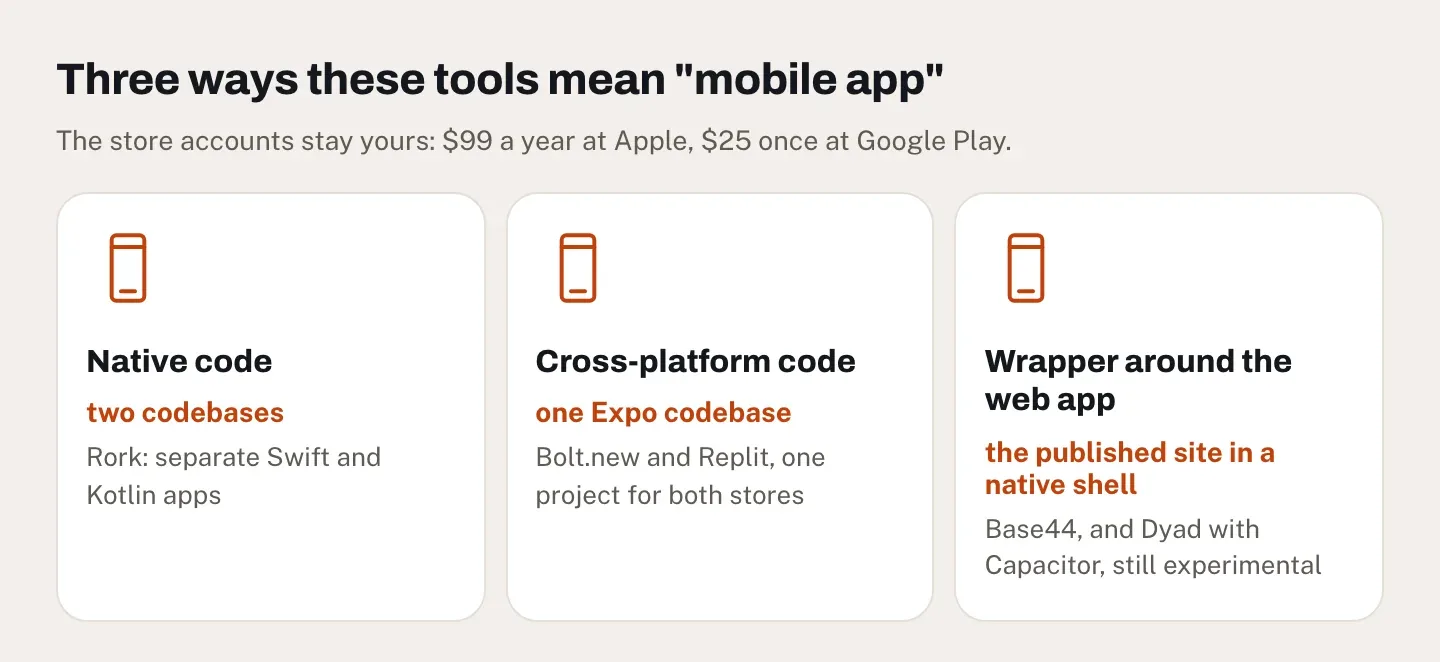
"Mobile app" covers three different things in this market. Check which one a tool means before you plan a store launch.
| Approach | What you get | Tools |
|---|---|---|
| Native code | separate Swift and Kotlin apps | Rork |
| Cross-platform code | one React Native (Expo) codebase for iOS and Android | Bolt.new, Replit |
| Wrapper around the web app | the published site inside a native shell | Base44, Dyad (experimental, Capacitor) |
Bubble sells separate Mobile plans for iOS and Android apps. We found no store path in Lovable's or v0's documentation.
Native code gives the closest fit to each platform, and two codebases to maintain, since Rork's two apps can drift apart. Expo keeps one codebase for both stores. A wrapper is the simplest to keep in sync, because a change on the site shows up in the app, and it suits apps built around content, bookings or accounts. Whatever the approach, the store accounts are yours to pay for: $99 a year at Apple and a one-time $25 at Google Play. Our step-by-step guide to publishing an app on the App Store and Google Play covers the review process for each store.
What Reddit recommends instead of Lovable
The Reddit answers point away from prompt-to-app builders altogether. In the r/lovable thread on alternatives, one reply suggests "Claude Code with a strong CLAUDE.md file", a file of project rules the agent reads, and says it is "still not foolproof" but more controllable. Another reply puts it more bluntly: "There isn't really a true safe-by-default lovable yet," adding that "claude code is closer to real dev workflows" (thread). A second thread on the same forum describes a split: Lovable for the front end, then Cursor or Windsurf for the backend (thread).
One nuance from Anthropic's own documentation: Claude treats CLAUDE.md files "as context, not enforced configuration", and "to block an action regardless of what Claude decides", the docs point to a hook instead (how Claude remembers your project). The Reddit advice holds, with a condition: it works for people who read what the agent changed. If you don't want to read diffs, the hosted builders above remain the realistic choice.
Bolt or Lovable: which is better?
For this brief, neither one wins outright. Both cost $25 a month on their entry paid plan, and both need it for a custom domain. Lovable renders apps created since May 2026 on the server and syncs with GitHub, GitLab or Bitbucket. Bolt shows you every file in a browser editor and builds Expo apps for the stores.
| Lovable | Bolt.new | |
|---|---|---|
| Free plan | 5 credits a day, 30 a month at most | 1M tokens a month, 300K a day |
| Entry paid plan | Pro, $25 a month | Pro, $25 a month |
| Own domain | Pro | Pro |
| Code | Git sync on Free, download on Pro | download and GitHub sync |
| Backend | built-in Cloud, moves to Supabase | Bolt database, claimable into Supabase on Pro |
| Phone app | no store path in its docs | Expo, to both stores |
| Full HTML in our measurement | 6 of 28 (random sample) | 1 of 11 (search sample) |
Pick Lovable if you want the most done for you inside one product. Pick Bolt if you want to watch and edit the code as it's written, or you know a store app is coming. Each has a hands-on review here: Lovable and Bolt.new.
When Lovable is still the right choice
Staying put makes sense more often than "alternatives" lists admit. New Lovable projects get server-side rendering, so search engines receive their text without running JavaScript. Git sync works on the free plan, and the documented exit leads to Supabase, a standard Postgres-based platform. If your real problem is credits, compare what you'd spend on Lovable Pro with the second bill some alternatives add: v0, Dyad and Claude Code leave hosting to you, and Vercel's free plan excludes commercial sites.
Where Eqlo fits
A reminder: Eqlo is my company. It builds websites and phone apps from a sentence, hosts them, and gives each project its own admin. For the studio brief, it covers the booking part out of the box: services with a duration and a price, opening hours, time slots, an optional Stripe deposit of up to 100%, confirmation and reminder emails, and members who log in with an email code or a password. See the booking website builder for the details.
Three choices set it apart in a comparison like this one:
- Pages that search engines can read from the day you publish. Every page goes out as full HTML with its title, description and canonical URL, and checks before each publish stop a page with a missing title or a broken link.
- The iPhone and Android app from the same project. The store app shares the site's database, so a price changed once is changed everywhere. You test it through a QR code, then Plus sends signed builds to TestFlight and Google Play's internal testing from a browser, with no Mac. The iPhone app and Android app pages explain each step.
- A choice of hosting region, the European Union, the United States or the United Kingdom, set per project. The data residency page lists what stays where.
On price, the Free plan includes five active projects, hosting on an eqlo.dev address and $3 of AI a month, with no card. Plus costs $19 a month and adds your own domain, signed store apps and $30 of AI a month (Eqlo pricing). The studio brief comes to $19 for the first month, plus Apple's and Google's developer fees if the app goes to the stores. On lock-in, every plan can send a complete Next.js project to your GitHub, and the Expo source of the phone app downloads on every plan too. Our page on Eqlo as a Lovable alternative compares the two on pages that have to be found.
How to choose
Start from what you need to keep, then let price decide among what's left.
- You can read code and never want to be locked in: Claude Code, or Dyad if you'd like a preview window.
- You like Lovable's flow but want code you can open: Bolt.new, or v0 if you're on Vercel.
- You want code, database and hosting in one cloud workspace: Replit.
- You want the backend handled and don't plan to leave: Base44.
- You never want to see code and accept staying on one platform: Bubble.
- The store app is the product: Rork.
- You need a business site with bookings, a store app and pages Google reads, without code: Eqlo, described above.
For a startup testing an idea, our guide to building a SaaS MVP covers what to put in front of users first.
Comparison made on October 16, 2026 from the public pricing pages and documentation of each tool, plus our own measurement of published apps on the same day. Prices and plans change often. If you spot an error, write to hello@eqlo.app and we'll fix it.
FAQ
Is there a free version of Lovable?
Lovable has a Free plan: 5 build credits a day, capped at 30 a month, publishing on a lovable.app address and Git sync with GitHub, GitLab or Bitbucket. A custom domain, code download and removal of the badge need Pro, at $25 a month on October 16, 2026.
Which Lovable alternative is free?
Dyad, if free means no subscription. The app is free and open source, and you pay only the AI provider through your own key and a host if the app is commercial. Among the hosted tools, Lovable, Bolt.new and Replit publish a working app on their free plans, with limits listed in the free-plan table above.
Is there an open-source alternative to Lovable?
Two of them: Dyad, under Apache 2.0 with its Pro features under the Functional Source License, and bolt.diy, the MIT-licensed project from StackBlitz Labs. Both need you to bring an AI model and a host, and Dyad runs as a desktop app on your own computer.
Which Lovable alternatives can build mobile apps?
Rork builds native Swift and Kotlin apps. Bolt.new and Replit build Expo apps for the stores, Base44 wraps the web app in a native shell from its Builder plan, Dyad does the same experimentally, and Bubble has separate mobile plans. Eqlo builds the store app from the same project as the site.
Can I move my Lovable project to another tool?
The code moves easily: Git sync works on every plan, and paid plans can download a .zip. The backend takes more work, because Lovable's supported destinations are managed or self-hosted Supabase, and authentication, storage and Edge Functions have to move along with the database.
Do apps built with these tools show up on Google?
They can, but most homepages we measured sent little or no text to crawlers that don't run JavaScript. In October 2026, v0 sent full HTML on 21 of 24, Lovable on 6 of 28, Base44 on 5 of 23, Replit on 3 of 23 and Bubble on none of 20. Google renders JavaScript later; according to Vercel, the major AI crawlers don't.
What does Reddit recommend instead of Lovable?
The threads we read point to Claude Code or Cursor, working on a real repository with written project rules. In the r/lovable thread on alternatives, replies describe Claude Code as "closer to real dev workflows" and still "not foolproof". It suits people who review every change the agent makes.